

The Executive Workspace: Navigating the Choice Between Standing and Traditional Desks
For many corporate leaders, the mid-afternoon hours bring a familiar but unwelcome companion: a dull ache in the lower back and a noticeable dip in mental clarity. This phenomenon is often dismissed as a byproduct of a demanding schedule, yet the physiological reality is frequently tied to the furniture supporting the executive. As the central hub of decision-making, the desk is more than a surface; it is a tool that either facilitates or hinders musculoskeletal health and cognitive performance.
The debate between traditional executive desks and modern standing desks often centers on a perceived trade-off between status and health. However, recent advancements in ergonomic engineering suggest that these two objectives are no longer mutually exclusive. By examining the physiological impact of sedentary behavior and the mechanical requirements of a high-performance workspace, leaders can make a data-driven choice that aligns with their professional stature and physical well-being.
The Physiology of Static Load and Blood Circulation
To understand why desk choice matters, one must first address the physiological principles of "static load." When an executive remains in a seated position for several hours, the body is subjected to sustained muscular contractions required to maintain an upright posture. This static load restricts blood circulation, particularly in the lower extremities, and places significant pressure on the intervertebral discs.
According to the World Health Organization (WHO) 2020 Guidelines on Physical Activity and Sedentary Behaviour, reducing sedentary time is critical for mitigating cardiovascular risks. Prolonged sitting leads to a decrease in the activity of lipoprotein lipase, an enzyme essential for breaking down blood fats. When this process slows, the risk of metabolic issues increases. Furthermore, a systematic review by Cochrane: Workplace interventions for reducing sitting at work indicates that sit-stand desks can reduce daily sitting time by approximately 84 to 116 minutes.
The primary ergonomic concern with traditional desks is the "fixed-height trap." Most standard desks are manufactured at a height of 29 inches (approximately 74 cm). While this may suit an average user, it rarely accommodates the 5th or 95th percentile of the population effectively. For a taller executive, this height forces a slumped posture, while for a shorter individual, it may lead to shoulder elevation and wrist strain. Both scenarios contribute to Musculoskeletal Disorders (MSDs), a category of injuries that the U.S. Occupational Safety and Health Administration (OSHA) identifies as a leading cause of workplace discomfort and lost productivity.

Strategic Comparison: Traditional vs. Standing Desks
In the executive suite, the desk serves as a strategic leadership tool. Its presence influences the psychology of the room, affecting perceived authority and decision-making clarity.
The Traditional Executive Desk
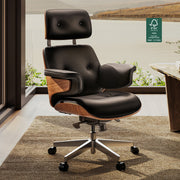
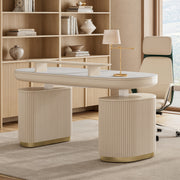
The classic traditional desk is often chosen for its "command presence." These desks typically offer expansive surface areas and integrated storage, communicating stability and permanence. From an ergonomic perspective, however, the traditional desk is a static environment. It relies entirely on the office chair to provide postural support. While a high-quality executive chair is essential, it cannot fully compensate for the lack of movement.
The Standing (Sit-Stand) Desk
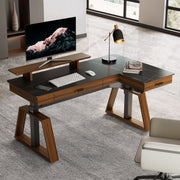
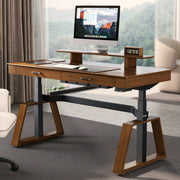
Modern standing desks designed for leadership roles integrate the health benefits of movement with premium materials like leather and hardwood veneers. The core value proposition of the standing desk is the ability to achieve a "Spinal Neutral Position" in both seated and standing modes. This flexibility allows the user to interrupt static loads, which ISO 11226:2000 Evaluation of static working postures identifies as a key intervention for preventing long-term tissue adaptation issues.
Expert Insight: Successful implementation of a standing desk in an executive context requires a gradual transition. Based on practitioner observations, starting with 30-minute standing intervals and slowly increasing the duration over several weeks helps avoid lower limb fatigue and ensures the body adapts to the new postural demands.
Scenario Modeling: The Tall Executive Analysis
To demonstrate the practical impact of desk choice, we modeled a scenario for a "Tall Executive Power User." This model highlights the ergonomic gaps present in standard office furniture and the potential return on investment (ROI) of an adjustable solution.
Method & Assumptions
This analysis uses a deterministic parameterized model based on common industry heuristics and anthropometric data. It is a scenario model intended for illustrative purposes, not a controlled laboratory study.
| Parameter | Value | Unit | Rationale / Source |
|---|---|---|---|
| User Stature | 190 | cm | 95th Percentile Male Height (US Data) |
| Shoe Heel Height | 3 | cm | Standard Executive Dress Shoes |
| Standard Desk Height | 29 | in | Industry Standard Fixed Height |
| Hourly Wage | 100 | USD | Executive Compensation ($200k/year) |
| Standing Time | 180 | min/day | Recommended 3-hour daily total |
Quantitative Findings
- Ergonomic Deficit: For a 190 cm executive, the ideal seated desk height is approximately 79 cm (31 inches). A standard 29-inch desk creates a 2.1-inch deficit, forcing the user into a compensatory posture that increases neck and shoulder strain.
- Productivity ROI: Using a conservative 10% productivity uplift during standing periods (attributed to increased alertness and reduced discomfort), the executive gains an estimated $7,500 in annual productivity value.
- Metabolic Impact: Standing for 3 hours daily burns approximately 134 extra calories compared to sitting. Over a 250-day work year, this equates to a metabolic equivalent of roughly 9.6 pounds of fat loss.

Technical Standards and Engineering Requirements
When selecting a desk for a corporate office, leaders should look for compliance with established engineering standards. These benchmarks ensure that the furniture is not only comfortable but also safe and durable for long-term use.
Adjustability and Fit
The BIFMA G1-2013 Ergonomics Guideline for Furniture provides recommended dimensions to cover the 5th to 95th percentile of the population. An executive desk should offer a range of adjustment that allows for:
- Neutral Wrist Position: The keyboard should be at a height where the wrists are straight and the forearms are parallel to the floor.
- Optimal Viewing Geometry: The top of the monitor should be at or slightly below eye level to minimize neck flexion, as detailed in the HSE: Working safely with display screen equipment (DSE) guidelines.
Motor Capacity and Safety
Executive setups often involve significant weight, including dual monitors, docking stations, and high-end workstations. Our modeling indicates that a premium setup can easily reach 87 kg (including the tabletop).
- Single Motor Capacity: Typically rated for 80 kg, which would exceed safety limits for a heavy executive setup.
- Dual Motor Requirement: A dual-motor system with a 120 kg capacity operates at approximately 72.5% utilization, which is within the 80% engineering best-practice threshold for motor longevity and stability.
According to The 2026 Workstation White Paper: Converging Ergonomic Science and Sustainable Engineering, the integration of dual-motor technology is no longer an optional luxury but a structural necessity for maintaining the precision and safety of high-load workstations.
Practical Recommendations for Implementation
Choosing the right desk is the first step; configuring it correctly is what delivers the health and productivity benefits. The following guidelines, derived from Cornell University Ergonomics Web, provide a framework for a healthy workday rhythm.
The 20-8-2 Rule
To maximize the benefits of a sit-stand workstation, aim for the following cycle every half hour:
- 20 Minutes Sitting: Use a high-quality chair with proper lumbar support.
- 8 Minutes Standing: Ensure your desk is at the correct elbow height.
- 2 Minutes Moving: Stretch or walk to stimulate blood circulation.
Monitor and Peripheral Placement
Proper alignment of accessories is vital to prevent Repetitive Strain Injury (RSI).
- Monitor Distance: Place the screen about an arm's length away.
- Keyboard and Mouse: Keep these on the same level, with the mouse close to the keyboard to prevent overreaching. According to the Canadian Centre for Occupational Health and Safety (CCOHS), maintaining a neutral shoulder posture is critical when using pointing devices.
- Document Holders: If you frequently reference paper documents, use a holder placed between the keyboard and monitor to reduce neck rotation.

Addressing Common Pitfalls
Even with the best equipment, users often encounter "gotchas" that can negate the ergonomic benefits.
- Cable Management: At maximum height, cables can become taut, potentially damaging ports or creating a tipping hazard. Ensure your setup includes a high-capacity cable management tray with enough slack for the full range of motion.
- Footwear Matters: Standing in dress shoes with hard soles for extended periods can lead to lower limb discomfort. Consider an anti-fatigue mat or keeping a pair of more supportive shoes in the office for standing intervals.
- The "Leaning" Habit: Many users tend to lean on one hip or the desk surface while standing. This creates asymmetrical loading on the spine. Focus on distributing weight evenly across both feet.
Decision Framework for Leadership
For the executive, the choice between a traditional and a standing desk should be viewed as a strategic investment in "Human Capital."
- Choose a Traditional Desk if: Your role involves frequent face-to-face meetings where a high-profile "anchor" piece is required for office aesthetics, and you are disciplined about taking frequent movement breaks away from the desk.
- Choose a Standing Desk if: Your work requires long periods of deep focus (debugging, architectural design, or financial analysis), you struggle with afternoon fatigue, or you have pre-existing back discomfort that is exacerbated by sitting.
In many corporate environments, the optimal solution is a "Hybrid Executive Desk"—a piece that maintains the traditional aesthetic of oak and leather but hides a powerful dual-motor lifting system within its frame. This allows the leader to command the room while prioritizing the musculoskeletal health necessary for long-term peak performance.
Disclaimer: This article is for informational purposes only and does not constitute professional medical advice. Individuals with pre-existing musculoskeletal conditions or cardiovascular concerns should consult a qualified healthcare professional or physiotherapist before making significant changes to their workstation or work habits.
Sources
- WHO 2020 Guidelines on Physical Activity & Sedentary Behaviour
- Cochrane: Workplace interventions for reducing sitting at work (2018)
- CCOHS: Office Ergonomics - Sit/Stand Desk
- OSHA eTools: Computer Workstations - Neutral Working Postures
- BIFMA G1-2013 Ergonomics Guideline for Furniture
- ISO 11226:2000 Evaluation of static working postures
- Cornell University Ergonomics Web — Workstation Guides

Leave a comment