

The Silent Struggle: Balancing Productivity and Infant Sleep
For the remote-working parent, the home office is rarely a sanctuary of isolation. It is often a shared ecosystem where the demands of professional productivity intersect with the delicate requirements of infant care. One of the most understated challenges in this environment is the acoustic profile of office equipment. While a standard standing desk may seem harmless, the mechanical whine of a low-quality motor can be the difference between a productive two-hour nap window and a startled, wakeful infant.
The transition from sitting to standing is a physiological necessity for the modern worker, yet for parents in shared nursery-office spaces, this movement often becomes a source of anxiety. The fear of waking a sleeping child frequently leads to "static load" fatigue—where parents remain seated for hours in suboptimal postures to avoid making noise. This trade-off is unnecessary. Understanding the engineering behind "stealth motors" and the safety standards governing ergonomic furniture allows parents to build a workspace that supports both their musculoskeletal health and their child's need for a calm environment.
The Physiology of Disruption: Why Decibels Matter
Infants possess a heightened sensitivity to sudden environmental changes, particularly auditory stimuli. During the lighter phases of the sleep cycle, a high-pitched mechanical noise—common in single-motor standing desks—can trigger a startle reflex. This disruption does more than just end a nap; it interrupts critical developmental rest.
From an ergonomic perspective, the parent's health is equally at risk. According to the ISO 11226:2000 standard for the evaluation of static working postures, maintaining a static position for extended periods leads to localized muscle fatigue and increased risk of musculoskeletal disorders (MSDs). When a parent "freezes" in a seated position to maintain silence, they are succumbing to static load.
The World Health Organization (WHO) 2020 Guidelines emphasize that adults should limit sedentary time and interrupt long periods of sitting with physical activity. A height-adjustable desk is a primary tool for this interruption, but its utility is predicated on its ability to operate without causing environmental stress. Noise levels below 45dB are generally considered the threshold for "quiet" operation in a residential setting. However, as noted in The 2026 Workstation White Paper: Converging Ergonomic Science and Sustainable Engineering, the frequency of the sound is often more disruptive than the volume. A low-frequency hum is less likely to penetrate a child's sleep than the high-pitched "whine" of a motor under heavy load.
Engineering the Quiet Office: Dual Motors and Load Management
The fundamental difference in noise production often stems from the motor configuration. Single-motor systems utilize a hex rod to drive both legs, which requires the motor to work harder, often resulting in higher vibration and acoustic output. Dual-motor systems, such as those found in the Opal Executive Standing Desk (66"x29"), distribute the load across two synchronized units, allowing for smoother, quieter transitions.
Modeling Motor Stress and Noise Correlation
To understand how load affects performance, we modeled a typical WFH parent's equipment setup. This "battlestation" includes a mid-tower PC, dual monitors on arms, and a buffer for parenting essentials (e.g., baby monitors, bottles).
| Parameter | Value | Unit | Rationale |
|---|---|---|---|
| Equipment Load | ~55.5 | kg | PC, dual monitors, arms, and peripherals |
| Single-Motor Capacity | 80 | kg | Standard industry baseline |
| Dual-Motor Capacity | 120 | kg | Premium dual-motor baseline |
| Single-Motor Utilization | 69% | % | Calculated stress on a single motor |
| Dual-Motor Utilization | 46% | % | Calculated stress on dual motors |
Methodology Note: This analysis is a scenario model, not a controlled lab study. It assumes a static distributed load and uses standard component weight estimates. The 80% utilization threshold is applied as a best practice for mechanical longevity and noise reduction.
Under a 55.5 kg load, a single-motor system operates at nearly 70% of its capacity. In practice, this leads to audible strain—a mechanical "groan" that can resonate through floors. Conversely, a dual-motor system like the Zen Pro Series, 87"/72" Executive Standing Desk with Cabinets Set operates at less than 50% capacity, maintaining a much lower acoustic profile.

Safety Standards: Beyond the Motor
For parents, child safety is the non-negotiable counterpart to quiet operation. An electric standing desk in a home environment must adhere to rigorous safety standards to prevent accidents.
1. Anti-Collision Systems
A sensitive anti-collision system is critical. According to UL 962 guidelines for the safety of height-adjustable desks, these systems must detect obstructions and stop movement immediately. For parents, this isn't just about protecting a wandering toddler; it's also about silence. A desk that hits an obstacle and thumps loudly is a failure in a nursery environment. High-end desks feature sensors that stop and reverse smoothly, minimizing both physical risk and acoustic shock.
2. Stability and Tip-Over Prevention
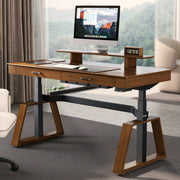
The CPSC STURDY Act (16 CFR Part 1261) focuses on preventing furniture tip-overs, a leading cause of injury in households with children. While this often applies to dressers, desks with integrated storage—like the Ark EL Executive Standing Desk (60"x26")—must be engineered with a low center of gravity and robust leg structures. The trapezoidal leg design of the Ark EL provides a wider footprint, enhancing stability even at maximum height.
3. Indoor Air Quality
Safety also extends to what we cannot see. The UL GREENGUARD Certification ensures that furniture has low chemical emissions (VOCs). For an infant spending hours in the same room as a desk, air quality is a vital health consideration. Choosing desks with GREENGUARD Gold certification or those utilizing lead-free coatings ensures a healthier environment for the child’s developing respiratory system.

Spatial Feasibility: The 14-Inch Buffer
One of the most common mistakes WFH parents make is overcrowding the shared nursery-office. A desk that is too large for the room creates "pinch points" that are dangerous when carrying an infant.
Room Layout Simulation
We modeled a standard 9x12 ft room (108 inches deep) converted into a shared space.
- Desk Depth: 24–30 inches
- Dynamic Chair Zone: 40 inches (required for movement)
- Primary Walkway: 30 inches (standard clearance for safety)
- Total Depth Required: 94 inches
- Surplus Buffer: 14 inches
A 14-inch surplus is a "tight" fit. It leaves very little room for error when moving through the room at night or during an emergency. Parents should prioritize desks with integrated storage, like the Opal Executive Standing Desk (66"x29"), to reduce the need for extra cabinets that would further eat into this safety buffer.

Practical Recommendations for the WFH Parent
To maximize the benefits of an ergonomic setup while maintaining a calm nursery environment, consider the following expert-vetted strategies.
The "Nap-Time Test"
Before committing to a workflow, perform a noise audit. Adjust your desk during the child's lightest sleep phase—typically 20 to 30 minutes after they fall asleep. If the motor's pitch causes the child to stir, consider adding vibration-dampening pads under the desk legs or moving the desk away from shared walls.
The 20-8-2 Rhythm
Cornell University’s Ergonomics Web recommends a specific sit-stand-move ratio:
- 20 Minutes Sitting: Maintain a neutral posture.
- 8 Minutes Standing: Use a height-adjustable desk to transition.
- 2 Minutes Moving: Stretch or walk around the room.
For parents, the "2 minutes moving" can often be replaced by gentle interaction with the child or a quick nursery task. To support the "20 minutes sitting" phase, a Footstool with Wheels can help maintain proper lower-limb alignment, reducing the pressure on the lower back.
Monitor and Desk Alignment
According to OSHA’s eTools for Computer Workstations, the top of your monitor should be at or slightly below eye level. This is especially important for parents who may be frequently looking down at a crib or playpen. Reducing neck rotation prevents the development of "tech neck," which can be exacerbated by the physical demands of lifting and carrying an infant.
Building a Sustainable Workflow
The goal of ergonomic intervention is to reduce the risk of Work-Related Musculoskeletal Disorders (WMSDs). As noted by Safe Work Australia, proper workstation setup is a primary defense against long-term injury. For the parent, this defense must be silent.
Investing in a desk with a dual-motor system, sensitive anti-collision technology, and certified low-emission materials is not merely a matter of office luxury. it is a strategic decision to protect the health of the worker and the well-being of the child. By choosing equipment that respects the acoustic and safety needs of the home, parents can stop the "nap-time gamble" and focus on what matters most: their work and their family.
Disclaimer: This article is for informational purposes only and does not constitute professional medical, safety, or legal advice. Ergonomic needs vary significantly based on individual physical health and home environments. Always consult with a qualified healthcare professional or ergonomic specialist before making significant changes to your workstation, especially if you have pre-existing musculoskeletal conditions. Ensure all furniture is installed according to the manufacturer's safety instructions to prevent tip-over accidents.
References
- BIFMA G1-2013 Ergonomics Guideline for Furniture
- Canadian Centre for Occupational Health and Safety (CCOHS): Office Ergonomics - Sit/Stand Desk
- Cornell University Ergonomics Web — Workstation Guides
- ISO 11226:2000 Evaluation of static working postures
- OSHA eTools: Computer Workstations - Neutral Working Postures
- UL 962 — Safety of Height-Adjustable Desks
- WHO 2020 Guidelines on Physical Activity & Sedentary Behaviour
- CPSC STURDY / 16 CFR Part 1261 (ASTM F2057)
- The 2026 Workstation White Paper: Converging Ergonomic Science and Sustainable Engineering

Leave a comment