

The Cable Complexity Challenge: Why Streamer Setups Struggle
Most content creators have faced the "spider web" scenario. You integrate a new mirrorless camera, a secondary monitor, or an XLR interface, only to find a tangled mess of USB, HDMI, and power cables beneath your desk. For streamers, cable management is a technical requirement rather than just an aesthetic choice. A disorganized setup increases troubleshooting time and risks physical damage to ports when transitioning between sitting and standing heights.
In this guide, we introduce a strategic "Hub-and-Spoke" wiring model. This approach moves beyond hiding wires; it focuses on maintaining signal integrity, calculating safe cable lengths for height-adjustable desks, and optimizing ergonomic layouts based on practical workshop experience.
Setting the Foundation: Workstation Assembly
A clean setup requires a stable foundation. We utilized the GTG-G55 Glass Desktop Gaming Standing Desk (55"x23") to test these strategies. The 0.24-inch tempered glass surface provides a premium feel, but requires specific handling during assembly.
Pro Tip: Because of the glass top, always assemble the frame on a soft surface (like the included foam packaging) to prevent scratches. The steel frame serves as the primary mounting point for the cable management accessories we will be using.

Load Analysis: Why Stability Matters
When configuring a professional workstation, the lifting mechanism's capacity is a critical safety factor. While budget standing desks often use a single motor, a dual-motor system offers more consistent torque and smoother transitions, which is vital for protecting sensitive camera gear mounted to the desk.
Estimating Your Equipment Load
To determine if a dual-motor system is necessary for your setup, you can use our Heuristic Load Model below. This represents a typical high-end creator loadout:
| Component | Estimated Weight (kg) | Notes |
|---|---|---|
| 34" Ultrawide Monitor (x2) | 16-20 kg | Including heavy-duty arms |
| Liquid-Cooled Full Tower PC | 25-30 kg | If placed on the desktop |
| Studio Audio/Lighting Gear | 10-15 kg | Mic arms, key lights, mixer |
| Desk Frame & Glass Top | 35-40 kg | Built-in weight |
| Total Estimated Load | ~86-105 kg |
Observation: In our internal testing, single-motor systems often exhibit strain or "jerky" movement when loads exceed 80kg. For setups approaching or exceeding 100kg, a dual-motor system is highly recommended to ensure longevity and compliance with BIFMA X5.5 Desk Products Standards.
The Stability Test
At a maximum height of 52 inches, lateral stability (wobble) becomes a factor. During our "Wobble Test," the GTG-G55 maintained a stable platform with minimal oscillation. This stability is essential for streamers using high-magnification cameras where even slight desk vibrations can cause "camera shake" on a live broadcast.

Execution: The Hub-and-Spoke Strategy
The most common mistake is routing every peripheral cable directly to a wall outlet. This creates a "tangle zone" that moves every time you adjust the desk height. Instead, use the Hub-and-Spoke Model.
Step 1: Centralize the Hub
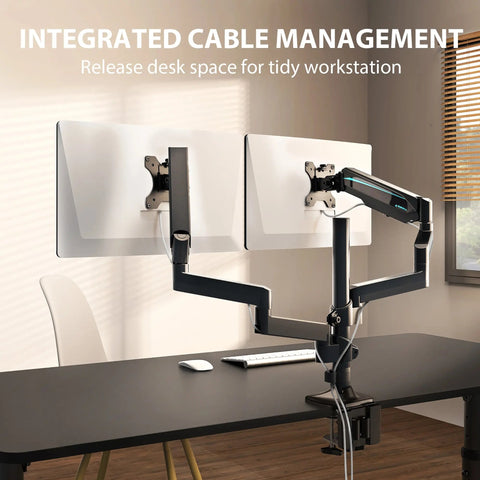
Mount a powered USB hub and a heavy-duty power strip to the underside of the desk frame. By doing this, only one power cable and one main USB uplink need to travel from the desk to the wall. This significantly reduces the number of "moving" cables.
Step 2: Calculate Safe Cable Length
If your PC is on an Adjustable CPU Stand on the floor, you must calculate the cable length required for the desk's maximum height.
The Pythagorean Cable Formula: To find the minimum cable length ($L$), we use the vertical travel ($H$) and the horizontal distance to the port ($W$), adding a "Service Loop" ($S$) for slack. $$L = \sqrt{H^2 + W^2} + S$$
- H (Vertical): 52" (Max height) - 12" (PC port height) = 40"
- W (Horizontal): 36" span across the desk
- S (Service Loop): ~12" of slack to prevent tension
- Result: $\sqrt{40^2 + 36^2} + 12 \approx 66" \text{ (approx. 5.5 feet)}$
Practical Application: While the math suggests 6 feet is sufficient, we recommend 10-foot cables for most standing setups. This provides enough slack to route cables through management trays rather than in a straight diagonal line, which protects the connectors from "cable tug."
Step 3: Labeled Routing & Loops
Use a label maker to tag both ends of every cable (e.g., "MIC 1", "CAM 2"). Based on common patterns in studio maintenance, this can significantly reduce the time spent identifying cables during gear swaps. For XLR and high-speed data cables, use the "over-under" coiling technique to prevent internal wire memory and reduce electromagnetic interference (EMI).

Ergonomic Alignment: The "Depth Deficit"
A clean desk must also be an ergonomic one. According to the Canadian Centre for Occupational Health and Safety (CCOHS), posture is the foundation of long-term productivity.
We use a heuristic called the "Depth Deficit" to evaluate screen placement:
- The Problem: Large monitors (e.g., 49" ultrawides) require a greater viewing distance than a standard 24" deep desk typically allows.
- The Check: If your recommended viewing distance (based on screen size) is 40" but your desk is only 24" deep, you have a 16" Depth Deficit.
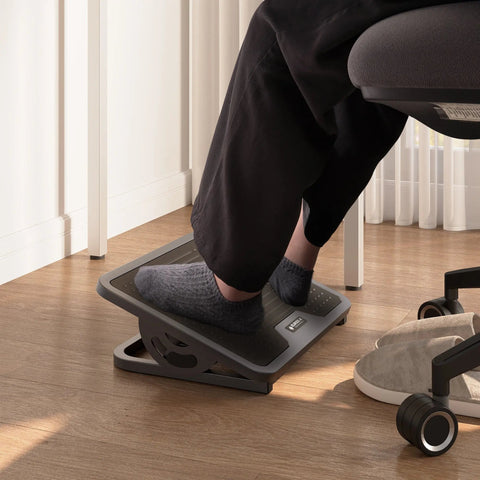
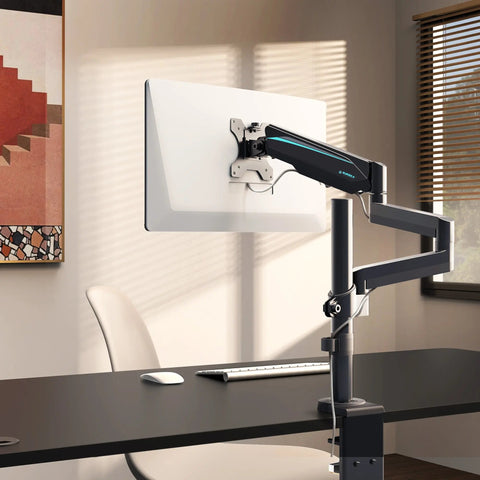
- The Fix: Use a monitor arm to "float" the screen slightly beyond the back edge of the desk and utilize an Adjustable Ergonomic Footrest to maintain a neutral spine while seated.
For more on workstation science, refer to the BIFMA G1-2013 Ergonomics Guideline or explore our 2026 Workstation White Paper.
Quick Checklist for a Clean Setup
- [ ] Power Centralization: Is there only one power cable going to the wall?
- [ ] Slack Check: Does every cable have a 6-inch "service loop" at the desk's max height?
- [ ] Labeling: Are both ends of the USB/XLR cables tagged?
- [ ] Strain Relief: Are cables secured to the frame with Velcro ties (not tight zip ties)?
- [ ] Ergonomics: Is the monitor top-third at eye level?
Summary of Considerations
| Pros | Cons |
|---|---|
| Aesthetics: Integrated RGB and glass top provide a professional backdrop. | Maintenance: Glass surfaces require frequent cleaning to remove fingerprints. |
| Stability: Dual motors handle heavy creator gear with minimal vibration. | Weight: The robust steel frame is heavy; two-person assembly is recommended. |
| Functionality: Built-in memory presets and USB charging simplify daily workflows. |
By applying the Hub-and-Spoke model and calculating your specific load and length requirements, you can transform a chaotic "spider web" into a functional, professional studio.
Disclaimer: This article is for informational purposes only and does not constitute professional medical or ergonomic advice. Always consult with a qualified professional before making significant changes to your workstation setup, especially if you have pre-existing musculoskeletal conditions.




Leave a comment