

The Biomechanics of the Afternoon Slump: Why Static Sitting Fails
Many professionals find that even with a high-end office chair, back fatigue and localized discomfort in the lumbar region intensify as the workday progresses. This phenomenon is often rooted in "static load"—the physiological strain caused by maintaining a single posture for extended periods. When the body remains stationary, blood circulation to the spinal discs slows, and muscle groups remain in a state of constant, low-level contraction.
According to research from EU-OSHA on prolonged static sitting, this lack of movement is a primary risk factor for Work-related Musculoskeletal Disorders (MSDs). The human spine is naturally designed for movement; it requires a dynamic environment to distribute pressure across the vertebrae and keep the supporting musculature engaged without overexertion.
The "synchro-tilt" mechanism was engineered to solve this specific problem. Unlike basic reclining chairs where the backrest and seat move in a 1:1 ratio—often lifting the user's feet off the floor and compressing the underside of the thighs—synchro-tilt allows the backrest to recline at a faster rate than the seat. This maintains the user’s "neutral position" while encouraging the micro-movements necessary for spinal health.
Decoding Synchro-Tilt Mechanics: The 2:1 Ratio and Beyond
At its core, a synchro-tilt mechanism typically employs a 2:1 ratio. For every two degrees the backrest reclines, the seat tilts upward by only one degree. This mechanical relationship is designed to keep the pelvis stable and the feet planted firmly on the floor, which is a critical requirement for maintaining circulation in the lower limbs.
Logic Summary: The 2:1 ratio is a biomechanical heuristic intended to prevent "shirt-pull" and foot-lift. By tilting the seat slightly, the mechanism opens the hip angle (hip flexion) without shifting the user’s center of gravity so far back that they lose contact with the floor. This is aligned with the BIFMA G1-2013 Ergonomics Guideline, which emphasizes dimensions that accommodate the 5th to 95th percentile of the population.
However, a common misconception is that a fixed 2:1 ratio is a "one-size-fits-all" solution. Our observations from technical support and user feedback indicate that individuals with longer torsos often experience a "forward displacement" during recline. This occurs because the pivot point of the chair does not perfectly align with the user's natural hip pivot. For these users, chairs with adjustable seat depth, such as the Forma, Ergonomic Executive Office Chair, are essential to recalibrate the center of gravity.

Comparison of Tilt Mechanisms
| Mechanism Type | Seat-to-Back Ratio | Primary Benefit | Common Drawback |
|---|---|---|---|
| Simple Recline | 1:1 | Familiarity, lower cost | Lifts feet; compresses thighs |
| Synchro-Tilt | 2:1 (Typical) | Maintains feet-on-floor; opens hip angle | May require tension fine-tuning |
| Weight-Sensitive | Automatic | No manual adjustment needed | Can feel "mushy" for very light/heavy users |
| Knee Tilt | Pivot at front | Keeps feet flat during deep recline | Does not always open the hip angle sufficiently |
The Three Pillars of Fluid Motion
To achieve true ergonomic benefit from a synchro-tilt backrest, the user must look beyond the mechanical ratio and address three interdependent systems: tension, lumbar alignment, and task-specific angles.
1. The Tension Paradox
The most frequent error we observe on the "repair bench" is users setting the tilt tension too high. Many people tighten the tension knob until the backrest feels rigid, believing this provides more "support." In reality, excessive tension forces the back muscles to work against the chair to initiate a recline, leading to early muscle fatigue.
Heuristic for Tension Setting:
- Start with the lowest possible tension.
- Lean back slowly. If you feel like you are "falling" backward, increase the tension by half-turns.
- The goal is "zero-gravity" balance: you should be able to stop and hold your position at any point in the recline range without using your core muscles to stay there.
2. Lumbar-Sync Synergy
Synchro-tilt works best when paired with precise lumbar support. As the backrest reclines, the lumbar curve of the chair moves downward and backward. If the lumbar support is not positioned correctly at the start, this movement can cause the support to press against the sacrum rather than the lumbar spine, negating the ergonomic benefit.
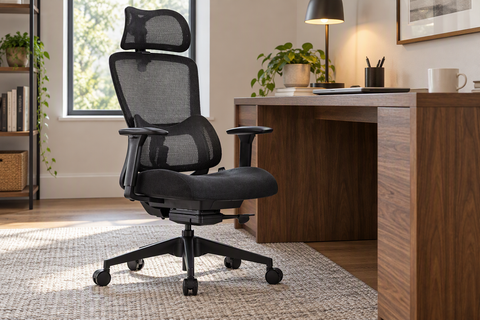
The Exis,Ergonomic Office Chair addresses this with a 4-level adjustable lumbar system. By setting the lumbar height to the "small" of your back before engaging the tilt, the synchronization ensures the support follows the natural flattening of the spine during recline.
3. Task-Specific Postures
Fluid motion does not mean staying in a deep recline all day. OSHA eTools on Neutral Working Postures suggest that while a reclined posture (100°–110°) is excellent for reducing spinal disc pressure, active tasks like intensive typing may require a more upright stance.
- Active Work (Typing/Data Entry): 95°–105° backrest angle.
- Cognitive Tasks (Reading/Meetings): 110°–125° backrest angle.
- Recovery/Thinking: 130°+ backrest angle.
How to Adjust Your Backrest for Fluid Motion: A Step-by-Step Protocol
To implement these principles, follow this professional setup guide, which incorporates standards from the Canadian Centre for Occupational Health and Safety (CCOHS).
Step 1: Establish the Base (Seat Height)
Before touching the backrest, adjust your seat height so your feet are flat on the floor and your knees are at a 90° to 100° angle. If the chair is too high, the synchro-tilt will pull your feet off the ground as you recline, causing pressure on the back of your thighs and restricting blood flow.
Step 2: Set Seat Depth
Ensure there is a 2-3 inch gap (about the width of three fingers) between the edge of the seat and the back of your knees. This prevents the seat from pressing against the popliteal fossa (the space behind the knee), which can cause nerve compression. For high-performance environments, the Royal II, Silicone & Leather Executive Ergonomic Office Chair provides a deep, contoured seat that supports the thighs even during a full recline.

Step 3: Calibrate the Tilt Tension
Using the "zero-gravity" heuristic mentioned earlier, adjust the tension until the chair mimics your body’s movements. If you have a shorter torso, you may need slightly less tension than the mechanical default, as you have a shorter lever arm to push against the backrest.
Step 4: Unlock the "Flow"
Many users keep their chairs locked in an upright position. For maximum health benefits, leave the tilt mechanism unlocked during the day. This encourages "dynamic sitting," where your body makes micro-adjustments as you reach for a phone, type, or lean back to think.
Modeling Note (Scenario Analysis):
- Scenario A (The Standard User): A 175cm user with a standard leg-to-torso ratio. A 2:1 synchro-tilt chair with medium tension provides optimal support.
- Scenario B (The Tall Executive): A 190cm user with a long torso. This user creates more torque on the backrest. They require a chair with a reinforced frame, such as the Forma, Ergonomic Executive Office Chair, and must increase the tension setting by ~20% compared to Scenario A to avoid a "flipping" sensation.
Advanced Dynamics: The Dual-Backrest Innovation
While standard synchro-tilt addresses the vertical angle of the spine, it often ignores lateral (side-to-side) movement. In a modern office, we don't just move forward and back; we reach for monitors, documents, and peripherals.
The Flex, Dual-Backrests Ergonomic Office Chair introduces a dynamic system where two independent backrests move with the user's ribcage. This "omni-directional" support complements the synchro-tilt by ensuring that even when you are reclined and twisting slightly to view a secondary monitor, your lumbar and thoracic spine remain supported. This aligns with the principles found in the The 2026 Workstation White Paper: Converging Ergonomic Science and Sustainable Engineering, which advocates for furniture that adapts to the user's biological "flow" rather than forcing the user to adapt to a rigid structure.

Standards, Safety, and Long-Term Reliability
When selecting or adjusting a chair, it is vital to ensure the hardware is capable of sustaining these dynamic forces. The ANSI/BIFMA X5.1 standard defines the safety and durability requirements for office chairs, specifically testing the tilt mechanism for thousands of cycles.
Furthermore, the ISO 9241-5:2024 standard provides updated guidelines on workstation layout and postural requirements. It emphasizes that "fluid motion" is not just a comfort feature but a requirement for modern VDT (Visual Display Terminal) work. A chair that meets these standards ensures that the synchro-tilt mechanism will not lose its tension calibration over time, preventing the "sagging" backrest common in lower-quality furniture.
Summary Checklist for Backrest Fluidity
- Unlocked Mechanism: Is the tilt lock off to allow for micro-movements?
- Plantable Feet: Can you recline fully without your heels leaving the floor?
- Resistance-Free Recline: Can you move from upright to 110° without straining your abdominal muscles?
- Lumbar Tracking: Does the lumbar support stay in contact with your spine as you move?
- Task Alignment: Are you using a more upright angle for intensive typing and a deeper recline for reading?
Integrating Movement into the Workday
Even the most advanced synchro-tilt mechanism cannot replace the need for postural variety. Ergonomics experts at Cornell University recommend the "20-8-2" rule: sit for 20 minutes, stand for 8 minutes, and move or stretch for 2 minutes.
By utilizing a synchro-tilt chair like the Exis,Ergonomic Office Chair, you can make those 20 minutes of sitting significantly more productive and less taxing on your musculoskeletal system. The goal is to transform your chair from a static seat into a dynamic tool that supports your body's natural need for motion.

YMYL Disclaimer: This article is for informational purposes only and does not constitute professional medical advice, diagnosis, or treatment. Always seek the advice of a qualified health provider or ergonomist with any questions you may have regarding a medical condition or the setup of your workstation, especially if you suffer from chronic back pain or pre-existing musculoskeletal disorders.
References
- BIFMA G1-2013 Ergonomics Guideline for Furniture
- ISO 9241-5:2024 Workstation layout & postural requirements
- OSHA eTools: Computer Workstations - Neutral Working Postures
- EU-OSHA: Musculoskeletal disorders and prolonged static sitting
- CCOHS: Office Ergonomics - Sit/Stand Desk Guidelines
- The 2026 Workstation White Paper: Converging Ergonomic Science and Sustainable Engineering




Leave a comment