

Introduction: The Hidden Cost of Micro-Wobble in Logistics Operations
In the high-stakes environment of logistics command centers and e-commerce fulfillment hubs, equipment failure isn't always a catastrophic breakdown. Often, it is a subtle, persistent inefficiency known as "micro-wobble." For a facility manager or procurement officer, a desk that sways slightly during rapid data entry or vibrates when a pallet jack passes nearby is more than a nuisance; it is a contributor to equipment fatigue and employee discomfort.
When selecting height-adjustable workstations for industrial-adjacent offices, the debate often centers on the frame architecture: T-Frame versus C-Frame. While aesthetic preferences exist, the choice for a logistics floor must be rooted in structural mechanics and the reality of non-standard flooring. A desk that feels stable in a carpeted corporate headquarters may exhibit significant lateral sway on a concrete slab floor that hasn't been leveled to high-precision standards.
This technical analysis explores the physiological impact of workstation instability and provides a data-driven framework for choosing the right frame architecture. By understanding the interaction between desk geometry, center of gravity (CG), and floor flatness, facility managers can optimize for both durability and the well-being of shift workers.

The Engineering Reality of Logistics Floors: Beyond the "Flat" Concrete Myth
A common misconception in facility procurement is that warehouse floors are perfectly level. In reality, logistics floors are measured by specific standards—FF (Floor Flatness) and FL (Floor Levelness). According to Face Consultants, even a floor rated as "very good" (FF 50) for Very Narrow Aisle (VNA) operations can have localized deviations of up to 1/4 inch over a 10-foot span.
These low-amplitude imperfections are the primary enemy of height-adjustable desk stability. As a desk rises to standing height, its center of gravity shifts upward, magnifying the effect of any floor deviation.
The "Teetering" Effect
On a concrete slab, a frame with a centralized support—the T-Frame—is mathematically more susceptible to "teetering" on high-frequency imperfections. If a leg lands on a minor peak in the concrete, the entire structure can act as a lever. Conversely, the Occupational Safety and Health Administration (OSHA) emphasizes that proper desk height and legroom are essential, but these cannot be maintained if the desk cannot be properly leveled on its primary surface.
Logic Summary: Our analysis of logistics floor stability assumes a standard deviation of ±3mm in floor height over the footprint of a standard 60-inch desk, based on common industry FF/FL ratings for industrial-adjacent office spaces.
T-Frame Structural Mechanics: Precision for Centered Workloads
The T-Frame is characterized by a support column positioned centrally relative to the desk's depth. From a physics perspective, this creates a balanced "load path" directly to the floor.
Direct Load Path and Repetitive Typing
For workstations where the primary task involves rapid, repetitive keyboard entry—such as manifest logging or inventory data entry—the T-Frame offers a distinct advantage. Because the column is directly under the center of the desktop, the downward force of typing is transmitted vertically with minimal leverage. This reduces the "seesaw" effect that can occur when a worker leans heavily on the front edge of the desk.
Stability Metrics and BIFMA X5.5
When evaluating T-Frames, procurement officers should look beyond static weight capacity. The ANSI/BIFMA X5.5 standard for 'Lateral Force Stability' is the critical metric. It measures the resistance to tipping when a horizontal force (typically 35 lbs) is applied to the desk's edge at its maximum height. In our observations of equipment handling in logistics centers, T-frames often excel in "Longitudinal Rigidity"—resistance to front-to-back rocking—provided the load is centered.
However, the T-Frame's balanced design is also its limitation. If a station requires heavy monitors to be mounted on the rear edge, the T-frame must combat a constant backward torque, which can induce a persistent lateral sway during height transitions.
C-Frame Dynamics: Torque Resistance and the Stability Polygon
The C-Frame architecture offsets the support columns toward the rear of the desk. While this was originally designed to provide more legroom and space for under-desk pedestals, it offers unique stability characteristics for modern multi-monitor setups.
The Stability Polygon
In physics, the "stability polygon" is the area defined by the points of contact with the floor. A wider polygon results in a lower risk of tipping. For mobile desk applications or stations equipped with heavy-duty casters, a C-frame's leg stance can be 15-20 inches wider than a comparable T-frame. This wider footprint is a squared factor in the physics of resisting lateral forces, making the C-frame an objectively safer choice for environments with frequent pallet jack traffic or accidental bumps.
Managing Asymmetric Torque
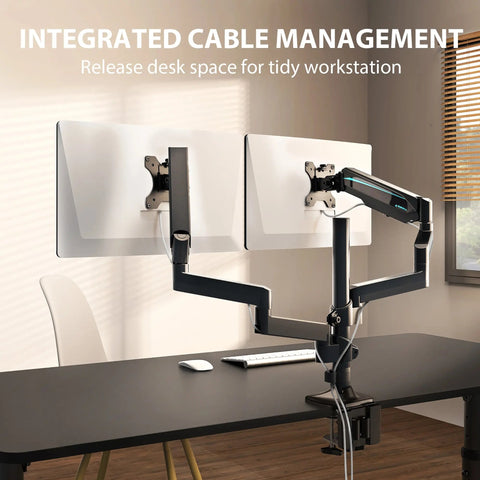
Logistics command centers often utilize large, multiple monitors. As noted in The 2026 Workstation White Paper: Converging Ergonomic Science and Sustainable Engineering, the integration of complex monitoring systems requires a frame that can handle asymmetric loads.
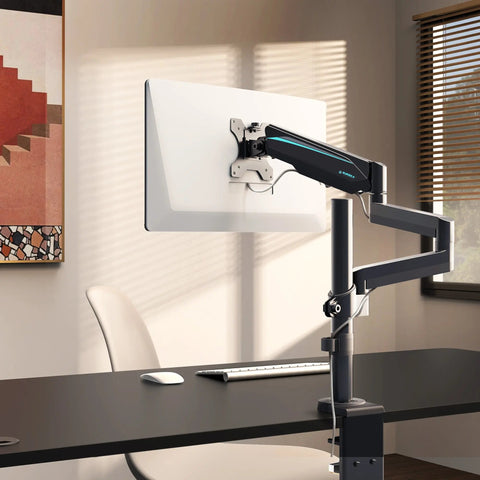
The C-frame is engineered to resist the torque generated by rear-mounted monitor arms. By placing the support columns closer to the weight of the screens, the frame minimizes the "diving" motion that occurs when a desk is top-heavy. This is particularly relevant for the Zen Pro Series, 87"/72" Executive Standing Desk with Cabinets Set, where the combination of a sintered stone top and integrated storage requires a robust, torque-resistant foundation.
The C-Frame "Gotcha": Over-tightening
A common mistake we observe in facility setups is the over-tightening of adjustable leveling feet on a C-frame desk situated on an uneven spot. Because the legs are part of a perimeter structure, over-tightening one corner can twist the entire frame, inducing a persistent lateral sway that is difficult to diagnose.
Comparative Analysis: Performance Metrics for Industrial Environments
To assist in procurement decisions, the following table models the performance of each frame type based on standard logistics use cases.
| Parameter | T-Frame Performance | C-Frame Performance | Logistics Rationale |
|---|---|---|---|
| Typing Vibration | Excellent (Centered Load) | Good (Offset Load) | T-frames minimize front-edge "diving." |
| Monitor Torque | Moderate | Excellent | C-frames align columns with rear-mounted arms. |
| Stability Polygon | Standard | Large (+15-20") | Wider footprint resists tipping from lateral hits. |
| Vibration Damping | High Frequency | Low Frequency | C-frames bridge floor deviations better. |
| Floor Sensitivity | High (Teetering Risk) | Moderate | C-frames are more stable on "wavy" concrete. |
Methodology Note: These ratings are hypothetical estimates under the assumption of a 50lb equipment load and a desk height of 42 inches (standing). Stability is measured as the displacement (in mm) of the desktop when a 10lb lateral force is applied.
Practical Implementation: Installation and Maintenance Heuristics
Regardless of the frame type chosen, the stability of a workstation on a logistics floor is only as good as its installation.
1. The Spirit Level Protocol
Never rely on visual estimation. During the installation of a desk like the Ark EX Executive Standing Desk (60"x26"), a high-quality spirit level must be used across both the X and Y axes. Stability should be verified at both the lowest seated height and the highest standing height, as the raised center of gravity fundamentally changes the mechanical dynamics.
2. The 20-8-2 Rhythm and Stability
The Cornell University Ergonomics Web recommends a 20-8-2 rhythm (20 minutes sitting, 8 minutes standing, 2 minutes moving). In a logistics environment, the transition between these states must be smooth. Dual-motor systems, like those found in the Ark Executive Standing Desk (63"x29"), provide the necessary torque to maintain stability during the lift cycle, even when the desktop is loaded with specialized scanning equipment.
3. Footwear and Floor Interface
In warehouses, workers often wear safety-toed boots. The Canadian Centre for Occupational Health and Safety (CCOHS) notes that standing for long periods requires proper support. From a desk perspective, ensure that the frame's feet do not create a trip hazard for workers in bulky footwear. C-frames, with their rear-set columns, typically provide a clearer path for the worker's feet during the 2 minutes of movement required every half hour.
Strategic Selection for Facility Managers
Choosing between T-frame and C-frame architecture is not a matter of which is "better," but which is better suited to the specific task and environment.
Choose a T-Frame if:
- The primary task is high-speed, repetitive keyboard entry.
- The workstation uses a single, centered monitor or a laptop.
- The floor is known to be high-precision (FF 60+).
- The worker frequently sits in a "forward-lean" posture.
Choose a C-Frame if:
- The station utilizes multiple monitors or heavy monitor arms.
- The desk needs to be mobile (equipped with casters).
- The floor is standard industrial concrete with minor waves or pits.
- The station requires under-desk storage or maximum leg clearance for shift-change transitions.
By prioritizing structural integrity and technical specifications over aesthetic marketing, logistics facility managers can ensure their teams remain productive and free from the Musculoskeletal Disorders (MSDs) associated with poor workstation ergonomics. Investing in the right frame is an investment in the longevity of both the equipment and the workforce.
YMYL Disclaimer: This article is for informational purposes only and does not constitute professional medical, legal, or engineering advice. The ergonomic recommendations provided are based on general industry standards and may not be suitable for individuals with pre-existing musculoskeletal conditions. Always consult with a qualified occupational therapist or health professional before making significant changes to your workstation setup.
References
- BIFMA G1-2013 Ergonomics Guideline for Furniture
- CCOHS: Office Ergonomics - Sit/Stand Desk
- OSHA eTools: Computer Workstations - Desks
- The 2026 Workstation White Paper: Converging Ergonomic Science and Sustainable Engineering
- ANSI/BIFMA X5.5 Desk/Table Products
- Cornell University Ergonomics Web — Workstation Guides
- Face Consultants - Floor Flatness Standards




Leave a comment