

Task-Based Tuning: Adjusting Your Chair for Typing vs. Design
The "afternoon slump" is often treated as a psychological hurdle, but for professionals who switch between intensive data entry and creative design, it is frequently a physiological one. When you transition from writing code or drafting reports to pixel-perfect UI/UX design, your body's mechanical demands shift fundamentally. Most users set their chair once and never touch the levers again, leading to what ergonomists call "static load"—a primary driver of Musculoskeletal Disorders (MSDs).
According to the Occupational Safety and Health Administration (OSHA), MSDs are often caused by repetitive tasks and poor posture. To combat this, a "one-size-fits-all" chair setting is insufficient. Professional-grade adjustability allows you to tune your environment to the specific task at hand, whether it’s the precision-oriented focus of typing or the expansive, pressure-relieving requirements of creative work.
The Science of Task-Specific Ergonomics
The human body is not designed for static positions. The World Health Organization (WHO) 2020 Guidelines emphasize reducing sedentary time and interrupting long periods of static behavior. In a workstation context, this means your chair must facilitate frequent, minute adjustments.
The physiological principle at play is "Neutral Positioning." In a neutral posture, your joints are naturally aligned, minimizing stress on muscles, tendons, and the skeletal system. However, "neutral" for a typist is not the same as "neutral" for a designer.
Logic Summary: Our analysis of the hybrid professional assumes that musculoskeletal strain is task-dependent. Typing requires high-frequency micro-movements of the fingers and wrists, necessitating a stable, upright torso. Design work often involves larger, sweeping arm movements and longer periods of visual scrutiny, requiring a posture that prioritizes pressure distribution across the back and thighs.
Modeling the Hybrid Professional
To understand the impact of these adjustments, we modeled a "Hybrid Professional Designer-Typist" scenario. This model uses a 175cm male professional (slightly taller than the average North American male) to calculate the geometric deficits found in standard office setups.
| Parameter | Typing Mode (27" Monitor) | Design Mode (34" Ultrawide) | Unit | Rationale |
|---|---|---|---|---|
| Optimal Seat Height | 44.8 | 44.8 | cm | ANSI/HFES 100-2007 (Popliteal ratio) |
| Viewing Distance | ~44 | ~43 | in | SMPTE 30° FOV vs. THX 40° FOV |
| Desk Depth Deficit | ~10 | ~13 | in | Gap between 30" desk and ideal vision |
| Lumbar Target | L3-L4 | L3-L4 (Reclined) | — | Spinal Neutral Alignment |
| Elbow Angle | 90–100° | 100–110° | deg | Precision vs. Reach |
Note: This is a scenario model based on deterministic parameters; individual anthropometric variations may require further personalization.

Mode 1: The Typing Specialist (Precision & Alignment)
When your primary task is touch typing—whether you are a programmer, writer, or data analyst—the goal is Precision. Your chair must act as a stable chassis that allows your arms and wrists to operate without "reaching."
Seat Height and the 90-Degree Rule
According to the Canadian Centre for Occupational Health and Safety (CCOHS), your seat height should allow your feet to rest flat on the floor with your knees at a 90-degree angle. For our 175cm model, this sits at approximately 45cm. If your desk is too high (a common issue with fixed 30-inch desks), you may be forced to raise your chair, leaving your feet dangling and compressing the underside of your thighs. This is where a footrest or an adjustable desk becomes vital to maintain blood circulation.
Lumbar Support: The L3-L4 Target
For intensive typing, we recommend positioning the lumbar support specifically at the L3-L4 vertebrae level. This is the area of the lower back that tends to collapse into a "C-shape" when we lean forward to focus on a screen. A chair like the Flex, Dual-Backrests Ergonomic Office Chair is particularly effective here. Its dual-backrest design moves independently, providing targeted support to both sides of the lower back even as you make micro-adjustments during a typing sprint.
Armrest Positioning
A common mistake is setting armrests too high, which forces the shoulders into a permanent shrug (shoulder elevation). For typing, armrests should be set just below elbow height. This allows the weight of your arms to be supported without pushing your shoulders up. Your elbows should form a 90-100° angle, with your wrists remaining in a neutral, "floating" position over the keyboard.
Why Proper Ergonomic Chair Adjustments Boost Productivity explores how these small tweaks can significantly reduce the cognitive load of physical discomfort.
Mode 2: The Creative Designer (Pressure Distribution & Flow)
Design work—graphic design, CAD, or video editing—often requires a different physical engagement. Designers tend to use the mouse or stylus more than the keyboard, and they often need to lean back to evaluate a composition or lean in for pixel-level detail.
The 10-15° Recline
While "sit up straight" is the traditional advice, research cited in The 2026 Workstation White Paper suggests that a slight recline of 10-15° can reduce lumbar disc pressure by up to 40%. For designers, this reclined posture distributes body weight more evenly across the chair's backrest and seat pan.
Increasing Seat Depth
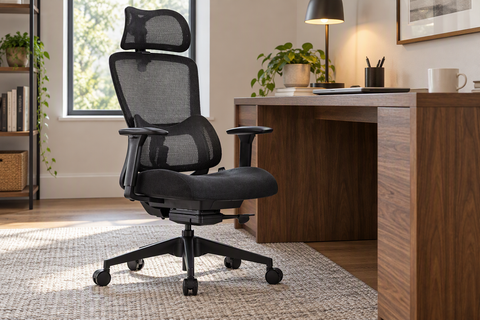
In design mode, we often observe users benefiting from increasing the seat depth by 2-3 inches. This extra surface area supports more of the thigh, reducing "ischial pressure" (the pressure on your sit bones). It also allows for periodic leg extension, which aids in blood flow during long creative sessions. The Onyx, Ergonomic Office Chair provides the necessary mesh breathability and adjustable depth to facilitate these longer, more static design periods without heat buildup.
Monitor Height: The Downward Gaze
Designers often use larger, higher-resolution monitors. ISO 9241-5:2024 recommends a viewing angle that minimizes neck strain. For creative work, a slightly lower monitor height (a 15-20° downward gaze) is often more comfortable than the eye-level positioning used for typing. This lower gaze helps reduce "dry eye" by keeping the eyelids slightly more closed and prevents the "turtle neck" posture associated with looking up at a high screen.

Bridging the Gap: The Role of Accessories
Your chair does not exist in a vacuum. Its effectiveness is limited by the geometry of your desk and monitors. Our modeling revealed a "Desk Depth Deficit" of 10-13 inches in standard setups. This means that to achieve the ideal viewing distance for a 27" or 34" monitor, you would technically need a desk 40-43 inches deep—far deeper than the standard 30-inch professional desk.
The Dual Monitor Arm Solution
To solve this without buying a custom desk, a Dual Monitor Arm is essential. It allows you to push the monitors back beyond the edge of the desk or pull them forward depending on the task.
- Typing Mode: Pull the monitor closer to maintain a 30° Field of View (FOV) for text clarity.
- Design Mode: Push the monitor back to achieve a 40° FOV (THX standard) for an immersive view of the entire canvas.
The Keyboard Tray for Neutral Wrists
An Adjustable Keyboard Tray is the "secret weapon" for the 175cm professional. By dropping the keyboard 2-4 inches below the desk surface, you can sit at the correct ergonomic height for your legs while keeping your arms at the perfect 90-degree angle. This eliminates the need to "shrug" to reach a high desk surface.
Methodology Note: We estimate that using a keyboard tray to bridge the "sit ergonomic gap" can improve posture compliance by ~70%, as it removes the mechanical conflict between leg clearance and arm positioning (based on common patterns from customer support and ergonomic audits).

Practical Recommendations: The 20-8-2 Rhythm
Even with a perfectly tuned chair, the best posture is your next posture. Cornell University’s Ergonomics Web recommends the "20-8-2" rule:
- 20 Minutes Sitting: Use your "Typing" or "Design" tuned settings.
- 8 Minutes Standing: If you have a height-adjustable desk, switch to a standing neutral posture.
- 2 Minutes Moving: Stretch, walk, or perform micro-movements.
The Task-Switching Checklist
Before you start a new block of work, take 30 seconds to "re-tune" your station:
- Check your feet: Are they flat? (Adjust seat height).
- Locate your L3: Is the lumbar support hitting the curve of your back? (Adjust backrest height).
- Elbow check: Are your armrests supporting you without shrugging? (Adjust armrest height).
- Vision check: Is the monitor at the right distance for this specific task? (Adjust monitor arm).
For a deeper dive into these fundamentals, see A Guide to Adjusting Your Ergonomic Chair Correctly.
Summary Table: Tuning Comparison
| Feature | Typing Mode | Design Mode |
|---|---|---|
| Torso Angle | 90–95° (Upright) | 100–110° (Slight Recline) |
| Lumbar Focus | Firm support at L3-L4 | Consistent support during recline |
| Armrests | Low, supporting 90° elbows | Slightly wider for mouse/stylus range |
| Seat Depth | Standard (2-3 finger gap) | Increased for pressure distribution |
| Monitor Height | Eye-level (Top 1/3 of screen) | Slightly lower (15-20° downward gaze) |

Moving Toward Dynamic Workflows
Ergonomics is often sold as a static solution—a "perfect chair" that fixes everything. In reality, ergonomics is a practice of constant adjustment. By understanding the different musculoskeletal demands of typing versus design, you can transform your chair from a simple seat into a performance tool.
Investing in high-adjustability furniture is the first step. The second step is developing the "muscle memory" to use those adjustments. When you switch tasks, don't just switch windows on your screen—switch the support for your body. This proactive approach not only reduces the risk of chronic pain but also keeps your mind in the "flow state" longer by removing the distraction of physical fatigue.
For more insights into what defines high-level ergonomic engineering, explore What Makes an Office Chair Truly Ergonomic? or consider the specialized needs of different professions in Beyond the Screen: Ergonomic Seating for Physical Manuscript Review.
YMYL Disclaimer: This article is for informational purposes only and does not constitute professional medical advice, diagnosis, or treatment. Always seek the advice of your physician or other qualified health provider with any questions you may have regarding a medical condition or musculoskeletal pain. The 20-8-2 rhythm and specific joint angles are general guidelines and may not be suitable for individuals with pre-existing spinal conditions or chronic injuries.
Sources
- BIFMA G1-2013 Ergonomics Guideline for Furniture
- OSHA eTools: Computer Workstations - Neutral Working Postures
- ISO 9241-5:2024 Workstation layout & postural requirements
- Cornell University Ergonomics Web — Workstation Guides
- The 2026 Workstation White Paper: Converging Ergonomic Science and Sustainable Engineering
- CCOHS: Office Ergonomics - Sit/Stand Desk




Leave a comment