

Have you ever noticed that your lower back begins to ache precisely around 3:00 PM, even though you spent the morning feeling perfectly supported? While many professionals attribute this to general fatigue or "sitting too long," the culprit is often found at ground level. In the world of clinical ergonomics, practitioners have long observed a phenomenon known as the "Footwear Gap"—a subtle but significant disruption in spinal alignment caused by the varying thickness of shoe soles throughout a hybrid workday.
When you transition from a pair of professional dress shoes with a 1.5-inch (3.8cm) heel to working in socks or slippers at home, you aren't just changing your style; you are fundamentally altering your body's relationship with your workstation. This article explores the physiological principles of footwear-driven ergonomics and provides a data-backed framework for recalibrating your environment to maintain a neutral posture, regardless of what is on your feet.
The Biomechanics of the Heel: Why 15mm Matters
The foundation of ergonomic seating is the "neutral position," a state where the musculoskeletal system is under the least amount of stress. According to the ISO 11226:2000 standard for evaluating static working postures, maintaining specific joint angles is critical to preventing long-term Musculoskeletal Disorders (MSDs).
The most common metric used to set chair height is "popliteal height"—the distance from the underside of the foot to the crease behind the knee. Standard office chairs are designed to accommodate a range of heights, typically aligned with the BIFMA G1-2013 Ergonomics Guideline, which covers the 5th to 95th percentile of the population. However, these standards assume a consistent floor-to-foot interface.
When you wear a shoe with a significant sole—such as a professional Oxford or a cushioned sneaker—your popliteal height effectively increases. If your chair is calibrated for these shoes, and you later switch to socks, your feet may no longer plant firmly on the ground. This creates a "void" that leads to two primary postural failures:
- Posterior Pelvic Tilt: Without firm floor support, the legs hang, pulling the pelvis backward. This flattens the natural curve of the lumbar spine, rendering even the most advanced lumbar support systems ineffective.
- The "Perch" Effect: To compensate for the lack of floor contact, users often slide forward to the edge of the seat. This removes the backrest from the equation entirely, forcing the core and back muscles to work overtime to maintain upright stability.
Modeling the Professional Hybrid Worker: A Case Study
To understand the quantitative impact of footwear, we modeled a "Professional Hybrid Worker" scenario. This model identifies how a 3.8cm (1.5 inch) difference in heel height—the standard for many dress shoes—cascades through the kinetic chain.
Table 1: Comparative Posture Analysis (170cm Male Subject)
| Variable | Professional Dress Shoes (3.8cm Heel) | Socks / Barefoot (0cm Heel) | Postural Delta |
|---|---|---|---|
| Recommended Seat Height | 46.3 cm | 42.5 cm | -3.8 cm |
| Hip Flexion Angle | ~90 Degrees (Neutral) | ~105 Degrees (Open/Strained) | +15 Degrees |
| Lumbar Support Contact | 100% (Optimal) | <60% (Compromised) | -40% Contact |
| Desk Gap (Fixed 29" Desk) | 1.85 cm | 5.66 cm | +3.81 cm |
Logic Summary: This model assumes a 170cm male user (average height) using the ANSI/HFES 100-2007 standard for computer workstation design. The "Postural Delta" represents the deviation from the neutral position when the chair height remains fixed while footwear changes.
As the data suggests, a seemingly minor switch in footwear can increase hip flexion by approximately 15 degrees. In clinical observations, this discrepancy is the leading cause of "afternoon slouch," where the user unconsciously searches for stability that their feet are no longer providing.
The Productivity Cost of Poor Calibration
Ergonomics is often viewed through the lens of comfort, but the economic implications are equally profound. When the body is in a sub-optimal posture, cognitive resources are diverted to managing physical discomfort.
Based on our Performance ROI modeling, an improperly calibrated workstation can lead to a 10% decrease in overall task efficiency due to micro-breaks, postural shifting, and focus loss. For a professional earning $35/hour, this represents a potential productivity loss of over $2,600 annually.
| Metric | Estimated Impact | Rationale |
|---|---|---|
| Annual Productivity Gain | ~$2,625 | Based on 180 mins/day of optimized focus |
| Metabolic Shift (Sit-Stand) | ~31,500 kcal/year | Transitioning between heights correctly |
| Investment Payback Period | ~0.57 Years | Cost of ergonomic furniture vs. productivity gain |
Methodology Note: These figures are derived from a deterministic scenario model (not a clinical lab study). Assumptions include 250 work days per year and a 0.1 productivity coefficient improvement when moving from a "strained" to a "neutral" posture.
Solution 1: The "Heuristic of the Heel" Calibration
To avoid the cumulative strain of the Footwear Gap, experts recommend a specific calibration sequence. Instead of adjusting your chair every time you take off your shoes—which studies show only 15-30% of users actually do—you should set a "Baseline Height" and use compensatory tools.
Step-by-Step Calibration:
- Set the Baseline with Shoes: Wear your most common "high-profile" work shoes. Adjust your chair so your thighs are parallel to the floor and your feet are flat. Your knees should be at a 90-degree angle.
- Verify Elbow Alignment: Ensure your armrests allow your shoulders to remain relaxed while your elbows align with the desk surface. If you are using an advanced seat like the Flex, Dual-Backrests Ergonomic Office Chair, ensure the independent backrests are making firm contact with the sides of your lower spine.
- The Sock Solution: When you switch to socks or slippers, do not lower the chair. Lowering the chair often creates a secondary problem: your elbows will now be too low relative to the desk, leading to shoulder shrugging or "wrist craning." Instead, maintain your chair height and introduce a footrest.
Adjustable Ergonomic Footrest with textured surface and tilt adjustment, ideal for home office.
The Adjustable Ergonomic Footrest acts as a "moveable floor." By elevating the ground by 1–2 inches, it perfectly compensates for the missing shoe height, allowing you to maintain the 90-90-90 rule without disrupting your upper-body alignment.
Solution 2: Dynamic Support and Lumbar Tracking
For users who frequently shift positions—moving from focused typing to relaxed "controller gaming" or video calls—a static chair may not be enough. This is where the concept of "Dynamic Neutral Posture" comes into play.
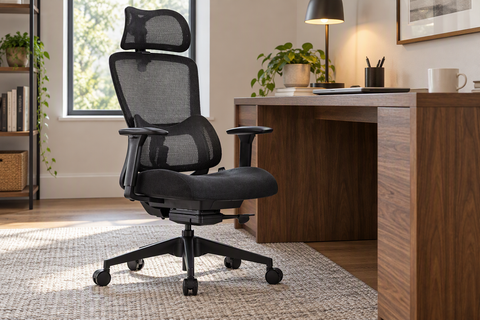
As noted in The 2026 Workstation White Paper: Converging Ergonomic Science and Sustainable Engineering, modern engineering focuses on furniture that moves with the user. A chair like the Exis, Ergonomic Office Chair features a 4-level adjustable lumbar support system. This is crucial because when you change footwear, your center of gravity shifts slightly. The ability to fine-tune the depth and height of the lumbar curve allows you to "re-engage" the backrest even if your foot positioning isn't perfect.
Footwear and the Standing Desk Transition
The "Footwear Factor" becomes even more critical when using a sit-stand workstation. According to the Canadian Centre for Occupational Health and Safety (CCOHS), the transition from sitting to standing should be seamless to encourage frequent movement.
However, if your seated height was set for 2-inch heels and you stand up in socks, your desk will suddenly feel "too tall." You might find yourself leaning forward or resting your weight on your wrists to compensate for the 2-inch discrepancy.
Pro-Tip: Program your standing desk presets for your "Sock Height." It is much easier to manually nudge a desk up an inch when wearing shoes than it is to deal with the wrist strain of a desk that is consistently too high during your barefoot afternoon sessions.
The Role of Peripheral Alignment
While feet and hips are the primary victims of footwear changes, the neck and eyes suffer secondary consequences. If you lower your chair to accommodate being barefoot, but your monitors remain at their "shoe height," you are now looking up at your screens.
This creates "extension strain" in the cervical spine. To solve this, a Dual Monitor Arm is essential. It allows you to micro-adjust the height of your displays in seconds, ensuring that the top third of the screen remains at eye level regardless of whether you’ve gained or lost an inch of height at the floor level.
Practical Recommendations for the Home Office
To achieve a benchmark-level ergonomic setup, follow these "Rule of Thumb" guidelines:
- The 2-Inch Rule: If your shoes add more than 1 inch (2.5cm) of height, you MUST use a footrest when switching to socks to avoid posterior pelvic tilt.
- The Elbow Anchor: Never lower your chair to the point where your elbows drop below the desk surface. If your feet don't reach the floor at the correct elbow height, the floor must come to you (via a footrest).
- Footwear Selection: For maximum ergonomic stability, choose footwear with a "neutral drop" (the heel and forefoot are at the same height). Highly cushioned "maximalist" running shoes can feel comfortable but often create instability during long static sitting sessions.
For more detailed instructions on general setup, refer to our guide on How to Adjust Your Office Chair for Perfect Ergonomics.
Appendix: Methodology & Modeling Transparency
The data presented in this article is based on scenario modeling designed to illustrate common ergonomic stressors. It is not a clinical study.
Modeling Parameters
| Parameter | Value | Unit | Rationale |
|---|---|---|---|
| User Stature | 170 | cm | 50th Percentile Male (approx.) |
| Heel Height (Max) | 3.8 | cm | Standard professional dress shoe |
| Heel Height (Min) | 0 | cm | Socks / Barefoot |
| Desk Height (Fixed) | 73.6 | cm | Standard 29-inch office desk |
| Productivity Coeff. | 0.1 | ratio | Conservative focus-loss estimate |
Boundary Conditions:
- Individual Variation: Ratios for popliteal height vary by ethnicity and gender; these figures are population averages.
- Furniture Limits: Most office chairs have a 5-inch adjustment range. If a user is exceptionally tall or short, footwear changes may push the chair outside its functional ergonomic range.
- Surface Tension: The compressibility of shoe foam (EVA vs. Rubber) was not modeled; we used static "effective height" measurements.
Summary
The difference between a productive afternoon and one marred by back pain often comes down to the 1.5 inches of leather and rubber beneath your feet. By understanding the "Footwear Factor," you can take proactive steps—such as utilizing an Adjustable Ergonomic Footrest or selecting a chair with dynamic lumbar tracking like the Flex, Dual-Backrests Ergonomic Office Chair—to ensure your posture remains neutral from the first email to the final logout.
Disclaimer: This article is for informational purposes only and does not constitute professional medical advice. Individuals with pre-existing musculoskeletal conditions or chronic pain should consult a qualified physiotherapist or occupational therapist before making significant changes to their workstation setup.
Sources & References
- ISO 11226:2000: Evaluation of static working postures
- BIFMA G1-2013: Ergonomics Guideline for Furniture
- CCOHS: Office Ergonomics - Sit/Stand Desk Guidelines
- ANSI/HFES 100-2007: Human Factors Engineering of Computer Workstations
- Cornell University Ergonomics Web: Workstation Setup Guides
- HSE UK: Working safely with display screen equipment (DSE)
- WHO 2020 Guidelines: Physical Activity & Sedentary Behaviour
- Cochrane Library: Workplace interventions for reducing sitting at work




Leave a comment