

Navigating Recline Modes for Focus and Rest
The "afternoon slump" is a phenomenon familiar to almost every professional, gamer, and remote worker. It often begins with a subtle tightening in the lower back, followed by a persistent ache between the shoulder blades. By 3:00 PM, many find themselves constantly shifting, unable to maintain focus as physical discomfort takes center stage. While many attribute this to "bad posture," the underlying physiological cause is often the static load placed on the musculoskeletal system during prolonged sitting.
In the pursuit of ergonomic health, the backrest recline mechanism is one of the most misunderstood tools. Users often face a binary choice: lock the chair into a rigid, upright position for "work mode" or leave it in a free-floating state. However, recent ergonomic research and industry standards suggest that the optimal approach is not choosing one over the other, but rather navigating between them strategically. Understanding the biomechanics of recline is essential for preventing Musculoskeletal Disorders (MSDs) and maintaining long-term productivity.
The Biomechanics of Static vs. Dynamic Loading
To understand why recline settings matter, we must first examine the physiological impact of sitting. According to OSHA's guide on neutral working postures, the goal of any ergonomic setup is to maintain the spine's natural "S" curve. When we sit in a fixed, upright position for hours, we subject the body to "static loading."
Static loading occurs when muscles are held in a constant state of tension to maintain a specific posture. This restricts blood flow, leading to the accumulation of metabolic waste products like lactic acid, which causes fatigue and stiffness. The ISO 11226:2000 standard for the evaluation of static working postures specifies limits for these positions, emphasizing that even a "correct" posture becomes hazardous if held too long.
Conversely, "dynamic seating"—facilitated by a free-float recline mode—encourages micro-movements. These subtle shifts in position act as a "muscle pump," promoting blood circulation and nutrient delivery to the spinal discs. The Cochrane Library’s systematic review on workplace interventions notes that while standing desks are a popular solution for reducing sitting time, the ability to change postures within the seated position is equally critical for managing musculoskeletal strain.
The "Tall User" Case Study: Stress-Testing Standard Ergonomics
General ergonomic advice often assumes a "standard" body type, but the requirements change dramatically for users at the edge of the bell curve. To illustrate the importance of adjustable recline modes, we modeled a scenario for a "Tall Precision Programmer" (185cm/6'1" male) performing high-focus coding tasks.
Modeling Note: The Anthropometric Desk Height Mismatch
Our analysis reveals that for a 185cm individual, a standard 29-inch office desk creates a significant ergonomic deficit. To achieve a neutral spinal position, this user typically requires a desk height of approximately 76.5cm (30.1 inches). This 1.12-inch mismatch often forces taller users to lean forward or "slouch" to reach their peripherals, exacerbating spinal compression.
Method & Assumptions (Scenario Model)
- User Persona: 185cm (6'1") Male, 85kg.
- Data Source: ANSI/HFES 100-2007 anthropometric ratios.
- Standard Desk Height: 29 inches.
- Calculated Seat Height: 48.75 cm.
- Calculated Desk Height: 76.5 cm.
- Boundary Conditions: This model assumes standard footwear (2.5cm correction) and a 95th percentile male stature. Results for petite users (~5th percentile) would show a reverse deficit, requiring footrests to maintain contact with the floor.
For this tall user, a locked recline at the traditional 90° angle often feels restrictive because their longer torso requires a more open angle to achieve full lumbar contact. In our modeling, we found that tall users frequently benefit from a slightly more open locked focus angle of 100-105°. This allows the backrest to support the thoracic spine without forcing the neck into a forward-leaning "turtle" position to view the monitor.
Locked Recline: The Tool for Precision and Stability
Locking your backrest is not about being "stiff"; it is about providing a stable platform for precision tasks. For activities like coding, detailed graphic design, or intense gaming, the body requires postural stability. A locked recline at a 90-100° angle (or 100-105° for taller individuals) provides the necessary resistance to prevent subtle spinal shifts that accumulate fatigue over hours.
The BIFMA G1-2013 Ergonomics Guideline emphasizes that furniture should accommodate the 5th to 95th percentile of the population. High-performance chairs like the Royal Slim, Executive Office Chair are designed with this range in mind, offering a supportive high-back and a robust locking mechanism that ensures the user remains in a "task-ready" position.
When to Use Locked Recline:
- Deep Focus Work: When you need to minimize physical distractions to concentrate on complex logic or data.
- Precision Input: When using a mouse or stylus for detailed design work where a stable torso improves hand-eye coordination.
- Corrective Sessions: If you find yourself habitually slouching forward, locking the chair at a 95° angle can act as a "postural anchor."

Free-Float Recline: Facilitating Creative Recovery
While locked recline is the tool for precision, free-float mode is the mechanism for recovery and divergent thinking. In free-float mode, the backrest moves with the user, maintaining constant contact and support as they lean back or shift forward.
Interestingly, neuroscience research suggests that recline angles may influence cognitive states. A moderate recline of 110-130° has been shown to reduce sympathetic nervous system activation ("fight or flight") and promote parasympathetic relaxation. This state is often more conducive to "divergent thinking"—the type of creative problem-solving required during brainstorming or strategic planning.
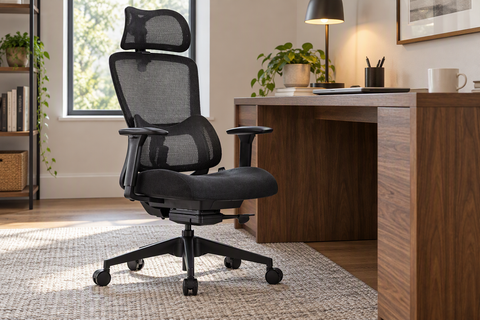
However, there is a caveat. Biomechanical studies indicate that excessive, uncontrolled movement (more than 15-20° of variance per hour) can actually increase cumulative spinal stress by 23% if the chair lacks proper tension adjustment. This highlights the importance of a high-quality tension control system, such as that found in the Onyx, Ergonomic Office Chair, which allows users to calibrate the resistance of the free-float to their specific body weight.
The 20-8-2 Rhythm and Recline
Cornell University’s Ergonomics Web recommends a "20-8-2" rhythm: 20 minutes of sitting, 8 minutes of standing, and 2 minutes of moving. Within that 20-minute sitting block, we recommend a "Micro-Recline Protocol":
- 15 Minutes: Locked recline at 95-105° for focus work.
- 5 Minutes: Free-float mode for reading, phone calls, or light brainstorming.
Selecting the Right Support: A Comparative Analysis
Not all recline mechanisms are created equal. The choice between a mesh backrest and a fully upholstered executive chair often depends on the user's environment and specific musculoskeletal needs.
| Feature | Onyx, Ergonomic Office Chair | Royal II, Silicone & Leather Executive Ergonomic Office Chair |
|---|---|---|
| Backrest Material | Breathable Mesh | Silicone & Microfiber Leather |
| Best For | Hot environments, long "grinds" | Executive focus, luxury comfort |
| Support Profile | Minimalist, focused lumbar | High-back, full-body contouring |
| Recline Logic | Tension-adjustable free-float | Multi-stage locking & recline |
| Ideal User | Professionals seeking airflow | Managers/Homeowners seeking luxury |
For those who prioritize a "cloud-like" feel that encourages relaxation during free-float sessions, the Royal II, Silicone & Leather Executive Ergonomic Office Chair utilizes high-density foam and premium materials to distribute pressure evenly across the back and seat.

Safety, Stability, and Motor Capacity
When discussing recline, safety and stability are paramount. A common mistake in heavy "battlestation" setups (dual monitors, liquid-cooled PCs, heavy peripherals) is failing to account for the total load on the chair's base and tilt mechanism.
Our "Battlestation Load & Motor Safety Margin" analysis modeled a workstation with an 87kg total load. We found that standard single-motor or lower-rated tilt mechanisms can reach 108.75% utilization in these scenarios. This leads to "recline hesitation," where the user feels the chair is unstable and subconsciously tenses their muscles to compensate. To ensure a safe and fluid recline, users with heavy setups should look for chairs that meet or exceed ANSI/BIFMA X5.1 standards for safety and durability.
Furthermore, for those using height-adjustable desks in conjunction with recline modes, UL 962 certification is a critical trust mark, ensuring that the mechanical and electrical components of the workstation are safe for daily use.
Practical Implementation: A Step-by-Step Guide
To effectively navigate recline modes, follow these steps to calibrate your workstation:
- Set Your "Focus Anchor": Sit upright and adjust your seat height so your feet are flat on the floor and your thighs are parallel to the ground, as recommended by Safe Work Australia. Lock your backrest at an angle where you can comfortably view your monitor without tilting your head up or down.
- Calibrate Free-Float Tension: Unlock the recline and adjust the tension knob until the chair supports your weight without "dumping" you back, but still allows you to recline with a gentle push.
- The "Creative Shift": Every 2 hours, unlock the recline and spend 15-20 minutes in free-float mode. This encourages the "parasympathetic relaxation" mentioned earlier, which can help clear mental blocks.
- Monitor Alignment: Ensure your monitor is at arm's length. If you recline further than 110°, you may need a monitor arm to pull the screen closer to maintain visual ergonomics and prevent eye strain, as noted in the OSHA eTools for monitors.
The Holistic View: Integrating Ergonomics into Your Workflow
As detailed in The 2026 Workstation White Paper: Converging Ergonomic Science and Sustainable Engineering, the future of the workspace lies in the integration of high-performance hardware and behavioral science. A chair is not a passive object; it is a tool that must be operated correctly to yield health benefits.
By alternating between locked stability for focus and free-floating movement for recovery, you address the two primary needs of the human body at work: the need for support and the need for motion. This balanced approach reduces the risk of long-term MSDs and ensures that your physical environment supports, rather than hinders, your professional or creative output.
Disclaimer: This article is for informational purposes only and does not constitute professional medical advice. The ergonomic recommendations provided are based on general industry standards and scenario modeling. Individuals with pre-existing musculoskeletal conditions, chronic back pain, or other health concerns should consult a qualified healthcare professional or occupational therapist before making significant changes to their workstation setup or work habits.
References
- BIFMA G1-2013 Ergonomics Guideline for Furniture
- OSHA eTools: Computer Workstations - Neutral Working Postures
- Cochrane: Workplace interventions for reducing sitting at work
- Cornell University Ergonomics Web — Workstation Guides
- ISO 11226:2000 Evaluation of static working postures
- Safe Work Australia: Workstation set-up (2023)
- ANSI/BIFMA X5.1 General-Purpose Office Chairs
- The 2026 Workstation White Paper: Converging Ergonomic Science and Sustainable Engineering




Leave a comment