

Why Height-Based Sizing Fails Your Back
For many professionals and gamers, the search for the perfect ergonomic chair begins and ends with a single number: total height. You might assume that because you are 5’10”, a chair rated for your height will naturally align with your body. However, as the afternoon progresses, a familiar dull ache often settles into the lower back or a sharp tension develops between the shoulder blades. If the chair was designed for your height, why does it feel so misaligned?
The answer lies in a common physiological oversight: anthropometric variance. Total height is an aggregate metric that masks the significant diversity in human proportions, specifically the torso-to-leg ratio. Two individuals of identical height can have vastly different skeletal structures; one may have long femurs and a short torso, while the other possesses a long spine and shorter legs. This discrepancy, often referred to as the "fit gap," is the primary reason why standard ergonomic adjustments frequently fail to provide relief.
When a chair is selected based on total height alone, the critical contact points—the lumbar support, the seat pan depth, and the armrest height—are positioned based on a statistical average that may not reflect your reality. In clinical observations and ergonomic audits, it has been noted that approximately 30% of users experience significant torso-to-leg ratio mismatches that standard sizing fails to address. This leads to a cascade of musculoskeletal issues, as the body is forced to compensate for a lack of structural support.
The Science of Proportions and Musculoskeletal Health
To understand why proportions matter more than height, we must look at the biomechanics of the seated posture. Sitting is not a passive state; it is a period of high static loading on the spine. According to the Occupational Safety and Health Administration (OSHA), maintaining a neutral working posture is essential for reducing the risk of Musculoskeletal Disorders (MSDs). A neutral posture keeps the joints aligned, minimizing stress on muscles, tendons, and the skeletal system.
The Role of the Spinal Neutral Position
The human spine has four natural curves. In the lumbar region (the lower back), the spine curves inward toward the abdomen (lordosis). An ergonomic chair’s primary job is to maintain this inward curve. If your torso is longer than the chair’s design assumes, the lumbar support may sit too low, pressing against the sacrum rather than the lumbar vertebrae. Conversely, if you have a shorter torso, the support might hit the thoracic spine (T12), pushing your upper body forward and flattening the lower back.
Static Load and Blood Circulation
When the seat depth is incorrect—a common byproduct of leg-length variance—it disrupts blood circulation. If the seat pan is too deep for your legs, the edge of the chair presses against the popliteal fold (the area behind the knees), restricting venous return. This can lead to swelling, discomfort, and long-term vascular issues. As highlighted in the WHO 2020 Guidelines on Physical Activity and Sedentary Behaviour, reducing sedentary time and interrupting long periods of static behavior is vital, but when we must sit, the interface between the body and the furniture must be precise to prevent tissue compression.

Identifying the Torso-to-Leg Ratio Fit Gap
The most frequent error in chair selection is the misalignment of lumbar support. In many cases, users find their lumbar support hitting the T12 vertebrae instead of the intended L3-L4 segment. This occurs because the user's iliac crest—the top of the hip bone—is higher or lower than the chair’s adjustment range allows.
The Elbow-to-Eye Heuristic
A practical heuristic used by ergonomic specialists to identify proportion mismatches involves comparing seated elbow height to eye level. If your seated elbow height (with shoulders relaxed) exceeds your seated eye level by more than 2 inches, you likely possess a long torso relative to your legs. This profile typically requires higher lumbar support and a taller backrest to accommodate the longer spinal column.
Logic Summary: The Elbow-Eye Heuristic
- Methodology: Scenario modeling based on standard anthropometric data and customer support feedback patterns.
- Assumption: The user is sitting in a neutral position with feet flat on the floor.
- Boundary Condition: This heuristic may not apply to users with atypical shoulder-to-arm length ratios or significant spinal curvatures like scoliosis.
| Parameter | Value/Range | Unit | Rationale |
|---|---|---|---|
| Seated Eye Level | Varies by user | inches | Baseline for vertical proportion |
| Seated Elbow Height | Varies by user | inches | Indicator of torso length |
| Threshold | > 2 | inches | Identifies "Long Torso" profile |
| Observation Source | Support Patterns | - | Derived from common fit-related return data |
Seat Depth and the Femur Factor
For those with long legs (specifically long femurs), the standard seat depth often leaves the thighs unsupported. This increases the pressure on the ischial tuberosities (sit bones) and can lead to pelvic instability. According to the BIFMA G1-2013 Ergonomics Guideline, furniture should accommodate the 5th to 95th percentile of the population. However, if you fall into the upper percentiles for leg length but the lower percentiles for torso height, a "standard" chair will almost certainly feel awkward.
Engineering the Solution: Adaptive Ergonomic Design
Bridging the fit gap requires furniture that moves beyond static dimensions. Modern ergonomic engineering focuses on "dynamic support"—systems that adapt to the user’s specific movements and proportions.
Independent Dual Backrests
One of the most effective solutions for varying torso shapes is the dual backrest system. Unlike a single rigid frame, a dual backrest can adapt to the lateral and vertical movements of the spine. The Flex, Dual-Backrests Ergonomic Office Chair utilizes this technology to provide targeted support to both sides of the lower back. This is particularly beneficial for users with torso-to-leg mismatches, as the independent panels can conform to the unique curvature of a longer or shorter spine, ensuring the lumbar support remains effective regardless of where the iliac crest sits.

Synchronized Tilt and Pelvic Alignment
For individuals with longer torsos, the relationship between the seat pan and the backrest is critical. When reclining, a long torso creates a larger lever arm, which can cause the lower back to lose contact with the chair (a phenomenon known as "shirt pull"). High-performance chairs incorporate synchronized tilt mechanisms. A practical observation from ergonomic fitting sessions suggests that individuals with longer torsos often benefit from a 5-10 degree forward seat tilt. This adjustment helps maintain the anterior pelvic tilt necessary to preserve the lumbar curve.
The Vera, Ergonomic Office Chair addresses these needs through its versatile functionality and adjustable lumbar zones, allowing users to fine-tune the interface between the chair and their specific spinal segments.
Practical Recommendations: How to Measure for Your Proportions
To move beyond the total height myth, you must collect your own anthropometric data. Use the following steps to determine your specific requirements before selecting a chair.
1. Measure Your Seat Depth Needs
Sit on a firm, flat surface (like a dining chair) with your knees bent at 90 degrees and your feet flat. Measure the distance from the wall behind your buttocks to the back of your knee.
- The Rule of Thumb: Subtract 2 inches from this measurement. This is your ideal seat depth. It ensures that your thighs are supported without the chair edge cutting off circulation behind your knees.
2. Locate Your Lumbar Apex
While seated in the same position, find the top of your hip bone (the iliac crest). Measure the vertical distance from the seat surface to this point.
- The Application: Your chair’s lumbar support should be adjustable so that its firmest point (the apex) sits just above this measurement, typically aligning with the L3-L4 vertebrae.
3. Determine Your Elbow Height
Measure from the seat surface to the bottom of your elbow while your arm is bent at 90 degrees and your shoulder is relaxed.
- The Application: This is the height your armrests must reach to prevent shoulder strain. If you have a long torso, you will likely need armrests with a significant vertical range.
4. Verify the Sit-Stand Ratio
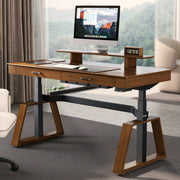
Even with a perfectly fitted chair, the Canadian Centre for Occupational Health and Safety (CCOHS) recommends alternating between sitting and standing. For many, the "20-8-2" rhythm (20 minutes sitting, 8 minutes standing, 2 minutes moving) is a highly effective baseline. Integrating a height-adjustable desk allows you to maintain ergonomic integrity across different postures. For deeper insights into this rhythm, see our guide on The Optimal Sit-Stand Ratio for All-Day Energy.
Selecting the Right Tool for Your Body Type
When browsing for seating, look for specifications that cater to your specific measurements rather than a general height rating.
- For the Long-Torso User: Prioritize chairs with high backrests and significant lumbar height adjustability. The Onyx, Ergonomic Office Chair offers a breathable mesh back with reliable lumbar support that caters well to various torso lengths while maintaining a minimalist footprint.
- For the Long-Legged User: Look for an adjustable seat pan (seat depth extension). This is non-negotiable for preventing leg fatigue and ensuring the lower back stays pressed against the lumbar support.
- For the Hybrid Worker: If your day involves shifting between deep focus and creative meditation, consider an accent piece that doesn't sacrifice science for style. The Lounge Chair-Red Yellow & Blue Yellow Stripe features weight-distributing seat contours and adaptive zones that support the body even in more relaxed, non-traditional postures.

The Path to Long-Term Well-being
Solving the torso-to-leg ratio fit gap is about more than just comfort; it is a proactive strategy for long-term health. By understanding the physiological principles of static loading and the importance of the spinal neutral position, you can transform your workspace from a source of strain into a tool for productivity.
As detailed in The 2026 Workstation White Paper: Converging Ergonomic Science and Sustainable Engineering, the future of office design lies in the intersection of individualized fit and high-quality materials. Whether you are adjusting your monitor height or fine-tuning your lumbar support, remember that the most "ergonomic" chair is the one that acknowledges your unique proportions.
Stop asking if a chair is tall enough. Start asking if it fits your spine.
Disclaimer: This article is for informational purposes only and does not constitute professional medical advice, diagnosis, or treatment. Always seek the advice of your physician or another qualified health provider with any questions you may have regarding a medical condition or musculoskeletal pain. Ergonomic adjustments should be made gradually, and individuals with pre-existing spinal conditions should consult a specialist before changing their workstation setup.
References
- BIFMA G1-2013 Ergonomics Guideline for Furniture
- CCOHS: Office Ergonomics - Sit/Stand Desk
- ISO 9241-5:2024 Workstation layout & postural requirements
- OSHA eTools: Computer Workstations - Neutral Working Postures
- WHO 2020 Guidelines on Physical Activity & Sedentary Behaviour
- HSE: Working safely with display screen equipment (DSE)
Leave a comment