

The Silent Communicator: Why Office Design Dictates Client Trust
In the high-stakes environment of wealth management and private banking, the physical workspace is far more than a functional necessity; it is a silent communicator of meticulousness, stability, and technological competence. For high-net-worth individuals (HNWIs), a single stray cable or a cramped, disorganized desk can subtly undermine the perception of an advisor’s attention to detail. Professional practitioners in wealth management note that client-facing desks should ideally maintain a "zero-clutter" policy, as even minor visual noise can erode the psychological safety required for sensitive financial consultations.
Beyond aesthetics, the executive office must resolve a complex ergonomic paradox: it must facilitate high-intensity, multi-monitor data analysis while remaining approachable and comfortable for hours of face-to-face client engagement. The transition from traditional, monolithic mahogany desks to modern, minimalist environments reflects a shift in client expectations. Younger HNWIs increasingly associate matte materials, clean lines, and integrated technology with transparency and forward-thinking stability rather than the heavy opulence of previous generations.
However, achieving this balance requires more than a minimalist eye. It demands a rigorous application of ergonomic science to ensure that the advisor remains physically resilient and mentally sharp. As we will explore, the physiological cost of a poorly configured "prestige" office can lead to chronic musculoskeletal issues that directly impact professional performance and decision-making clarity.
The Physiological Cost of the Executive Lifestyle
The primary health risk in the modern executive suite is not acute injury, but the cumulative effect of static load. Prolonged sitting, even in expensive traditional chairs, triggers a cascade of physiological responses. According to Musculoskeletal disorders and prolonged static sitting, long periods of inactivity lead to reduced blood circulation, increased pressure on intervertebral discs, and the development of Work-related Musculoskeletal Disorders (WMSDs).
The Mechanics of Static Load
When an executive remains seated for hours during market analysis or client reviews, the muscles in the back and neck remain in a state of continuous, low-level contraction. This "static" work is more fatiguing than "dynamic" work because it restricts blood flow, preventing the delivery of oxygen and the removal of metabolic waste products like lactic acid.
- Spinal Compression: In a seated position, the lumbar spine often loses its natural lordotic curve, increasing intradiscal pressure.
- Shoulder Elevation: A common mistake in executive setups is a desk that is slightly too high, forcing the trapezius muscles to remain engaged to keep the arms at keyboard level.
- Visual Fatigue: The use of large, high-resolution displays—essential for financial modeling—requires precise viewing distances to avoid "accommodation stress" in the eyes and "forward head posture" (often termed "tech neck").
The World Health Organization (WHO) 2020 Guidelines emphasize that adults should reduce sedentary time and interrupt long periods of static behavior. For a wealth manager, this isn't just a health recommendation; it is a productivity mandate. Fatigue and physical discomfort are significant cognitive distractors that can impair the "system 2" thinking required for complex financial strategy.
Engineering the Modern Executive Suite: Beyond Traditional Opulence
To address these risks, the modern executive office must move from Administrative Controls (reminding oneself to stand) to Engineering Controls (furniture that facilitates movement). The OSHA hierarchy of controls suggests that engineering solutions are inherently more effective because they design the hazard out of the environment.
The Foundation: The Ark EL Executive Standing Desk
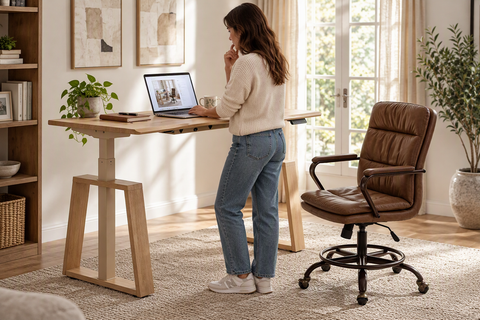
For a wealth manager, a desk must provide a minimum depth of 29 inches. This is not arbitrary; it is a practical requirement for side-by-side document analysis with clients without forcing monitors too close to the user’s face. The Ark EL Executive Standing Desk (60"x26") provides a sophisticated platform that balances this need for space with an oak texture veneer that avoids the high-maintenance fingerprints of gloss surfaces.
Logic Summary: We recommend a minimum 29-inch depth for client-facing desks based on practitioner observations regarding side-by-side document review and the Vision-Quest THX/SMPTE Viewing Distance model which identifies a "depth deficit" in shallower workstations.

A critical, non-obvious insight for wealth managers is the use of sit-stand presets as a meeting pacing tool. A deliberate transition to a standing position can signal a shift in the tone of a consultation or help re-engage a client's attention during a long session. This behavioral intervention, supported by the desk's motorized height adjustment, transforms a health feature into a professional asset.
The Seating Strategy: Support vs. Luxury
While the desk facilitates movement, the chair provides the primary support during deep-work phases. The Royal II, Silicone & Leather Executive Ergonomic Office Chair is designed for the high-priority segment where a sense of being "enveloped" and high-back support are paramount. It meets the ANSI/BIFMA X5.1 standards for safety and durability, ensuring that the chair remains a stable platform for years.

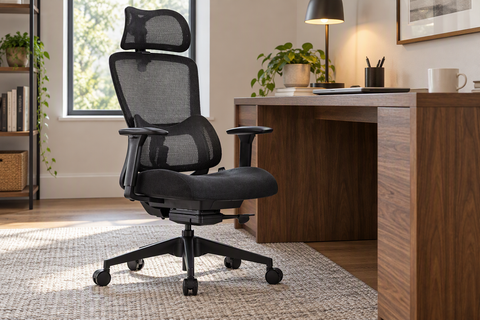
For advisors who prefer a more technical aesthetic, the Flex, Dual-Backrests Ergonomic Office Chair offers an innovative dual-backrest design. Unlike traditional rigid backs, this system moves independently to adapt to the body’s lateral movements, providing targeted lumbar support that aligns with ISO 9241-5:2024 requirements for postural flexibility.
The "Tall Executive" Modeling: Solving the Hidden Ergonomic Mismatch
Generic ergonomic advice often fails for executives who fall outside the median height range. To demonstrate the importance of precision, we modeled a scenario for a 188cm (approx. 6'2") wealth manager using dual 34-inch ultrawide monitors.
The Height and Depth Deficit
Our scenario modeling reveals that a standard 29-inch fixed desk height is approximately 1.6 inches too low for a user of this stature to maintain a neutral spinal position. More critically, the "Viewing Distance Deficit" becomes a major issue. To achieve a comfortable 40° field of view (the THX standard for visual immersion without strain), a viewing distance of ~43 inches is required. On a standard desk, this creates a 10-inch deficit, forcing the user to sit uncomfortably close to high-intensity light and small text.
| Parameter | Value | Unit | Rationale |
|---|---|---|---|
| User Stature | 188 | cm | 95th Percentile US Male |
| Ideal Sitting Desk Height | ~30.6 | in | Based on ANSI/HFES 100-2007 ratios |
| Ideal Standing Height | ~45.4 | in | Including professional shoe correction |
| Recommended Viewing Dist. | ~43 | in | THX 40° FOV for dual 34" monitors |
| Minimum Cable Length | 10 | ft | To prevent tension at 48" desk height |
The Cable Tension Trap
For the tall executive, cable management is not just about aesthetics; it is a mechanical constraint. Standard 6-foot or 8-foot cables often reach their tension limit when a desk is raised to a 45+ inch standing height. This tension can damage ports or, more likely, create a visible "pull" that ruins the clean aesthetic. We recommend 10-foot cables with a 25% slack allowance to ensure that the transition from sitting to standing is fluid and invisible to the client.
Implementation Framework: Optimizing Your Professional Environment
Designing a world-class wealth management office requires a systematic approach. Use the following framework, aligned with The 2026 Workstation White Paper, to audit and optimize your workspace.
1. The 20-8-2 Rhythm
Adopt the Cornell University Ergonomics Web recommendation: for every 30 minutes of work, spend 20 minutes sitting, 8 minutes standing, and 2 minutes moving or stretching. This rhythm prevents the accumulation of static load while maintaining the focus required for financial analysis.
2. Strategic Storage Placement
Avoid the common mistake of placing file cabinets directly under the desk. This restricts leg movement and can lead to "bumping" injuries or forced awkward postures. Instead, utilize lateral storage like the Ark EL, 29" Display File Storage Cabinet, Oak. Placing it to the side, within arm’s reach but out of the immediate sightline, maintains workflow efficiency without compromising the minimalist aesthetic.

3. Monitor Calibration
Ensure the top of your screen is at or slightly below eye level. According to HSE guidelines for display screen equipment, this reduces neck extension. For dual-monitor setups, angle them in a slight "V" shape to minimize head rotation, keeping the primary data stream directly in front of your neutral line of sight.
4. Material and Tactile Selection
In wealth management, the "feel" of the office matters. While glass looks modern, it is acoustically "bright" (creating echoes during calls) and visually "busy" due to reflections. Matte wood veneers or sintered stone are superior choices; they are non-porous, resistant to stains, and provide a tactile warmth that encourages client trust.
Summary of Ergonomic Standards for Executive Furniture
To ensure your selections meet global benchmarks for health and safety, refer to the following compliance table:
| Standard | Focus Area | Relevance for Wealth Managers |
|---|---|---|
| BIFMA G1-2013 | Ergonomic Dimensions | Ensures furniture fits the 5th to 95th percentile of the population. |
| ISO 11226:2000 | Static Working Postures | Provides limits for how long a specific posture should be maintained. |
| UL 962 | Height-Adjustable Safety | Covers the mechanical and electrical safety of motorized desks. |
| ANSI/HFES 100-2007 | Computer Workstations | The gold standard for integrating displays, keyboards, and furniture. |
Modeling Transparency (Method & Assumptions)
The quantitative data presented in this article is derived from a deterministic scenario model designed for high-stature professionals.
- Modeling Type: Anthropometric Scenario Analysis (Deterministic).
-
Key Assumptions:
- User Height: 188cm (95th percentile).
- Shoe Correction: 2.5cm (Professional dress shoes).
- Monitor Setup: Dual 34-inch ultrawide (21:9 aspect ratio).
- Visual Goal: THX 40° Field of View for document clarity.
- Boundary Conditions: This model specifically addresses the "Tall User" mismatch. Users under 170cm or those using single, smaller monitors will have different optimal viewing distances and height requirements. Cable length recommendations assume a standard floor-to-desk routing path.
Disclaimer: This article is for informational purposes only and does not constitute professional medical, legal, or financial advice. The ergonomic recommendations provided are based on general industry standards and scenario modeling; individuals with pre-existing musculoskeletal conditions should consult a qualified healthcare professional or occupational therapist before making significant changes to their workstation.
References
- BIFMA G1-2013 Ergonomics Guideline for Furniture
- ISO 9241-5:2024 Workstation layout & postural requirements
- WHO 2020 Guidelines on Physical Activity & Sedentary Behaviour
- Cochrane: Workplace interventions for reducing sitting at work (2018)
- Cornell University Ergonomics Web — Workstation Guides
- The 2026 Workstation White Paper: Converging Ergonomic Science and Sustainable Engineering




Leave a comment