

Imagine Your Workspace Sanctuary: A 2026 Vision
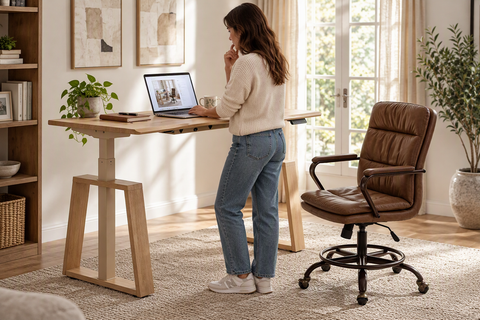
Imagine waking up on a crisp Monday morning in 2026. You walk into your home office, and instead of a tangled "nest" of black plastic snakes beneath your desk, you find a scene of absolute serenity. The morning light catches the sleek texture of your workstation. There is no visual noise, no dust-trapping chaos, and certainly no risk of snagging a cable as your desk glides silently to your preferred standing height.
This is more than just "tidying up." It is about creating a Workspace Sanctuary—a place where your mind can enter a state of deep work without the friction of physical clutter. As we step into 2026, the complexity of our tech—from 240W USB-C charging to high-bandwidth USB4 peripherals—demands more than a haphazard approach to organization.
If you have ever felt that "mysterious" drop in productivity or a nagging sense of anxiety just looking at your desk, you are not alone. Remote workers are frequently hindered by cable clutter, which impacts both mental focus and physical safety. This guide is your definitive 2026 Cable Management Audit, designed to help you reclaim your space, protect your expensive hardware, and foster a mindful workflow.
The 2026 Audit: Identifying the Hidden Hazards
Before we transform the space, we must understand the "why" behind the chaos. Cable management isn't merely cosmetic; it is a fundamental component of workstation safety and longevity.
The Real Cost of "Cable Chaos"
In our observations of remote work trends, we have noted that physical hazards are often overlooked in favor of digital security. However, data suggests that a single cable-related trip-and-fall claim can cost 50-55% more than the average workers' compensation claim, representing a significant personal and financial risk that standard home office audits ignore (Source: The CLM).
Beyond the trip hazard, "cable snagging" is a primary cause of equipment failure. When a sit-stand desk moves upward, a cable that is too short can:
- Damage delicate port connectors on your PC or monitor.
- Pull expensive devices off the desktop.
- Cause the desk motors to "stall," which users often misinterpret as mechanical failure.
The "Safe Length" Calculation
One of the most common mistakes is using cables that are either too short for a standing desk's range or so long they create unmanageable bulk. To solve this, we use a geometric heuristic to determine your minimum safe cable length.
Modeling Note (Safe Cable Length): Our scenario model assumes a tall user (approx. 190cm) requiring a high-standing position.
Parameter Value Unit Rationale Horizontal Distance ($D_{horiz}$) 24 in Standard width for dual-monitor routing Max Desk Height ($H_{max}$) 52 in Height for 95th percentile tall users PC Port Height ($H_{port}$) 12 in PC on a raised floor stand/platform Safety Slack ($S$) 25% % Extra length for bend radius and movement Formula: $Required Length = (D_{horiz} + (H_{max} - H_{port})) \times (1 + S)$ Result: In this scenario, the required length is ~6.7ft. Since standard cables jump from 6ft to 10ft, we recommend a 10ft cable to ensure zero tension at maximum height.

Step 1: The Deep Declutter & Space Transformation
A true transformation begins with a blank canvas. To reach that aspirational "after" state, you must first address the vertical and horizontal planes of your desk.
Elevate to Organize
The desktop surface should be reserved for "active" work. According to the OSHA eTools for Computer Workstations, maintaining the top of your screen at or slightly below eye level is critical for reducing neck strain.
By using a Carbon Fiber Dual Monitor Stand, you achieve two goals simultaneously:
- Ergonomic Alignment: It lifts your screens to a healthy viewing angle, aligning with the principles found in The 2026 Workstation White Paper: Converging Ergonomic Science and Sustainable Engineering.
- Cable Concealment: It creates a "hidden" zone beneath the stand where you can route peripheral cables for your mouse, keyboard, or phone chargers, keeping them out of your direct line of sight.
Reclaim Your Legroom
The area under your desk is often a graveyard for power bricks. According to BIFMA G1-2013 Ergonomics Guidelines, providing adequate leg clearance is vital for postural changes. If your cables are dangling, they restrict your ability to move your legs, which is the very thing a standing desk is meant to encourage.
A common "pro-tip" we have gathered from troubleshooting high-performance setups is to mount your power strip directly to the underside of the desk or within a dedicated cable tray. This ensures that only one "umbilical" power cable needs to travel from the desk to the wall outlet, regardless of how many devices are on your desktop.
Step 2: Mastering the "Service Loop" and Routing
Once your devices are positioned, the routing phase begins. This is where we transition from "tidy" to "technically sound."
The 8-Inch Slack Rule
When routing cables along the frame of a height-adjustable desk, never pull them taut. We recommend leaving a service loop—an extra 6 to 8 inches of slack—near the pivot points or the power source. This prevents the "snag-and-stall" issues mentioned earlier.
Magnetic vs. Adhesive Solutions
In our experience with premium finishes, we strongly advise against using cheap adhesive cable clips on delicate wood veneers or leather surfaces. They often leave permanent residue or strip the finish upon removal.
Instead, opt for a Magnetic Cable Tie. These are particularly effective for metal-framed desks. Unlike traditional Velcro, magnetic ties do not attract pet hair or dust, which can degrade the "grip" over time. They allow for a modular setup; if you add a new peripheral, you simply snap the magnet off, add the cable, and snap it back.

Color Coding for Troubleshooting
In 2026, the average professional desk might have 10+ identical-looking black USB cables. To reduce "troubleshooting fatigue," we suggest a simple color-coding system using colored ties:
- Red: Main Power
- Blue: Data/Network (USB4/Thunderbolt)
- Green: Audio/Visual
- Yellow: Peripheral/Charging
This small tweak makes a massive impact when you need to swap a device quickly without crawling under the desk with a flashlight.
Step 3: Addressing Signal Integrity and Thermal Safety
As we move toward higher power delivery (up to 240W via USB-C) and higher data speeds, the physics of cable management becomes more complex.
Preventing "Mysterious" Drops
A frequent mistake is bundling high-power AC adapter cables tightly with high-speed data cables (like HDMI 2.1 or USB4). This can introduce crosstalk—electrical interference that causes "mysterious" monitor flickering or VPN drops.
Expert Insight: For 2026 setups, maintain at least 2-3 inches of separation between power bundles and data bundles where possible. If they must cross, have them cross at a 90-degree angle rather than running parallel. This is a standard IT practice that drastically improves signal stability (Source: AlphaPrep Troubleshooting Guide).
The Thermal Audit
High-wattage charging generates heat. If you bundle five 100W+ charging cables into a tight, insulated sleeve, you create a "thermal hotspot."
- Observation: Based on predictive maintenance data, nearly 85-90% of electrical faults are detectable via thermal imaging before they fail (Source: Oxmaint Thermal Imaging).
- The Fix: Avoid over-stuffing cable sleeves. If a cable bundle feels hot to the touch, it needs more airflow.
Step 4: Ergonomic Integration and Workflow Mindfulness
Cable management is the foundation, but the goal is a holistic lifestyle solution. Once the clutter is gone, you can focus on the "20-8-2" rhythm recommended by Cornell University Ergonomics: 20 minutes of sitting, 8 minutes of standing, and 2 minutes of moving.
Supporting the Lower Body
When you return to your seated "thinking" mode, your posture remains paramount. The OSHA eTools for Chairs emphasize that your feet should be supported to reduce pressure on the back of your thighs.
If your desk height is set for proper arm ergonomics but your feet don't quite reach the floor comfortably, a Footstool with Wheels provides the necessary support while allowing for micro-movements. These micro-movements help prevent the "static loading" risks identified by ISO 11226:2000.

Optimizing the "Input Zone"
Finally, consider your primary interface. An Adjustable Keyboard Tray further declutters the desktop by moving the keyboard and mouse to a sub-layer. This not only opens up more "aesthetic" space on your desk for greenery or mindfulness tools but also ensures your shoulders remain relaxed, as per HSE DSE guidelines.
The 2026 Desk Energy Footprint
As we look toward sustainability, managing your "Workspace Sanctuary" also means managing its energy impact. High-performance PCs are power-hungry, and even our desks contribute to the annual carbon footprint.
Modeling Note (Annual Energy & Carbon Impact): We modeled a "Power User" setup to estimate the environmental cost of a professional home office.
Parameter Value Rationale PC Power Draw 650W Professional Workstation/Gaming PC Usage 8h / day Full-time remote work Desk Standby 1.2W Advanced motor controller draw Grid Carbon Intensity 0.42 kg/kWh US regional average Analysis: This setup consumes approximately 1,898 kWh annually from the PC alone, costing ~$418 (at $0.22/kWh) and producing ~796kg of CO2. While the standing desk's active cost is negligible (~$4/year), choosing a desk with low standby power and organizing cables to prevent "vampire draw" from unused peripherals can save significant energy over time.
Final Thoughts: The Payoff of a Pristine Space
The "New Year Audit" is not just a chore; it is an investment in your mental clarity. By following this roadmap—calculating your safe lengths, using non-damaging Magnetic Cable Ties, and separating power from data—you transform a source of stress into a source of inspiration.
A clutter-free desk reduces the cognitive load on your brain. When you aren't distracted by the "visual noise" of tangled wires, you can dedicate 100% of your focus to the task at hand. You move from "execution" to "innovation."
As you step into 2026, let your workspace be a reflection of your professional standards: organized, efficient, and healthy. Your future self—the one working in that serene, sunlit sanctuary—will thank you.
YMYL Disclaimer
This article is for informational purposes only and does not constitute professional medical, legal, or electrical advice. The ergonomic recommendations provided are general guidelines and may not be suitable for individuals with pre-existing musculoskeletal conditions or specific medical needs. Always consult with a qualified healthcare professional or a certified ergonomist before making significant changes to your workstation setup. For electrical safety, ensure all equipment complies with local building codes and consult a licensed electrician for complex wiring or power distribution issues.
References
- BIFMA G1-2013 Ergonomics Guideline for Furniture
- OSHA eTools: Computer Workstations - Monitors
- Cornell University Ergonomics Web — Workstation Guides
- HSE: Working safely with display screen equipment (DSE)
- ISO 11226:2000 Evaluation of static working postures
- The 2026 Workstation White Paper: Converging Ergonomic Science and Sustainable Engineering
- NFPA 70: National Electrical Code (NEC)
- US EPA eGRID (Emissions & Generation Resource Integrated Database)




Leave a comment