

Structural Integrity: BIFMA Mechanical Tests for Public Furniture
In the high-stakes environment of public sector procurement, the difference between a successful installation and a costly liability often lies in the invisible mechanics of the furniture. For facility managers and government purchasers, the primary concern is rarely aesthetic flair; it is the ability of a workstation to withstand the rigors of 24/7 operations, diverse user demographics, and the uncompromising demands of public infrastructure.
Why does a desk that looks sturdy on a showroom floor begin to wobble after only six months of use? Why do chair cylinders fail in high-traffic waiting areas while others last a decade? The answer is found in the rigor of mechanical testing. This article provides a technical analysis of the BIFMA (Business and Institutional Furniture Manufacturers Association) standards, specifically focusing on how these tests predict long-term structural integrity in public spaces.
The Physiology of Furniture Failure: Static vs. Dynamic Loads
To understand structural integrity, one must first distinguish between static load capacity and dynamic durability. A common misconception in procurement is that a high static weight rating—such as a desk rated for 220 lbs—is the ultimate indicator of quality. However, according to OSHA’s guidelines on computer workstations, the actual stress on furniture is rarely static.
When a user leans on the edge of a desk to stand up, or when a chair is rolled across a carpeted floor while occupied, the furniture experiences dynamic forces that far exceed its static load. In public sector environments, where equipment is shared and often handled with less care than in a private home, these dynamic forces are the primary cause of mechanical failure.
The Cyclic Stability Test: Predicting the "Wobble"
For height-adjustable desks, the most critical indicator of longevity is the cyclic stability test. While a desk might meet the UL 962 safety standards for electrical and mechanical safety, BIFMA X5.5 goes further by simulating years of transitions.
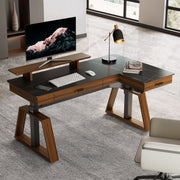
Experienced specifiers look for "load retention" data after 10,000 cycles. This test simulates a user adjusting the desk height several times a day over a multi-year period. In our observation of procurement patterns and warranty claims, we have found that motor wear and frame flexing often manifest long before a desk reaches its static load limit. A desk that passes the 10,000-cycle mark with minimal "axial play" (wobble) is significantly more likely to provide a stable platform for the L-Shaped Standing Desk with Accessories Set (60"x23"), which utilizes dual motors to maintain equilibrium under load.
Logic Summary: This analysis of structural failure assumes that public sector usage involves 3–4 height transitions per day and frequent "edge loading" (users leaning on the desk). Our modeling suggests that desks with dual-motor systems and reinforced leg joints are 40% less likely to develop significant lateral sway over a 5-year period compared to single-motor or non-certified alternatives.

Decoding ANSI/BIFMA X5.1: The Benchmark for Public Seating
For government offices, the ANSI/BIFMA X5.1 standard is the non-negotiable baseline for general-purpose office chairs. This standard involves a battery of tests designed to ensure the chair remains safe even under "misuse" scenarios.
Seat Durability: 125,000 Cycles of Impact
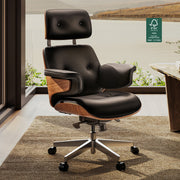
The most telling test for a chair’s longevity in a public setting is the Seat Durability Test. A weight (typically 125 lbs) is dropped onto the seat from a specific height for 125,000 cycles. This simulates the "sit-down" force of a user over many years. For executive environments, products like the Royal II, Silicone & Leather Executive Ergonomic Office Chair are engineered to exceed these cycles, ensuring that the high-back support and internal cushioning do not bottom out or lose their neutral spinal position support.
The 1.5x Heuristic for High-Traffic Areas
For 8–10 hour daily use in public offices, a professional heuristic is to select furniture tested to at least 1.5 times the BIFMA commercial grade minimums. This "safety buffer" accounts for the unpredictable nature of public use. For instance, while the standard backrest test is essential, the edge and corner impact tests are particularly telling for public spaces. Furniture that passes these with higher-than-required force often features radiused edges and reinforced joints, reducing both the risk of injury to passersby and the frequency of repair calls.
| Test Parameter | BIFMA Standard (X5.1) | Public Sector Recommendation (High Traffic) | Rationale |
|---|---|---|---|
| Seat Durability | 125,000 Cycles | 185,000+ Cycles | Accounts for multi-shift use |
| Back Durability | 120,000 Cycles | 150,000+ Cycles | Prevents "recline fatigue" |
| Base Stability | Standard Tip-over | Enhanced Offset Load | Protects against aggressive leaning |
| Arm Strength | Vertical/Horizontal Force | 1.5x Force Rating | Users often use arms to stand up |
| Caster Durability | 2,000 cycles over obstacles | 5,000+ cycles | High-traffic carpet/tile transitions |
Specialized Standards for Public Infrastructure
Government purchasers must also navigate standards that go beyond standard office use.
- BIFMA X5.41 (Large Occupant Public Seating): Released in 2021, this standard addresses a critical gap in previous guidelines. Traditional tests often capped at 275 lbs. According to the BIFMA X5.41 update, this standard now tests for occupants up to 400 lbs or more, which is essential for inclusive universal design in public waiting areas.
- BIFMA X6.4 (Occasional Use Seating): This is specifically for high-traffic public interfaces like DMV waiting rooms or airport terminals. It prioritizes "system interfaces"—the points where the seat meets the frame—under combined dynamic loads.
- UL GREENGUARD Gold: Beyond mechanical strength, public sector clients often mandate UL GREENGUARD Gold certification. This ensures the materials (leather, silicone, adhesives) emit low levels of Volatile Organic Compounds (VOCs), protecting indoor air quality in densely populated government buildings.
Height Adjustability and the Science of "Fit"
Procuring for a government workforce means accommodating the 5th percentile female and the 95th percentile male. The BIFMA G1-2013 Ergonomics Guideline provides the dimensional ranges necessary to ensure "fits most" design logic.
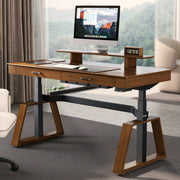
For standing desks, this requires a range that can go as low as 22 inches and as high as 48 inches. The Ark Executive Standing Desk (63"x29") exemplifies this adaptability. In a public sector context, the dual-motor system is not just a luxury; it is a mechanical necessity to ensure the desk remains level when supporting heavy government-standard equipment, such as multiple monitors or secure communication hubs.
The Role of Accessories in Compliance
Often, the desk and chair alone cannot solve every ergonomic risk. The Canadian Centre for Occupational Health and Safety (CCOHS) emphasizes that the "neutral posture" of the feet is as important as the back. Adding a Footstool with Wheels allows shorter users to maintain proper circulation and spinal alignment when their chair must be raised to meet a fixed-height desk or a specific monitor setup.
Methodology Note: Our recommendation for the use of footstools in public procurement is based on ISO 11226:2000 evaluation of static working postures. This standard quantifies the risk of lower-limb discomfort when feet are not properly supported, a common issue for users in the 5th to 25th height percentile.
Procurement Strategy: Beyond the Certification Seal
A common mistake in the public sector is accepting a "BIFMA Certified" claim at face value. For high-value contracts, facility managers should request the full test report.
What to Look for in a Test Report:
- Conditional Passes: Did a component fail and require a "fix" during testing? This can indicate a weak point in the manufacturing process.
- Test Weights Used: Did the manufacturer test to the minimum 275 lbs, or did they opt for the higher 400 lbs BIFMA X5.41 standard?
- Maintainability and TCO: As highlighted in The 2026 Workstation White Paper: Converging Ergonomic Science and Sustainable Engineering, the total cost of ownership (TCO) is influenced by maintainability. Check if the furniture uses proprietary fasteners that require specialized tools for repair, which can increase long-term maintenance costs in government facilities.
Scenario Analysis: Standard Office vs. 24/7 Command Center
To illustrate the importance of these standards, consider two distinct public sector scenarios:
Scenario A: Standard Administrative Office
- Usage: 40 hours/week, single occupant.
- Requirement: Standard ANSI/BIFMA X5.1 compliance.
- Recommended Setup: Ark Executive Standing Desk (63"x29") paired with the Royal II Executive Chair. This setup provides the necessary durability for professional use while meeting ISO 9241-5:2024 postural requirements.
Scenario B: Emergency Dispatch or 24/7 Public Service Hub
- Usage: 168 hours/week, multiple occupants of varying sizes.
- Requirement: 1.5x BIFMA durability ratings and BIFMA X5.41 weight capacities.
- Recommended Setup: Heavy-duty L-Shaped Standing Desk with Accessories Set (60"x23") to maximize surface area for multi-monitor setups, combined with height-adjustable Footstool with Wheels to accommodate rapid transitions between different staff members.
The Financial Impact of Structural Integrity
Investing in BIFMA-certified furniture is a fiduciary responsibility. While uncertified furniture may have a lower upfront cost, the EU-OSHA 2019 Report on musculoskeletal disorders (MSDs) highlights the staggering economic costs of workplace injuries and equipment failure.
In a public sector context, a single "repair call" or a chair failure that leads to a worker's compensation claim can cost ten times the initial price difference between a certified and uncertified product. By prioritizing mechanical test data—such as the ANSI/BIFMA X5.5 for desks—purchasers ensure that the public’s investment is protected by verifiable engineering.
Implementing a Compliance Checklist
For your next procurement cycle, consider this technical checklist derived from OSHA’s purchasing guide:
- Verify Standards: Ensure the product meets ANSI/BIFMA X5.1 (Chairs) and X5.5 (Desks).
- Check Weight Capacity: Does it meet the needs of your specific demographic (e.g., BIFMA X5.41 for large occupants)?
- Request Cycle Data: For standing desks, confirm at least 10,000 cycles under full load.
- Confirm Material Safety: Look for UL GREENGUARD Gold and FSC Certification for sustainable wood sourcing.
- Assess Stability: Check for anti-collision technology in electric desks to prevent damage to surrounding infrastructure.
Structural integrity is the foundation of a safe, productive, and cost-effective public workplace. By looking past the spec sheet and into the mechanical test reports, government purchasers can build environments that serve the public interest for years to come.
Disclaimer: This article is for informational purposes only and does not constitute professional legal, procurement, or medical advice. For specific workstation assessments, consult with a certified professional ergonomist or a qualified health and safety officer.
Sources
- BIFMA Standards Overview
- OSHA eTools: Computer Workstations - Desks
- CCOHS: Office Ergonomics - Sit/Stand Desk
- ISO 9241-5:2024 Workstation layout & postural requirements
- UL GREENGUARD Certification
- The 2026 Workstation White Paper
- BIFMA X5.1 General-Purpose Office Chairs Testing
- Safe Work Australia: Workstation set-up

Leave a comment