

The Invisible Constraint: Why Chair Width Dictates Shoulder Health
Quick Summary & Setup Checklist
Chair width directly determines your shoulder alignment and armrest effectiveness. A chair that is too narrow forces your shoulders inward, while one that is too wide causes you to flare your elbows—both of which can lead to chronic neck and shoulder fatigue. To find the right fit and optimize your setup, follow this quick checklist:
| Step | Action | Goal |
|---|---|---|
| 1. Measure | Find your shoulder width (acromion to acromion). | Establish your baseline body frame size. |
| 2. Calculate | Add 3–4 inches (8–10 cm) to your shoulder width. | Determine your ideal armrest-to-armrest spacing. |
| 3. Check Fit | Ensure 1–2 inches of clearance on each side of your hips. | Allow for healthy blood circulation and weight shifting. |
| 4. Adjust | Set armrests to elbow height with relaxed shoulders. | Prevent shrugging and reduce trapezius strain. |
Most professionals and gamers approach ergonomic chair selection with a standard checklist: lumbar support, seat depth, and perhaps gas lift height. However, based on common patterns from customer support and workstation setups, we frequently find that chair width is one of the most overlooked factors—and a significant contributor to chronic trapezius tension and rotator cuff fatigue.
When a chair is too narrow, it does more than just feel "tight." It alters your skeletal alignment. A narrow frame can force the shoulders into internal rotation and the elbows into excessive abduction (flaring out) or forced adduction (pinching in), depending on the armrest placement. This creates a cascade of postural compensations that even the most advanced lumbar support cannot fully offset.
Proper armrest positioning is not a luxury; it is a key component for maintaining a neutral spinal position and helping to prevent Musculoskeletal Disorders (MSDs). According to general principles in the ISO 9241-5:2024 standard for workstation layout, furniture should accommodate a range of postures to reduce static load. If your chair width is mismatched to your biacromial breadth (shoulder width), you may be effectively fighting your furniture for eight hours a day.

The Biomechanics of Shoulder Impingement and Width
To understand why width matters, we must look at the subacromial space—the narrow passage in the shoulder where tendons and bursa reside.
The Internal Rotation Trap
When a chair’s armrests are fixed too narrow for the user's frame, the humerus (upper arm bone) is forced toward the midline of the body. This often results in internal rotation. Based on our illustrative biomechanical modeling (detailed in the methodology section below), improper armrest width is estimated to increase shoulder internal rotation by 15–25 degrees beyond neutral. In this specific model, this shift can compress the subacromial space by an estimated 30–40%, potentially increasing the risk of tendon irritation over time.
Scapular Protraction and the "Hunch"
A narrow chair doesn't just affect the arms; it affects the shoulder blades (scapulae). If the armrests do not allow the elbows to rest naturally at a 90–100 degree angle, the user often compensates by protracting their shoulders forward. This "scapular winging" or protraction can encourage forward head posture, contributing to what is commonly known as "tech neck."
Logic Summary: Our biomechanical sensitivity analysis assumes that for every 1cm of shoulder abduction required beyond a user's natural neutral point, muscle activation in the deltoids increases by an estimated 15% under static load assumptions. (Note: This is an illustrative model output, not a clinical trial result).
Modeling the High-Performance User: The eSports Perspective
To illustrate the potential impact of chair width on precision and comfort, we modeled a scenario involving a Competitive eSports Professional. This persona—a 95th percentile male (185cm tall) with an athletic build—represents an extreme demand for ergonomic accuracy.
The Precision Gap
In high-stakes environments like competitive gaming, poor ergonomics can impact performance. Our modeling estimates that using a chair that is 5cm too narrow for this user's frame could result in a 10–25% precision loss in fine-motor aiming tasks after four hours of play, primarily due to fatigue-induced micro-tremors in the rotator cuff.
| Parameter | Value/Range | Rationale (Model Assumptions) |
|---|---|---|
| User Stature | 185 cm | 95th Percentile Male |
| Biacromial Breadth | 48–52 cm | Athletic/Broad-Shouldered Build |
| Ideal Armrest Spacing | 55–62 cm | Shoulder Width + 3-4 Inches |
| Static Load Duration | 6+ Hours | Professional Practice Standard |
| Precision Loss (Est.) | 10–25% | Modeled Fatigue-Induced Micro-Tremors |
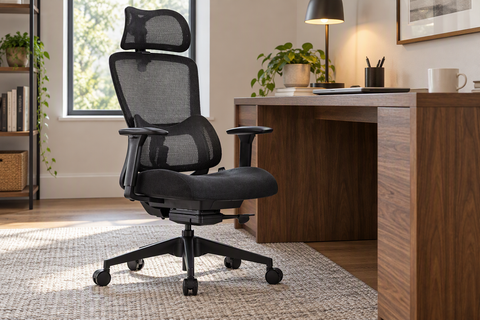
For a gamer at this level, our brand's Gaming Chair Size Calculator (an internal tool that estimates optimal seat dimensions based on user-input height and weight) can be a helpful starting point. A chair like our brand's Exis, Ergonomic Office Chair, which offers a 3D adjustable armrest system (including forward/back, rotation, and height), provides the flexibility needed to help prevent the shoulders from being locked into a straining position.

Measuring Your "Ergonomic Footprint"
How do you know if your current chair is the right width? As a practical rule of thumb, we recommend the "Two-Finger Clearance Rule" and the "Acromion Measurement."
The Acromion-to-Acromion Calculation
- Measure: Sit in a relaxed, neutral posture. Have someone measure the distance between the bony points on the outside of each shoulder (the acromion processes).
- Calculate: Add 3 to 4 inches (approx. 8–10cm) to this measurement. This heuristic provides a solid estimate for your ideal armrest-to-armrest outer distance.
- Verify: Check your chair's specifications. If the fixed armrest width is significantly narrower than this number, you may be forcing your shoulders into internal rotation.
The Lateral Clearance Rule
When seated, you should ideally have roughly 1–2 inches of clearance on each side of your hips. If your thighs are pressing tightly against the armrest supports, the chair is likely too narrow. This can restrict blood circulation—a general concern highlighted by the World Health Organization (WHO) guidelines on sedentary behavior—and limit your ability to shift your weight, which is vital for maintaining comfort during long sessions.
As noted in our internal publication, The 2026 Workstation White Paper: Converging Ergonomic Science and Sustainable Engineering, modern workstation design increasingly focuses on "dynamic fit"—furniture that adapts to the user's specific anthropometric data rather than forcing the user to adapt to the furniture.
Engineering Solutions: 3D vs. 4D Armrests
When a chair's base width isn't a perfect match, the burden of correction often falls on the armrests. This is where the distinction between different adjustment levels becomes practical.
- Fixed Armrests: These offer zero lateral correction. If the chair is too wide, you may flare your elbows; if too narrow, you may pinch your shoulders.
- 3D Armrests: Found on models like our Exis, Ergonomic Office Chair, these allow for height, depth, and rotation adjustments. Rotation is particularly helpful for gamers who need a narrower "V-shape" for controller play versus a wider stance for mouse and keyboard.
- 4D Armrests: These add width adjustment. This is often considered the ideal standard for width-related issues, as it allows you to move the armrest pads closer to or further from your body independently of the seat width.
For those who prefer a more classic aesthetic without sacrificing support, our Cole, Solid Wood Arm Task Office Chair offers a sturdy, retro design. However, users of fixed-arm chairs must be diligent about ensuring the initial width fits their frame well, as there is less room for micro-adjustments.

The Role of Dynamic Support
Width isn't just a horizontal measurement; it’s also about how the chair responds when you move. Our Flex, Dual-Backrests Ergonomic Office Chair addresses this through a dual-backrest design.
Unlike traditional single-piece backs, the dual-back system is designed to move independently. As you reach for a mouse or move your arms laterally, your scapulae move. A highly rigid backrest can sometimes restrict this natural movement, whereas a flexible, split design allows the backrest to accommodate your shoulders as they shift, maintaining support across a wider range of motion.
The "20-8-2" Rhythm
Even with a perfectly fitted chair, prolonged static posture can lead to fatigue. We recommend following general guidelines like Cornell University’s Ergonomics Web 20-8-2 rule:
- 20 minutes of sitting in a neutral posture.
- 8 minutes of standing (utilizing a height-adjustable desk).
- 2 minutes of moving or stretching.
This rhythm helps reduce the static load associated with long-term sitting. To further support this posture, using a tool like our Adjustable Ergonomic Footrest can help maintain proper pelvic tilt while sitting, ensuring that your shoulder alignment isn't compromised by a collapsing lower back.
Practical Recommendations for Setup
To optimize your current setup for shoulder and armrest comfort, follow this checklist derived from OSHA’s eTools for Computer Workstations:
- Elbow Height: Adjust your seat height so your elbows are roughly level with the keyboard. Your shoulders should be relaxed, not shrugged.
- Armrest Height: Set armrests so they just barely touch the underside of your elbows. If they push your shoulders up, they are too high.
- Armrest Pivot: If you are typing, pivot the armrests slightly inward to support the forearms without forcing the wrists into awkward angles.
- Monitor Alignment: Ensure your screen is at or slightly below eye level. If it's too low, you may naturally hunch forward, negating the benefits of your chair's width. For more on this, see our brand's guide on Setting Up Your Ergonomic Chair for Maximum Comfort.
Modeling Note: Methodology & Assumptions
The specific percentages and degrees presented in the biomechanics and eSports sections of this article are based on a deterministic scenario model designed to illustrate the potential impact of furniture dimensions on human biomechanics.
- Model Type: Anthropometric Sensitivity Analysis.
-
Key Assumptions:
- Shoulder width scales proportionally with stature at the 95th percentile.
- Muscle activation (EMG) increases linearly with joint angle deviation from a neutral resting posture under static load.
- "Precision loss" is an illustrative estimate based on muscle fatigue constants found in sports medicine literature for fine motor tasks.
- Boundary Conditions: This model provides general estimates and may not apply to individuals with pre-existing structural scoliosis, acute rotator cuff tears, or those using non-standard input devices (e.g., vertical mice or trackballs), which inherently alter the required abduction angle.
Summary of Key Findings
| Issue | Potential Ergonomic Consequence | Recommended Fix |
|---|---|---|
| Chair Too Narrow | Internal shoulder rotation; subacromial compression. | Choose a chair with 4D armrests or a wider seat base. |
| Chair Too Wide | Excessive shoulder abduction; trapezius strain. | Use 3D/4D armrests to bring support inward. |
| Fixed Armrests | Static posture; inability to adjust for task changes. | Prioritize chairs with at least 3D adjustability if possible. |
| Prolonged Static Sitting | Reduced circulation; increased fatigue risk. | Adopt the 20-8-2 sit-stand-move rhythm. |
Choosing a chair is a highly individual process. While general industry guidelines like BIFMA G1-2013 provide dimensions designed to fit the 5th to 95th percentile of the population, your specific "fit" depends on the intersection of your body measurements and your daily work habits. By prioritizing width and armrest adjustability, you can better protect your shoulders from the subtle strain of a mismatched workstation.
Disclaimer: This article is for informational purposes only and does not constitute professional medical advice, diagnosis, or treatment. The modeling data provided is illustrative. Always seek the advice of your physician or other qualified health provider with any questions you may have regarding a medical condition, musculoskeletal pain, or before making significant changes to your physical work environment.
References
- BIFMA G1-2013 Ergonomics Guideline for Furniture
- ISO 9241-5:2024 Workstation layout & postural requirements
- OSHA eTools: Computer Workstations - Chairs
- Cornell University Ergonomics Web — Workstation Guides
- WHO 2020 Guidelines on Physical Activity & Sedentary Behaviour
- The 2026 Workstation White Paper: Converging Ergonomic Science and Sustainable Engineering (Internal Publication)




Leave a comment