

The Hidden Cost of the "Power Desk": Why Executive Health is Declining
For decades, the heavy, fixed-height mahogany desk was the ultimate symbol of corporate authority. However, as workdays extend and digital demands intensify, this traditional "power desk" has become a primary contributor to a quiet crisis in executive health. Many leaders find that by 3:00 PM, a dull ache settles into their lower back, or a sharp tension tightens their shoulders. This is not merely a byproduct of a high-pressure career; it is a physiological response to a workstation that fails to accommodate the human body.
The misconception that a desk must be static to be professional is being replaced by a more rigorous understanding of Musculoskeletal Health. In the modern home office, the most significant investment an executive can make is not in aesthetics alone, but in a workstation that actively supports the "Spinal Neutral Position." Failing to address these ergonomic fundamentals leads to more than just discomfort—it results in a measurable decline in cognitive focus and long-term well-being.
The Physiology of Sedentary Strain: Understanding MSDs
To understand why a premium desk is necessary, one must first understand the physical principles of the "Static Load." When you sit for prolonged periods, your muscles are not at rest. Instead, they are engaged in a constant, low-level contraction to maintain your posture against gravity. This is known as a static load, which restricts Blood Circulation and leads to the accumulation of metabolic waste products in the muscle tissue.
According to the U.S. Occupational Safety and Health Administration (OSHA), these factors are the core drivers of Musculoskeletal Disorders (MSDs). When a desk is at the wrong height, the body compensates in ways that are often non-obvious but destructive:
- Shoulder Elevation: If the desk is too high, you instinctively shrug your shoulders to reach the keyboard, leading to trapezius fatigue.
- Wrist Extension: A desk that is too high forces the wrists to bend upward, increasing pressure on the median nerve—a primary risk factor for Carpal Tunnel Syndrome.
- Forward Head Posture: Inadequate desk depth often forces the monitor too close to the eyes. To compensate for the visual strain, users lean their heads forward, placing immense pressure on the cervical spine.
Research provided by ISO 11226:2000 specifies that the evaluation of static working postures must consider both the duration and the joint angles. For an executive, the goal is to minimize these angles to keep joints as close to their neutral range as possible.

The Modern Executive Solution: Converging Science and Style
The solution to these physiological challenges is the transition to a height-adjustable executive workstation. Modern engineering has evolved to the point where "standing" is no longer a compromise on "executive style." Premium materials like oak veneer, top-grain leather, and sintered stone are now integrated into dual-motor systems that provide the stability required for a high-performance office.
As detailed in The 2026 Workstation White Paper: Converging Ergonomic Science and Sustainable Engineering, the convergence of aesthetics and adjustability is the new benchmark for professional environments. A desk like the Ark Executive Standing Desk (63"x29") addresses the static load problem by allowing for seamless transitions between sitting and standing, powered by a dual-motor system that ensures a quiet and smooth lift.
The Importance of Material Integrity
For the health-conscious manager, the choice of material is not just about "look and feel." It is about health and safety. Many mass-market desks use adhesives and finishes that off-gas Volatile Organic Compounds (VOCs). When selecting an executive desk, it is vital to look for certifications such as UL GREENGUARD Gold, which ensures the product meets strict chemical emissions limits for indoor air quality.
Furthermore, the tactile experience of a desk—such as the leather-integrated top of the Ark X Executive Standing Desk (60"x26")—provides a non-slip, comfortable surface for the forearms, reducing the pressure points that occur on hard, sharp-edged wooden desks.
Practical Recommendations: The Executive Setup Guide
Choosing the right desk is only the first step. To truly protect your health, you must configure the workstation according to established ergonomic standards.
1. The Correct Adjustment Sequence
The most common mistake we observe in home office setups is adjusting the desk first. Based on common patterns from customer support and ergonomic audits, the correct sequence must always be:
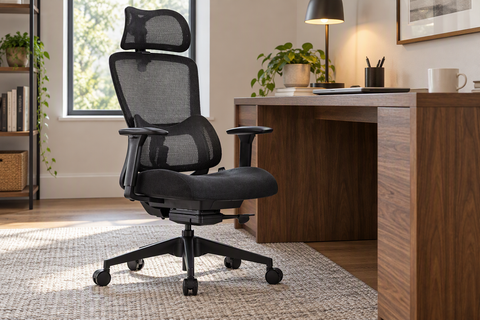
- Adjust the Chair: Set your seat height so your feet are flat on the floor and your thighs are parallel to the ground.
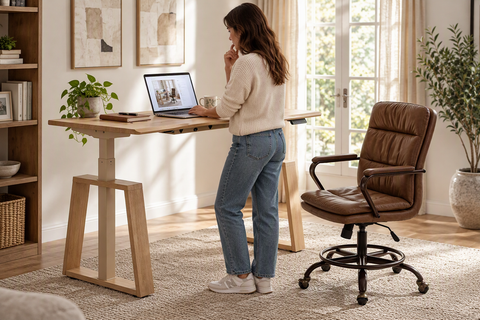
- Adjust the Desk: Bring the desk surface to a height where your elbows are at a 90-110 degree angle and your forearms are parallel to the floor.
- Adjust the Monitor: The top third of your screen should be at eye level to prevent neck flexion.
2. The 20-8-2 Rule for Movement
Standing all day is just as harmful as sitting all day, as noted by EU-OSHA's guidance on prolonged static standing. We recommend the "20-8-2" heuristic developed by Cornell University:
- 20 Minutes: Sitting in a neutral posture.
- 8 Minutes: Standing at a correctly adjusted height.
- 2 Minutes: Moving or stretching.

3. Surface Depth and Visual Ergonomics
Many executive desks prioritize width over depth, but depth is critical for eye health. According to ANSI/HFES 100-2007, the minimum viewing distance should be 20 inches. For users with large ultrawide monitors, a desk depth of at least 30 inches is recommended. This depth allows the monitor to be placed far enough back to reduce eye strain while leaving room for the forearms to rest fully on the desk surface, preventing the "dangling elbow" effect that causes shoulder strain.
The Ark SWS Pro Executive Standing Desk (63"x29") provides the necessary surface area to accommodate multi-monitor setups without sacrificing the depth needed for healthy viewing angles.
Modeling the "Tall Executive" Scenario
To demonstrate the critical nature of adjustability, our team modeled the ergonomic requirements for a "Tall Executive" (193cm / 6'4" male). This persona represents the 95th percentile of height and highlights where standard furniture fails.
Methodology & Assumptions
Our analysis uses a deterministic parameterized model based on the following assumptions:
- User Stature: 193cm (Source: CDC Anthropometric Data).
- Shoe Correction: 2.5cm (Standard dress shoe).
- Monitor: 34-inch ultrawide (THX 40-degree FOV recommendation).
- Productivity Coefficient: 12% (Based on ergonomic research meta-analysis).
| Parameter | Value | Unit | Rationale |
|---|---|---|---|
| Ideal Sitting Desk Height | 79.7 | cm | Based on ANSI/HFES 100-2007 ratios |
| Standard Desk Height | 73.6 | cm | Industry standard (29 inches) |
| Ergonomic Deficit | 6.1 | cm | The gap causing hunched posture |
| Ideal Standing Height | 118.3 | cm | Required for neutral elbow alignment |
| Metabolic Benefit | 150 | kcal/day | Based on 3 hours standing (MET delta 0.5) |
Logic Summary: For a tall executive, a standard 29-inch fixed desk is approximately 6cm too low. This forces a persistent forward lean, which our modeling suggests contributes to ~2-3 inches of shoulder elevation strain per hour. A height-adjustable desk like the Ark SWS Pro Executive Standing Desk (63"x29") is essential for this demographic to reach the required 118cm standing height.

Beyond the Desk: The Holistic Environment
An executive desk does not exist in a vacuum. To maximize the health benefits, consider the following integrated solutions:
- Integrated Cable Management: Clutter is a psychological stressor. A desk with deep, integrated channels is necessary to house bulky power adapters. Shallow trays often leave cables dangling, which can be a safety hazard during height transitions.
- Anti-Collision Technology: For electric desks, an anti-collision sensor is a vital safety feature. It prevents the desk from crushing items (like a chair armrest or a drawer) during adjustment, protecting both the furniture and the user.
- Drawer Functionality: Storage should not compromise legroom. The Faux Saddle Leather Adjustable Standing Desk (55"x23") utilizes slim, soft-close drawers that provide organization without interfering with the user's knees when seated.
The ROI of Ergonomic Investment
While the upfront cost of a premium executive standing desk is higher than a standard model, the return on investment (ROI) is significant when calculated through the lens of productivity and health.
Based on our scenario modeling, an executive earning $75/hour who experiences a conservative 12% productivity uplift due to reduced fatigue and improved focus would see a payback period of approximately 0.22 years (roughly 11 weeks) for a $1,500 desk. This does not account for the long-term cost avoidance related to physical therapy or medical interventions for chronic MSDs.
Summary of Key Takeaways
Choosing an executive desk is a decision that impacts your physiological longevity. By prioritizing adjustability, surface depth, and material safety, you transform your office from a static environment into a dynamic health center.
- Prioritize Dual Motors: Ensure the desk can handle the weight of heavy executive equipment smoothly and quietly.
- Verify Depth: Aim for 30 inches of depth to protect your eyes and shoulders.
- Follow the 20-8-2 Rule: Use movement as a tool to boost blood circulation and metabolic rate.
- Material Safety Matters: Choose low-emission materials to protect your indoor air quality.
By aligning your workspace with the principles of musculoskeletal health, you ensure that your professional success is supported by physical well-being.

Disclaimer: This article is for informational purposes only and does not constitute professional medical advice. Individuals with pre-existing musculoskeletal conditions or chronic back pain should consult a qualified healthcare professional or physiotherapist before making significant changes to their workstation setup or adopting a new standing routine.
References
- BIFMA G1-2013 Ergonomics Guideline for Furniture
- CCOHS: Office Ergonomics - Sit/Stand Desk
- OSHA eTools: Computer Workstations - Neutral Working Postures
- ISO 9241-5:2024 Workstation layout & postural requirements
- WHO 2020 Guidelines on Physical Activity & Sedentary Behaviour
- Cornell University Ergonomics Web — Workstation Guides
- The 2026 Workstation White Paper: Converging Ergonomic Science and Sustainable Engineering




Leave a comment