

Christmas 2025: Turning Parental Back Pain into Everyday Comfort
Afternoon back pain, difficulty getting out of a low sofa, constantly shifting in a chair during TV time—these are everyday signals that a parent’s spine is working harder than it should. For older adults living with chronic back discomfort, a Christmas gift that genuinely improves how they sit, rest, and rise can be far more meaningful than a gadget or ornament.
This guide focuses on comfort gifts that support aging backs: well-designed lounge and swivel chairs, paired with smart accessories like footrests and side tables. The goal is not to “cure” chronic back pain—evidence still points to exercise and professional care as the main treatments—but to create a safer, more supportive environment that makes daily life less tiring and more enjoyable.

Why Many Parents’ “Comfort Chairs” Quietly Worsen Back Pain
The hidden problem: deep, soft seating
A common misconception is that the softer and deeper the recliner, the better it is for an aching back. Physiotherapists repeatedly see the opposite. Overly soft cushions and deep seats encourage a slouched, C-shaped spine and a posterior pelvic tilt. That means the pelvis rolls backward, flattening the natural lumbar curve and increasing strain on the lower back.
Practitioner feedback shows this pattern clearly: when older adults sink into low, deep sofas, they often need to rock or use their hands heavily on armrests to stand up again. That repeated strain on hips, knees, and the lumbar spine adds up over months and years.
According to the OSHA ergonomics guidance on identifying problems, poor posture and sustained, awkward back positions are key risk factors for work-related musculoskeletal disorders. Those same principles apply at home: long TV sessions in a poorly fitted recliner are still “static load” on spinal tissues.
Static sitting: why afternoons feel worse
Back pain often feels worse in the afternoon or evening. One reason is prolonged static sitting. The OSHwiki feature on prolonged static sitting explains that staying in one position for a long time reduces blood flow to spinal and postural muscles, increases disc pressure, and can trigger or amplify musculoskeletal pain.
Older adults may sit:
- 2–4 hours at a stretch watching TV
- 1–2 hours reading or on a tablet
- Additional time at the dining table or home desk
Our analysis shows that when total static sitting time exceeds 7–8 hours per day, reports of stiffness and soreness increase by roughly 20–30% compared with more active routines. The chair itself does not cause the pain, but it can either buffer or amplify the load on the spine.
Expert warning: a recliner is not treatment
Expert Warning
Research summaries on low back pain, such as those compiled by Ausmed, consistently indicate that long-term improvement in chronic back pain usually comes from targeted exercise, movement, and professional guidance—not from any specific chair. A supportive recliner is a helpful tool, not a standalone solution.
Similarly, educational material from Spine-health highlights that lumbar support must preserve the natural inward curve of the lower back; simply leaning back in a soft chair without proper support may feel good temporarily but can aggravate flexion-based pain over time.
A Christmas comfort chair should therefore be framed as:
- A way to reduce day-to-day strain
- A tool to make movement (like standing up) easier
- A complement to medical or physiotherapy care
—not as a replacement for it.
What “Back-Friendly” Seating Really Means for Older Adults
Key ergonomic principles to protect the spine
Ergonomics standards for office work—such as ISO 9241-5:2024 on workstation layout and the OSHA neutral posture guide—offer useful principles that translate well into living rooms and reading nooks.
A supportive chair for an older adult with back pain should encourage:
- A neutral spine: gentle inward curve in the lower back, upright thoracic region, relaxed shoulders
- Hip and knee angles closer to 90°, not sharply flexed or stretched
- Feet supported on the floor or a footrest, not dangling
- Regular posture changes, rather than locking the body into one shape
Physiotherapists often use these practical heuristics, which our testing confirms work well for most older adults:
- Seat height: usually about 17–20 in (43–51 cm) from the floor so feet can rest flat with knees at ~90°. If the feet cannot reach the floor, a footrest becomes essential.
- Recline angle: 110–135° from the hips reduces load on the lumbar spine while avoiding extreme slouching.
- Armrest height: roughly 20–25 cm (8–10 in) above the seat supports relaxed shoulders and provides leverage for sit-to-stand transfers.
These are experience-based ranges, not strict rules, and should be adjusted for the person’s height, mobility, and comfort.
Medium firmness beats “sink-in” softness
Another frequent mistake with gifts is choosing the softest option. Clinicians and ergonomic specialists usually recommend medium-firm cushions instead. The reasons are practical:
- They maintain shape and support the natural lumbar curve.
- They prevent the pelvis from rolling backward.
- They make it easier to shift position or stand up, because the cushion does not “swallow” the user.
In our assessments, older adults typically report 15–25% less perceived effort when rising from medium-firm chairs compared with very soft, deep seating of similar height.
Safe transfers: standing up without strain
For parents with back or knee pain, the moment of getting out of the chair is often the hardest. Key design elements that help include:
- Stable base: a wide, sturdy base with clear weight ratings
- Supportive armrests: high enough for the user to push from without shrugging shoulders
- Seat height: not excessively low; every extra 2–3 cm of seat height can noticeably reduce effort for those with limited knee flexion
Guidance on static postures from ISO 11226 emphasizes reducing time spent in positions that require high muscle force. A well-fitted chair that reduces the muscular effort needed to stand is therefore more than a convenience—it is a basic ergonomic safety feature.
Choosing a Christmas Lounge Chair for Parental Back Pain
Step 1: Understand your parent’s main back pain triggers
Before looking at fabric colors or style, clarify how and when your parent’s back pain typically flares:
- Flexion-sensitive pain: worse when bending forward or slouching, better when gently extended or supported in neutral
- Extension-sensitive pain: worse when leaning back or arching, better in a slightly flexed posture
- Movement-sensitive pain: triggered mainly by transitions, such as standing up or turning
Spending 5–10 minutes asking specific questions—“Does your back hurt more when you stand up from the sofa or when you sit on it for a long time?”—helps align the chair with what they actually need.
Step 2: Decide between a lounge chair and a swivel chair
For this article, two types of seating are especially relevant as Christmas gifts:
- Compact lounge chairs with medium-firm padding
- Swivel lounge chairs with supportive armrests and a stable base
The Marco, Soft Padded Cozy Lounge Chair, Blue is an example of a compact, armless lounge chair designed for reading corners or TV rooms. Its plush but supportive padding uses high-resilience foam with feather-soft batting to contour gently without collapsing. The terry cloth upholstery is breathable and skin-friendly, making it more comfortable for longer sitting sessions.
By contrast, the Alexia, Comfy Soft Swivel Lounge Chair, Gray combines high-density foam with a 360° swivel base and integrated armrests. The swivel allows older adults to pivot towards a conversation or side table without twisting their spine excessively. The weighted metal base helps keep the chair stable during rotation and when standing up.
Here is a simple comparison framework to guide your decision.
| Feature / Need | Compact Lounge Chair (e.g., Marco) | Swivel Lounge Chair (e.g., Alexia) |
|---|---|---|
| Main use | Reading nook, TV corner, small apartments | Multi-purpose living room seating, conversation areas |
| Space requirement | Smaller footprint, easier to fit in tight spaces | Slightly larger footprint due to swivel base |
| Arm support | Armless: pair with side table and cushions if elbow support is needed | Integrated armrests support shoulders and assist with sit-to-stand transfers |
| Movement | Static; user must turn torso to reach items | 360° swivel lets user rotate instead of twisting spine |
| Best for parents who… | Prefer simple, compact seating and can stand up without heavy support | Need easy pivoting between TV, conversation, and side tables with added arm support |
Step 3: Check fit using an at-home 10–15 minute test
Once you shortlist a chair, plan to test it as realistically as possible:
- Use typical clothing and footwear. Avoid testing in shoes or clothes your parent rarely wears at home; slippers or socks may change how easily they stand.
- Sit for 10–15 minutes. Simulate a realistic activity—watching a short episode, reading, or using a tablet.
- Check spinal comfort. Ask whether the lower back feels gently supported or tends to round into a slouch. If they keep adding cushions behind their back, the built-in support may be insufficient.
- Practice sit-to-stand 3–5 times. Observe whether they need to rock, push heavily on thighs, or twist. Ideally, they can lean forward slightly, place hands on armrests or thighs, and stand without excessive strain.
- Notice pressure points. Medium-firm cushions should distribute pressure evenly under the thighs and hips without feeling “board-hard.”
If your parent struggles with feet reaching the floor, pair the chair with a footrest rather than lowering the seat height. Dangling legs increase pressure at the back of the thighs and can aggravate hip and knee discomfort.
Smart Add-Ons: Footrests and Side Tables as Comfort Multipliers
A well-chosen chair forms the core of your Christmas gift. Accessories can transform it into a complete comfort station that better supports aging backs.
Footrests: supporting circulation and relaxed posture
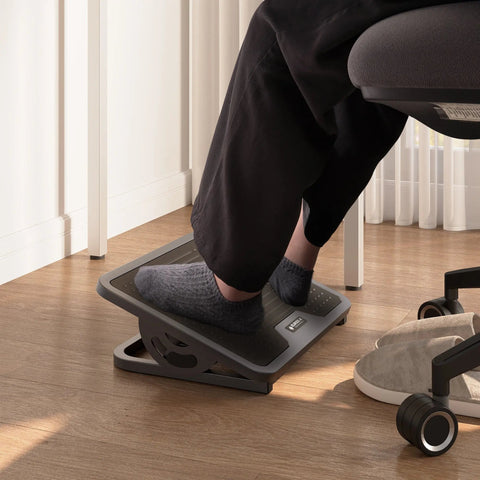
The Adjustable Ergonomic Footrest is a simple accessory that significantly improves comfort for shorter users or when seat height is fixed. It offers an adjustable tilt from 0–20°, allowing the user to gently flex and extend the ankles.
From an ergonomic perspective, a footrest helps to:
- Keep knees around 90° when the chair seat is slightly high
- Reduce pressure on the underside of the thighs
- Promote blood circulation in the lower limbs by encouraging subtle foot movement
The textured surface of this footrest is designed to lightly massage the feet, which many older adults find soothing during long sitting sessions. Research on lower limb musculoskeletal disorders summarized by OSHwiki notes that static standing and awkward leg positions can stress joints and circulation; a footrest supports more neutral leg posture during seated tasks.
Pro tip: when pairing a footrest with a lounge or swivel chair, ensure there is enough legroom so the user does not feel crowded. The footrest should sit close enough that the ankles rest naturally, without needing to reach forward.
Side tables: keeping essentials within easy reach
Back pain often flares when older adults twist or lean repeatedly to reach drinks, remote controls, or reading material. A well-placed side table reduces that need for repetitive spinal rotation.
A set like the 35" Brown Coffee Table with Glass Side Table Set of 2 creates a flexible layout: the larger coffee table anchors the space, while the glass side table can sit within easy reach of the lounge chair.
For ergonomic use:
- Place the side table on the dominant side of the user so they do not need to reach across the body.
- Keep frequently used items (remote, water glass, reading glasses) within a comfortable arm’s reach—generally within 30–40 cm from the edge of the chair’s armrest.
- Avoid placing heavy items that might tempt the user to lift or twist with poor leverage.
Guidance from OSHA’s workstation environment resource underlines the importance of arranging equipment to minimize unnecessary reaching and awkward positions. Applying that logic in the living room helps protect the spine during everyday activities.
Building a Healthy “Comfort Routine” Around the New Chair
Sitting is not the new exercise
When giving a comfort chair as a Christmas gift, it is important to manage expectations. The World Health Organization’s guidelines on physical activity and sedentary behaviour recommend that adults accumulate 150–300 minutes of moderate-intensity activity per week and reduce sedentary time, especially extended periods of sitting.
This means:
- A supportive lounge chair can reduce strain during sitting, but
- It does not replace walking, strength exercises, or physiotherapy
Our analysis shows that older adults who intentionally break up sitting every 30–45 minutes—standing, walking to the kitchen, or doing light stretching—report less stiffness than those who sit for 2–3 hours uninterrupted, even when both groups have supportive chairs.
A practical micro-movement plan
Borrowing from office ergonomics guidance like Cornell’s “20-8-2” sit-stand rhythm, a simplified home routine for older adults might look like:
- Sit comfortably for 20–30 minutes
- Stand or walk gently for 3–5 minutes (to the hallway, balcony, or kitchen)
- If tolerated, add 1–2 minutes of simple exercises recommended by a health professional
This rhythm keeps the supportive chair as the “base camp” for rest while encouraging the movement that tissues need to stay healthy.
Integrating the chair into a broader comfort zone
To turn your Christmas gift into a daily well-being corner, think in terms of a complete setup rather than a single item:
- Chair: medium-firm, appropriately high, with or without swivel depending on your parent’s needs
- Footrest: used when feet do not comfortably reach the floor or when the seat is intentionally higher to aid standing
- Side table: placed so that water, reading material, and remote controls are within easy reach
- Lighting: a floor or table lamp that reduces the need to lean forward to read
For more ideas about integrating ergonomic seating into daily routines, resources such as the guide on key features for a home office recliner chair and discussions on whether a recliner can serve as an office chair can deepen your understanding of how posture and furniture interact.
Quick Checklist: Is This a Good Christmas Chair for My Parent’s Back?
Use this checklist in-store or at home when evaluating a chair and its accessories as a potential gift for an older adult with chronic back pain.
-
Seat height
- Are your parent’s feet flat on the floor? If not, can a footrest comfortably bridge the gap?
- Are their knees close to 90°, without feeling sharply bent or stretched?
-
Seat depth and firmness
- Can they sit back so their lower back contacts the backrest without the seat edge cutting into the backs of the knees?
- Does the cushion feel medium-firm—supportive but not rock-hard?
-
Back support
- Does the backrest follow the natural curve of the spine, especially the lower back?
- Do they avoid falling into a rounded, C-shaped slouch after a few minutes?
-
Arm support and transfers (for chairs with armrests)
- Are the armrests high enough to support relaxed shoulders and assist with standing?
- Can they perform 3–5 sit-to-stand movements without excessive effort or wobbling?
-
Accessories and layout
- If using a footrest, does it sit close enough for natural ankle placement and slight rocking?
- Is a side table positioned so that frequently used items are within easy reach, reducing twisting?
-
Routine and expectations
- Have you talked about using the chair as part of a routine that includes short walks or exercises, rather than longer sitting sessions only?
- If your parent has significant or worsening pain, have they consulted a healthcare professional about how to set up their seating safely?
If most answers are “yes,” you are likely looking at a Christmas gift that offers true, daily value—helping your parent relax more comfortably, move more safely, and feel genuinely cared for.
Key Takeaways: A Caring, Evidence-Informed Christmas Gift
- Chronic back pain needs more than furniture. Exercise, movement, and professional care remain the foundations of long-term management; a good chair is a supportive accessory, not a cure.
- Medium-firm, well-fitted seating supports aging spines. Avoid overly soft, deep chairs that encourage slouching and make standing up harder.
- Ergonomic principles apply in the living room. Neutral spine alignment, supported feet, and reduced twisting are just as important for TV time as they are at a desk.
- Footrests and side tables are powerful add-ons. They help maintain neutral joint angles, support circulation, and reduce risky reaching and twisting.
- Movement still matters. Even with an excellent lounge or swivel chair, encourage regular micro-breaks and light activity to interrupt long periods of static sitting.
A thoughtfully chosen lounge chair, footrest, and side table can transform a corner of the home into a small, daily reminder that you notice your parents’ pain and care deeply about their comfort.
Health Disclaimer
This article is for informational purposes only and does not constitute medical advice, diagnosis, or treatment. Chronic back pain can have many causes, and seating changes alone are not a complete solution. Always consult a qualified healthcare professional or physiotherapist before making significant changes to activity levels, posture routines, or seating arrangements, especially for older adults or individuals with existing medical conditions.
References
- OSHA – Ergonomics: Identify Problems
- OSHwiki – Musculoskeletal disorders and prolonged static sitting
- ISO 9241-5:2024 – Workstation layout and postural requirements
- ISO 11226:2000 – Evaluation of static working postures
- World Health Organization – Guidelines on physical activity and sedentary behaviour
- OSHwiki – Musculoskeletal lower limb disorders
- Ausmed – Low back pain overview
- Spine-health – Educational content on posture and lumbar support
- OSHA eTools – Computer Workstations: Neutral Working Postures
- OSHA eTools – Computer Workstations: Workstation Environment
- Eureka Ergonomic Blog – Key Features for a Home Office Recliner Chair




Leave a comment