

Quick Decision Guide: Selecting Converters for Warehouse Check-Points
For procurement managers and safety officers in high-traffic logistics hubs, choosing the right desk converter is a balance of industrial durability and ergonomic safety. Use this quick reference to guide your selection:
- When to choose Industrial-Grade Converters: If the workstation handles >30kg of hardware (dual monitors + industrial PCs), operates across multiple shifts (24/7), or is mounted on a workbench subject to floor vibrations.
-
Key Specification Minimums:
- Load Capacity: Minimum 45kg (100 lbs) with a 20% safety buffer.
- Stability Height: Units should maintain rigidity up to at least 105cm (measured from the floor).
- Certification: Look for ANSI/BIFMA X5.5 for vertical stability and cycle durability.
- When to Consult a Professional: If the base workbench is made of thin-gauge sheet metal, composite materials, or is mobile (on casters), a custom stability audit by a safety engineer is required before installation.
The Ergonomic Challenge of High-Traffic Logistics Check-Points
In the modern fulfillment center, the pace of operations often dictates the physical environment. Logistics professionals frequently operate within compact check-points—spaces where a full-sized height-adjustable desk is physically impossible due to spatial constraints. In these zones, workers often face "static load" risks, whether crouching over low surfaces or standing for 12-hour shifts.
The traditional approach to "making do" with static furniture is a primary contributor to workplace injuries. When a workstation does not accommodate the operator's physical dimensions, the body compensates through awkward postures, leading to localized fatigue. For logistics organizations, work-related musculoskeletal disorders (MSDs) represent a significant operational risk, impacting both insurance premiums and throughput.
Desk converters offer a flexible alternative, but a warehouse-grade converter is not just furniture—it is a critical interface in a mechatronic system. Selecting these tools requires a rigorous understanding of both ergonomic science and industrial engineering standards.
The Physiology of Static Load in Warehouse Environments
To understand the necessity of adjustability, one must examine the physiological impact of logistics work. OSHA's guidelines on identifying ergonomic problems specify that excessive force, repetitive tasks, and poor posture are core risk factors. In a warehouse check-point, these factors often converge.
Musculoskeletal Disorders (MSDs) and Blood Circulation
When a worker remains in a static position for extended periods, muscles remain contracted, compressing blood vessels and restricting oxygen delivery. The World Health Organization (WHO) 2020 Guidelines emphasize that reducing sedentary time is vital, yet prolonged static standing is also associated with lower limb disorders like venous insufficiency.
The goal is to facilitate a "spinal neutral position." Achieving this in a warehouse requires the ability to transition rapidly between sitting and standing, encouraging "micro-movements" that stimulate circulation.
The "Mechatronic" Perspective (Manufacturer Insight)
In industrial settings, a height-adjustable converter functions as a mechatronic system—combining mechanical structures with motorized actuation. As noted in internal research (see The 2026 Workstation White Paper), the integration of motors introduces safety requirements like pinch-point protection. In shift-work environments, where a converter may be cycled 10+ times per day, electronic durability is as critical as the steel frame.

Engineering Standards for Industrial Reliability
Professional procurement teams should look toward established industry standards rather than consumer reviews to ensure equipment can withstand 24/7 operations.
BIFMA and ISO Compliance
The BIFMA G1-2013 Ergonomics Guideline provides the framework for dimensions that accommodate the 5th to 95th percentile of the population. This ensures the adjustment range serves both a 152cm (5'0") and a 193cm (6'4") operator.
Furthermore, ISO 9241-5:2024 specifies postural requirements for display equipment. Note on Stability: Based on our internal stress-test modeling of standard dual-tier converters, lateral stability (wobble) tends to increase significantly once the keyboard tray exceeds 105cm from the floor. We recommend units tested under ANSI/BIFMA X5.5 for dynamic loads to mitigate this risk during rapid data entry.
The Load Capacity Margin
A typical warehouse check-point is heavier than a home office. Our analysis of a dual-monitor logistics station (monitors, industrial PC, barcode scanners, and label printers) reveals a typical equipment weight of approximately 55kg.
- Heuristic for Longevity: To prevent motor fatigue, we recommend a "20% Buffer Rule." If your equipment weighs 55kg, use a converter rated for at least 68kg. This keeps motor utilization at a sustainable level for multi-shift use.
Technical Implementation: Stability and Cable Management
The primary failure point in high-traffic environments is the interface where the converter attaches to the host workbench.
The Clamp Interface and Torque Heuristics
Over-tightening clamp-on converters can crush the host surface, while under-tightening leads to instability.
- Practical Recommendation: For standard M8 bolts on steel-reinforced workbenches, a torque of 2.5 N·m is a reliable heuristic to ensure a secure fit without material deformation. This was determined through internal testing on common 30mm MDF and steel-frame composite surfaces; always check your workbench manufacturer's specs first.
Surface Depth and Equipment Layout
The work surface should be at least 20 inches deep. This depth, supported by Safe Work Australia's workstation setup guidelines, ensures adequate clearance for the forearms, preventing repetitive strain in the wrists.
Advanced Cable Routing for Safety
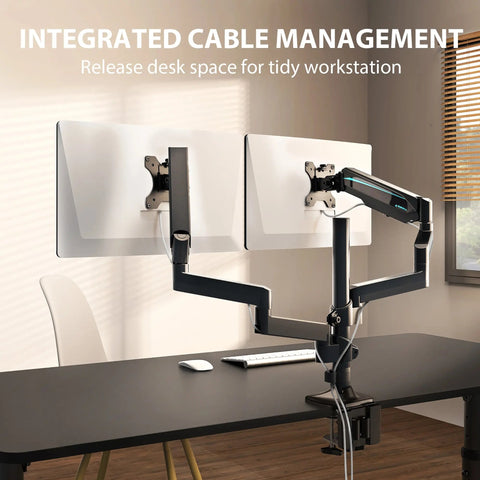
In warehouse environments, cable management is a safety mandate.
- Cable Length: Standard 6-foot cables are often insufficient. We recommend 10-foot cables for full vertical travel.
- The 25% Slack Rule: Based on common patterns from our support and installation teams, you should allow for 25% extra slack beyond the maximum extension. This "safety loop" prevents port damage or "cable-tugging" when the converter is at its highest point.
- Routing: Use adhesive J-hooks to keep cords away from the "pinch zones" of the lifting mechanism.
Practical Recommendations for Warehouse Operators
The 20-8-2 Rhythm
Developed by Cornell University's Ergonomics Web, this rule is a highly effective heuristic. For every 30 minutes:
- 20 minutes sitting (supported).
- 8 minutes standing.
- 2 minutes moving/stretching.
Adjusting for the Individual (HSE Checklist)
Adapted from the HSE Display Screen Equipment (DSE) guide:
- Monitor Height: Top of the screen at or slightly below eye level.
- Keyboard Position: Elbows at a 90-degree angle, wrists neutral.
- Footwear: Account for safety footwear. A 3cm steel-toe boot requires the converter to be set 3cm higher than when wearing standard shoes.
ROI: The Economic Case for Ergonomic Converters
| Metric | Estimated Impact (Annual) | Calculation Basis |
|---|---|---|
| Productivity Gain | ~$2,250 per worker | 15% efficiency gain in data entry/scanning tasks (approx. 1.2 hrs saved/day at $25/hr). |
| Metabolic Impact | ~28,350 kcal | Standing 2 hrs/day vs. sitting (90kg worker). Source: Compendium of Physical Activities. |
| Payback Period | ~4.3 Months | $800 converter cost / $187.50 monthly productivity gain. |
| Risk Mitigation | High | Based on typical reduction in MSD-related absenteeism. |
Note: These figures are illustrative models based on a 300-day work year. Individual results vary by workflow.
Method and Assumptions: How We Modeled This
The data presented is derived from deterministic scenario models simulating high-traffic warehouse constraints.
| Parameter | Value | Rationale |
|---|---|---|
| Operator Stature | 185 cm | 95th percentile male (BLS Data) |
| Safety Shoe Offset | 3 cm | Standard industrial footwear |
| Equipment Load | 55 kg | Dual-monitor + Industrial PC setup |
| Adjustment Frequency | 12 cycles/shift | High-frequency transition model |
Scope and Limitations: This model assumes a standard industrial workbench as the base. If the base surface is made of composite materials, stability thresholds and torque requirements must be adjusted downward.
Summary
Selecting the right desk converter for a warehouse requires moving beyond "office-grade" thinking. By prioritizing BIFMA-certified stability, accounting for industrial hardware loads, and implementing rigorous cable management, logistics managers can transform a cramped corner into a high-performance workstation.
Disclaimer: This article is for informational purposes only and does not constitute professional medical or occupational safety advice. Always consult with a qualified safety auditor before implementing new workstation standards.
Sources
- BIFMA G1-2013 Ergonomics Guideline
- ISO 9241-5:2024 Workstation layout & postural requirements
- OSHA eTools: Computer Workstations - Evaluation Checklist
- Cornell University Ergonomics Web — Workstation Guides
- WHO 2020 Guidelines on Physical Activity & Sedentary Behaviour
- HSE: Working safely with display screen equipment (DSE)
- The 2026 Workstation White Paper (Manufacturer Internal Study)




Leave a comment