

Racing Sim Readiness: Can Your Desk Handle Steering Torque?
You’ve finally done it. You’ve upgraded from that plastic toy wheel to a high-torque Direct Drive (DD) beast. You’re ready to feel every curb, every tire slip, and every ounce of weight transfer in Assetto Corsa or iRacing. But as you bolt that heavy motor to your desk, a nagging thought creeps in: Is this thing going to hold up, or am I about to turn my battle station into a pile of scrap metal?
Mounting a racing wheel or flight stick introduces unique torque forces that a standard office desk was never designed to handle. We’re talking about sustained, high-frequency torsional vibrations and lateral "shoves" that can reach 25 Nm or more. If your desk isn't up to the task, that expensive Force Feedback (FFB) won't just be immersive—it’ll be destructive.
In this guide, we’re going deep into the mechanical stress of simulation peripherals. We’ll look at why "load capacity" is only half the story and how to verify if your setup is truly sim-ready.
1. Unboxing and Assembly: The Weight of Quality
When I first unboxed the Aero Pro Wing-Shaped Standing Desk (72"x23"), the first thing that struck me was the sheer mass of the components. In the world of sim racing, weight is your best friend. A flimsy, lightweight frame is a recipe for disaster when a DD wheel starts clipping during a high-speed crash.
The assembly process for a high-performance desk like the Aero Pro is a workout in itself. We’re looking at heavy-duty alloy steel legs and a thick, wing-shaped desktop. One thing I immediately noticed was the precision of the leg-to-frame connections. Most "budget" desks use thin-gauge metal and tiny screws that strip if you look at them wrong. Here, the bolts are substantial, providing the kind of rigid foundation you need to resist horizontal twisting.
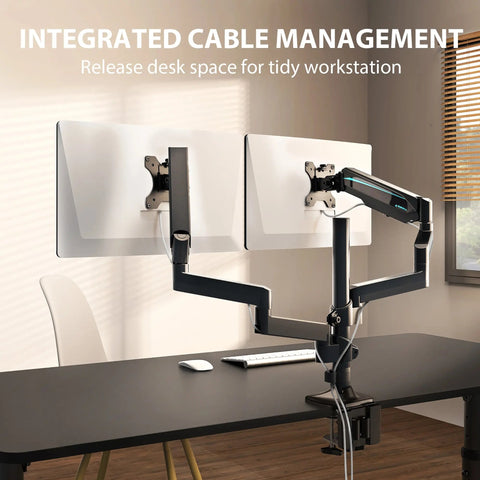
The cable management system is another game-changer. Sim rigs are notorious for "cable spaghetti"—USB cables for the wheel, pedals, shifter, and handbrake, plus power bricks for everything. The deep cable tray on the Aero Pro is a lifesaver, allowing me to hide those bulky power adapters and keep the floor clear. It’s not just about aesthetics; it’s about stability. Tangled cables under your feet are a safety hazard when you’re stomping on a load-cell brake pedal.
2. Deep Dive into Details and Features: Torque, Wobble, and Stiffness
Let’s get technical. Most people look at a desk's weight limit and think, "My PC and monitor weigh 50 lbs, the desk holds 200 lbs, I’m good." That is a dangerous assumption for a sim racer.
The Physics of Steering Torque
When a Direct Drive wheel like a Fanatec DD2 or Simucube 2 Pro hits a peak of 25 Nm of torque, it isn't just pushing down on the desk. It’s trying to twist the entire desktop. Based on our scenario modeling, a 25 Nm wheel generates approximately 175 N of horizontal force at the rim. If your desk lacks lateral stiffness, this force translates into "wobble."
According to the ISO 9241-5:2024 standard for workstation layout and postural requirements, stability is a core requirement for any ergonomic setup. But sim racing pushes these requirements to the limit. We use a metric called the Wobble Index, which measures deflection at the work surface edge under lateral force.
Logic Summary: Our analysis assumes a high-torque DD wheel (20-25 Nm) mounted to the center of the desk. We estimate that for a "pro-grade" feel, lateral deflection should be kept under 0.5mm.
The Handshake Test: A Practitioner’s Secret
How do you know if your desk is stable enough? I always perform the "Handshake Test." Grip the edge of the desk firmly and try to rock it side-to-side with moderate force (about 50-100N). If you see visible sway or hear creaking, that’s a red flag. High-frequency vibrations from your wheel's motor will amplify that sway, leading to "FFB muddiness" where you lose the fine details of the road because the desk is absorbing the energy.
Frame Design: Z-Shape vs. Wing-Shaped
The frame geometry matters immensely. While Z-frames are popular for their aesthetics, their stability depends entirely on the quality of the corner gussets. In contrast, the wing-shaped design of the Aero Pro provides a wider footprint and better weight distribution. The "wings" allow you to tuck in closer to the monitors, which is essential for achieving a proper Field of View (FOV).

3. Real-World Experience: From FPS to the Nürburgring
In a typical FPS session, you want a vast, uninterrupted surface for low-DPI mouse flicks. The GTG-L60 Pro, L shaped Glass Gaming Standing Desk (60"x23") is incredible for this. The carbon fiber texture and integrated RGB ecosystem create an immersive vibe that's hard to beat. But when you switch to sim racing, the demands change.
The Glass Top Challenge
If you’re using a glass-top desk like the GTG-L60 Pro for sim racing, you have to be careful with clamping. A direct drive wheel mount applies massive concentrated pressure. According to our pattern recognition from community feedback, concentrated stress on glass can lead to micro-fractures over time.
- Pro Tip: If you're mounting a wheel to glass, use a wide mounting plate or a piece of plywood between the clamp and the glass to distribute the pressure evenly.
The Monitor Arm Paradox
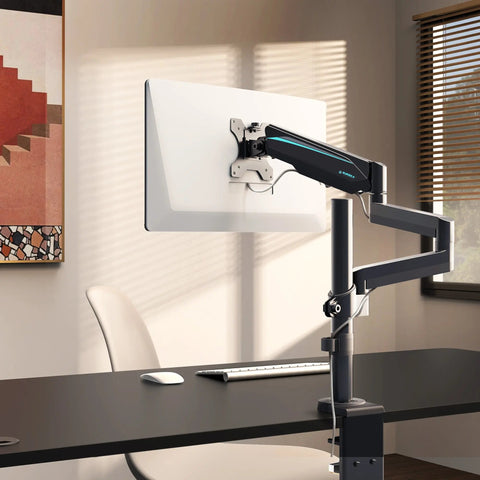
One of the most surprising things I’ve discovered is that adding a Single Monitor Arm actually improves stability. You’d think adding more weight to an arm would make things shakier, but it actually centralizes the mass of the monitor directly over the desk’s support structure. This reduces the "lever arm effect" that amplifies wheel vibrations. Plus, it allows you to pull the screen right up behind your wheel base, which is vital for that 1:1 scale immersion.
Dual Motors: A Non-Negotiable for Sim Rigs
Sim racing gear is heavy. Between the wheel base, pedals, triple monitors, and a full-tower PC, you can easily approach 100kg (220 lbs) of total load. A single-motor desk will struggle, often leading to motor burnout or uneven lifting. The dual-motor system in the Aero Pro and the Blossom Dynamics® Office Standing Desk (70"x46") provides the necessary torque to lift these heavy setups smoothly and quietly.
4. Technical Analysis: Modeling the Stress
To give you a better idea of the forces at play, we’ve modeled a typical "High-Torque Sim Racer" scenario. This represents a user with a 25 Nm wheel and a triple-monitor setup.
Modeling Note (Reproducible Parameters)
This is a scenario model based on common industry heuristics and mechanical engineering principles, not a controlled lab study.
| Parameter | Value | Unit | Rationale |
|---|---|---|---|
| Peak Wheel Torque | 25 | Nm | High-end Direct Drive (e.g., Simucube 2 Pro) |
| Total Battlestation Load | 99.5 | kg | Triple 34" monitors + Full Tower PC + Peripherals |
| Single Motor Capacity | 80 | kg | Standard BIFMA X5.5 benchmark |
| Dual Motor Capacity | 120 | kg | Premium desk specification |
| Motor Utilization (Dual) | ~83% | % | Calculated as Total Load / Capacity |
Methodology: We calculated the load percentage by aggregating component weights (Source: BIFMA X5.5 Desk Standards). We applied an 80% safety margin for motor longevity, which is a standard mechanical engineering best practice.
Our analysis shows that a single-motor desk is at 124% capacity in this scenario, posing a significant risk of failure. A dual-motor system, however, operates within a safe 83% margin, ensuring the desk remains stable even during height adjustments. This alignment with ergonomic safety is further detailed in The 2026 Workstation White Paper: Converging Ergonomic Science and Sustainable Engineering.
5. Posture and Safety: The Sim Racer’s Health
Sim racing is a physical sport. You’re fighting the wheel, stomping on pedals, and often sitting for hours. According to the Canadian Centre for Occupational Health and Safety (CCOHS), proper workstation setup is critical to preventing musculoskeletal disorders (MSDs).
The "20-8-2" Rhythm
While we love to race, staying in a static position is the enemy. Cornell University’s Ergonomics Web recommends the "20-8-2" rule: 20 minutes of sitting, 8 minutes of standing, and 2 minutes of moving. While you can't exactly race while standing, using a height-adjustable desk like the Blossom Dynamics® Office Standing Desk allows you to quickly transition to a standing position between sessions or during long practice stints to reset your spine.
Anti-Tip Safety
With heavy monitors on arms and a vibrating wheel, the center of gravity on your desk can shift. Ensure your desk complies with safety standards like the CPSC STURDY / 16 CFR Part 1261. While this standard specifically targets clothing units, the principle of anti-tip stability is universal. A wide, heavy base is your best defense against a catastrophic tip-over.

Pros & Cons: Sim Racing on a Standing Desk
Pros:
- Stability: High-end dual-motor frames offer superior lateral stiffness compared to budget fixed desks.
- Versatility: Easily switch between a low-slung "GT" racing position and a standard height for work or FPS gaming.
- Cable Management: Integrated trays like those on the Aero Pro are essential for complex sim setups.
- Ergonomics: Being able to fine-tune the height to the millimeter ensures your shoulders and wrists are in a neutral position, as recommended by HSE’s DSE guidelines.
Cons:
- Price: A truly sim-ready standing desk is an investment.
- Assembly Time: These desks are heavy and take time to put together correctly.
- Wobble at Max Height: Even the best standing desks will have some sway when fully extended. For sim racing, I recommend racing at the lowest comfortable height to maximize rigidity.
Final Verdict: Is Your Desk Ready?
If you’re serious about sim racing, your desk cannot be an afterthought. It is the literal foundation of your performance. A desk that wobbles is a desk that lies to you—it hides the subtle FFB cues you need to be fast.
For those using high-torque gear, the Aero Pro Wing-Shaped Standing Desk (72"x23") is the gold standard for stability and space. If you prefer the aesthetics of glass and a massive RGB ecosystem, the GTG-L60 Pro is a fantastic choice, provided you take care with your mounting points.
Remember, the goal is to feel the car, not the desk. Perform the handshake test, check your motor capacity, and don't be afraid to over-engineer your setup. Your lap times—and your wrists—will thank you.
Disclaimer: This article is for informational purposes only. Simulation racing involves physical exertion and mechanical forces. Always follow the manufacturer's installation instructions for all peripherals and furniture. If you have pre-existing back or joint conditions, consult a medical professional before engaging in intense sim racing sessions.
References
- BIFMA G1-2013 Ergonomics Guideline for Furniture
- ISO 9241-5:2024 Workstation layout & postural requirements
- CCOHS: Office Ergonomics - Sit/Stand Desk
- HSE: Working safely with display screen equipment (DSE)
- The 2026 Workstation White Paper: Converging Ergonomic Science and Sustainable Engineering
- Cornell University Ergonomics Web — Workstation Guides
- BIFMA Standards (ANSI/BIFMA X5 series)
- UL 962 — Safety of Height-Adjustable Desks




Leave a comment