

The Stability Paradox: Why Your Standing Desk Sways
You are deep into a focused work session or an intense competitive match. As your typing speed increases or your mouse movements become more rapid, you notice a rhythmic, distracting shimmer on your screen. This side-to-side movement, technically known as lateral sway or lateral force, is the "hidden friction" of the modern ergonomic workstation.
Many users assume that a standing desk is either "stable" or "unstable" as a binary trait. However, based on patterns we observe from technical support logs and professional setup audits, stability is a dynamic interaction between engineering, installation precision, and load distribution. Lateral wobble is not merely a nuisance; it is a physical manifestation of energy transfer that can lead to increased visual fatigue and decreased precision.
This article provides a rigorous technical analysis of why lateral sway occurs, the physiological impact of unstable surfaces, and the engineering-grade solutions required to achieve a rock-solid workstation.

The Physics of Lateral Force and Torsion
To solve side-to-side sway, we must first understand the mechanical principles at play. When a desk is raised to a standing height, it becomes an inverted pendulum. The higher the desk, the longer the lever arm, and the more any small force at the top is amplified at the base.
The Lever Arm Effect
In physics, a lever arm is the perpendicular distance from the axis of rotation to the line of action of the force. For a standing desk, the "axis" is the floor-to-leg connection. According to the 2026 Workstation White Paper: Converging Ergonomic Science and Sustainable Engineering, increasing the height of a workstation significantly shifts its center of mass, making it more susceptible to external lateral loads.
Static Tipping vs. Torsional Deflection
Most users fear the desk will tip over, but actual tipping is rare in products compliant with ANSI/BIFMA X5.5 standards. The real culprit is torsion—the twisting of the frame. Lateral sway is primarily a torsional issue where the desk frame "twists" under the uneven pressure of typing or leaning.
Modeling Note: Static Tipping Analysis We estimate the stability of a workstation using a moment-based model. This is a scenario model used for setup optimization, not a controlled laboratory certification.
Parameter Typical Value Unit Rationale $W_{total}$ (System Weight) 150 - 250 lbs Average frame + desktop + gear $b$ (Base Depth) 24 - 30 inches Standard foot length $W_{load}$ (User Force) 15 - 25 lbs Typical leaning force during focus $x$ (Load Distance) 12 - 15 inches Distance from center to edge $SF$ (Safety Factor) 2.0 - 3.0 ratio Required for cyclic loads (typing) Boundary Conditions: This model assumes a level, hard flooring surface. Results vary significantly on high-pile carpets or uneven flooring.
A common approach to calculate the resisting moment is $M_{resist} = W_{total} \cdot \frac{b}{2}$. If the overturning moment ($M_{overturn} = W_{load} \cdot x$) approaches this value, the desk feels "floaty." However, lateral sway occurs long before this limit is reached because the steel components themselves flex under load.
The Physiological Cost of an Unstable Surface
Why does a few millimeters of sway matter? The human body is highly sensitive to micro-movements in its environment. When your monitor sways laterally, your eyes must constantly adjust their focal point. This leads to a condition often discussed in OSHA's eTools regarding computer workstations and monitors, where visual fatigue is exacerbated by poor equipment stability.
Musculoskeletal Strain
If the desk surface is unstable, the user often compensates by tensing the muscles in the forearms, shoulders, and neck to "steady" their own input. This creates a static load on the musculoskeletal system. Over time, these static positions can contribute to Musculoskeletal Disorders (MSDs). According to the European Agency for Safety and Health at Work (EU-OSHA), prolonged static postures—even while standing—increase the risk of lower limb disorders and spinal strain.
By ensuring a stable surface, you allow your body to maintain a "neutral position," where joints are naturally aligned and the stress on muscles and tendons is minimized.
Engineering Solutions: Column Staging and Motor Sync
Not all standing desks are engineered equally. When selecting a high-performance setup, two technical factors dictate lateral stability: column staging and motor synchronization.
Two-Stage vs. Three-Stage Columns
Conventional wisdom suggests that three-stage columns (which have two telescoping joints) are "better" because they offer a wider height range. However, from a stability standpoint, two-stage columns (one telescoping joint) are typically 30–40% stiffer at full extension. This is because longer individual segments allow for more "overlap" between the steel tubes. This overlap acts as a structural brace against torsional deflection.
Dual Motor Calibration
In dual-motor systems, such as those found in the GTG-G55, Glass Desktop Gaming Standing Desk (55"x23"), synchronization is critical. If one motor starts even 50 milliseconds after the other, it induces a "twisting force" across the frame. High-quality controllers ensure both motors start simultaneously, preventing the frame from pre-loading with stress that manifests as lateral wobble.

The Installer's "Gotcha": Torque and Joint Rigidity
Based on patterns from customer support and warranty handling, the most common cause of "mechanical" wobble is actually an installation error: undertightened bolts.
Most users assemble their desks using the provided hex key and tighten until it "feels snug." However, achieving the joint rigidity required for a 200lb load at 45 inches of height requires specific clamping force.
The Torque Requirement
For standard M8 frame bolts, the ideal torque is typically 15-20 Nm (11-15 ft-lbs). This creates approximately 3,000 to 4,000 lbs of clamping force, which effectively turns the separate steel components into a single, rigid structure. Without a torque wrench, most users achieve less than half of this requirement.
Pro Tip: Do not overtighten until the metal warps. The goal is to reach a level where the bolt is fully seated and the friction between the frame parts prevents any micro-sliding.
Practical Recommendations for a Rock-Solid Setup
If you have already invested in a desk like the GTG-G55, Glass Desktop Gaming Standing Desk (55"x23"), but still experience sway, the issue likely lies in your equipment layout.
1. Optimize the Center of Gravity
The further your monitors and PC are from the desk's central support columns, the more they act as "weights" on the end of a lever.
- The 60% Rule (Heuristic): Try to keep 60% of your total equipment weight distributed within the middle third of the desktop.
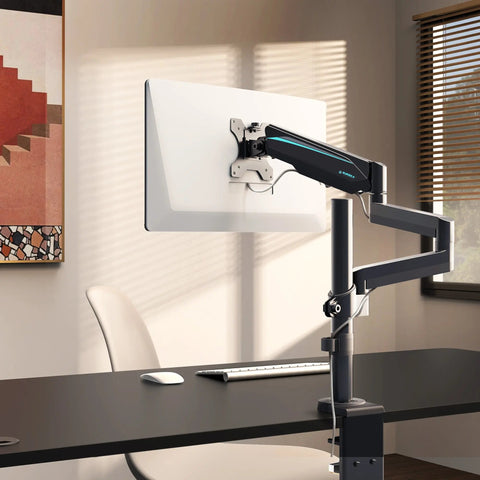
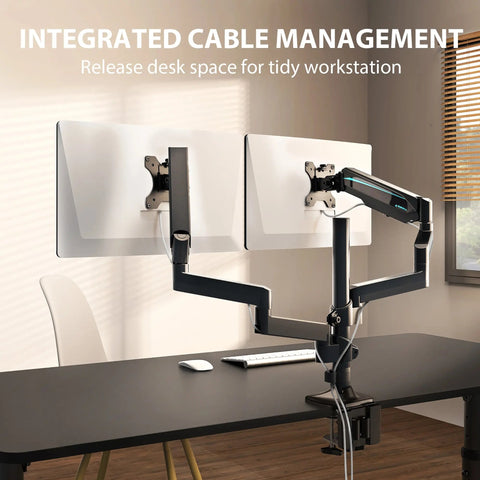
- Low-Profile Mounts: Use a high-quality Dual Monitor Arm to keep the monitors' mass closer to the desk surface. High risers or "stacked" monitor setups significantly increase the lever arm and amplify wobble.
2. Manage Cable Tension
A non-obvious cause of lateral sway is cable tension. If your cables are too short or tightly bundled, they can exert a constant 5-10 lb pull on the desk when it is at standing height. This "lateral pull" makes the desk more susceptible to vibration. Ensure your cable "slack" is sufficient for the full range of motion.
3. Offload Mass to the Floor
If your PC tower is massive, consider moving it off the desktop. Using an Adjustable CPU Stand, Mobile, Black or a Mobile Height Adjustable CPU Cart removes 20-50 lbs of off-center mass from the desk surface. This drastically reduces the "pendulum effect" and improves the desk's natural frequency of vibration.

Standardized Setup Checklist
To ensure your workstation meets the ergonomic requirements set by bodies like the Canadian Centre for Occupational Health and Safety (CCOHS), use the following checklist:
| Category | Action Item | Technical Goal |
|---|---|---|
| Foundation | Check floor levelness. | Eliminate "base rock" before it amplifies. |
| Hardware | Retighten frame bolts to ~15 Nm. | Ensure maximum joint rigidity. |
| Layout | Center the heaviest equipment. | Reduce torsional lever arms. |
| Peripherals | Use low-profile monitor mounts. | Lower the center of mass. |
| Cables | Verify slack at max height. | Prevent unintended lateral tension. |
The Ideal Sit-Stand Rhythm
Stability is also about the user's interaction with the desk. Even the most stable desk cannot protect you from the health risks of "static standing." Experts at Cornell University's Ergonomics Web recommend the 20-8-2 rhythm:
- 20 Minutes Sitting: In a neutral posture.
- 8 Minutes Standing: To increase blood circulation and reduce static load.
- 2 Minutes Moving: Stretching or walking to interrupt sedentary behavior.
This rhythm, combined with a stable surface, ensures that you are not trading back pain for neck strain caused by an unstable, swaying monitor.

Summary of Stability Optimization
Achieving a wobble-free experience is a combination of choosing the right engineering—such as thick steel frames and synchronized motors—and executing a precise setup. By understanding that lateral force is a manageable physical variable, you can transform a "shaky" desk into a professional-grade command center.
Prioritize rigid joint connections, center your heavy equipment, and maintain a healthy movement rhythm. A stable desk is not just a luxury; it is the foundation of long-term musculoskeletal health and peak cognitive performance.
Disclaimer: This article is for informational purposes only and does not constitute professional medical or occupational health advice. If you suffer from chronic musculoskeletal pain or pre-existing spinal conditions, please consult a qualified physiotherapist or ergonomic specialist before significantly altering your workstation setup or work habits.
Sources and References
- BIFMA G1-2013: Ergonomics Guideline for Furniture
- CCOHS: Office Ergonomics - Sit/Stand Desk Guidelines
- ISO 9241-5:2024: Workstation layout & postural requirements
- OSHA eTools: Computer Workstations - Component Guides
- Cornell University: Workstation Setup and the 20-8-2 Rule
- EU-OSHA: Musculoskeletal disorders and prolonged static sitting
- Eureka Ergonomic: The 2026 Workstation White Paper
- Agarwal et al. (2018): Sit-Stand Desks & Low Back Discomfort Systematic Review




Leave a comment