

The Cost of Uptime: Monitoring Fatigue and the DevOps Engineer
In the high-stakes world of Site Reliability Engineering (SRE) and DevOps, "uptime" is the primary metric of success. However, maintaining a five-nines (99.999%) availability often comes at a significant physical cost to the human operator. We frequently observe a pattern in professional workspaces where cognitive performance plateaus in the late afternoon, not due to a lack of technical skill, but as a direct result of musculoskeletal fatigue.
The central challenge lies in the "monitoring gaze." DevOps engineers often manage three or more high-resolution displays to track CI/CD pipelines, real-time logs, and infrastructure health. When these screens are positioned haphazardly, the body compensates through repetitive micro-rotations of the cervical spine and sustained static loading of the trapezius muscles. This physical strain triggers a cascade of discomfort that distracts from critical incident response. To maintain peak operational readiness, the workstation must be viewed as a technical component that requires the same level of optimization as the software it supports.

The Physiology of "Dashboard Neck"
The human head weighs approximately 10 to 12 pounds in a neutral position. According to ISO 9241-5:2024 Workstation layout & postural requirements, maintaining a "spinal neutral" position is essential for minimizing Musculoskeletal Disorders (MSDs). However, for every inch the head tilts forward or rotates laterally to check a secondary dashboard, the effective weight on the cervical spine increases dramatically.
Prolonged static sitting, as detailed by EU-OSHA, leads to reduced blood circulation and "static load" on the lower back and neck. In DevOps environments, the most common culprit is the lateral placement of secondary monitors. When an engineer must turn their head more than 30 degrees to read a metric, they are engaging in repetitive strain that can lead to chronic neck stiffness and tension headaches. This is not merely a comfort issue; it is a physiological bottleneck that increases Mean Time to Detection (MTTD) by introducing physical distraction into the diagnostic loop.
Engineering Controls: The Role of the Sit-Stand Workstation
To address these risks, we look to the "hierarchy of controls" defined by OSHA's Ergonomics Guidelines. While taking breaks is an administrative control, implementing a height-adjustable workstation is an "engineering control"—a more effective solution that fundamentally changes the work environment to fit the user.
A professional-grade sit-stand desk, such as the GTG-G55, Glass Desktop Gaming Standing Desk (55"x23"), allows for the necessary postural shifts that mitigate static load. Research from Cochrane (2018) suggests that sit-stand desks can reduce daily sitting time by over 80 minutes, which is critical for engineers who may be tethered to their desks during major incidents.
However, the transition between sitting and standing must be seamless. A common mistake we see is failing to adjust monitor height after changing the desk height. To maintain the "top third at eye level" rule, the monitors must move in perfect synchronization with the desk surface. This requires a stable frame that prevents "monitor wobble"—a frequent frustration when using heavy multi-screen arrays on single-motor desks.
Advanced Monitor Geometry: The 30-Degree Glance Rule
For DevOps engineers, the layout of the "dashboard wall" is a critical architectural decision. The objective is to maximize information density while minimizing cervical rotation.
The Primary Focus Zone
Your primary monitor—typically where you code or run terminal commands—should be directly in front of you. Following guidelines from OSHA eTools: Computer Workstations - Monitors, the screen should be at a distance of 20 to 40 inches from your eyes. The top of the screen should be at or slightly below eye level so that your primary gaze is slightly downward (about 15 to 20 degrees).
The Secondary Glance Zone
Secondary monitors should be angled inward (curved toward the user) to maintain a consistent focal length. This is where the 30-degree glance rule comes into play: secondary dashboards should be placed so that critical metrics can be read with eye movement alone. If you find yourself physically turning your chin to see a Grafana board, the monitor is too far lateral.
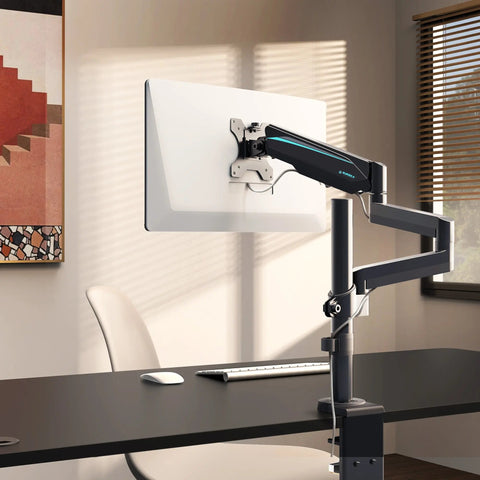
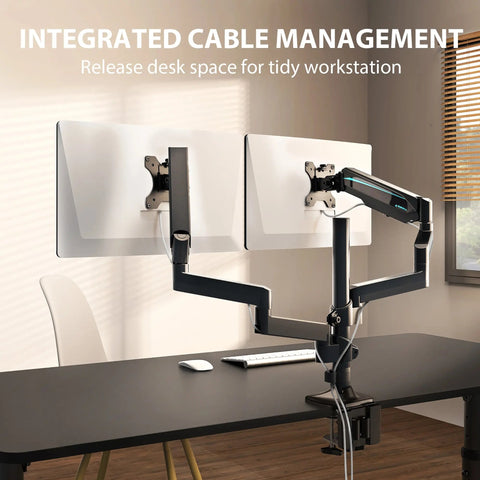
To achieve this level of precision, a dedicated stand like the Carbon Fiber Dual Monitor Stand can elevate smaller auxiliary screens to eye level, preventing the "look down" strain that often occurs when laptops or tablets are used as secondary displays.
Logic Summary: Our monitor geometry recommendations are based on the ANSI/HFES 100-2007 standards for viewing angles and the 30-degree lateral limit to minimize cervical torque.
The Tall Engineer’s Dilemma: Overcoming Anthropometric Gaps
Standard office furniture is often designed for the 50th percentile of the population. For tall DevOps engineers (e.g., 190cm / 6'3"), standard fixed desks are almost always too low, leading to a chronic upward gaze or a hunched posture.
Based on our scenario modeling for a 190cm user, a standard 29-inch desk creates a 1-inch ergonomic gap when seated, forcing the user to extend their neck. When standing, this same user requires a desk height of approximately 116.5cm (45.8 inches). Using a desk with a wide adjustment range is non-negotiable for this demographic to prevent "monitor neck."
Furthermore, tall users often experience a "viewing distance deficit." With deep 30-inch desks, the addition of a 49-inch super-ultrawide monitor can actually place the screen too close for optimal immersion. In these cases, we recommend using a keyboard tray or an L-shaped return to increase the effective distance between the eyes and the pixels.
Hardware Stability: Managing the "Battlestation" Load
A professional DevOps setup is heavy. Between liquid-cooled workstations, triple monitors, and heavy-duty arms, the total load can easily exceed 75kg (165 lbs). As noted in The 2026 Workstation White Paper: Converging Ergonomic Science and Sustainable Engineering, structural integrity is the foundation of ergonomic success.
Our analysis of motor safety margins reveals a critical "gotcha":
- Single-motor desks typically have a capacity of ~80kg. A high-end DevOps setup utilizes nearly 98% of this capacity, leading to slower transitions and increased motor wear.
- Dual-motor desks offer a ~120kg capacity, bringing the same setup down to a much safer 65% utilization.
For stability and longevity, we consider dual motors mandatory for any setup involving more than two monitors or a full-tower PC. To keep the desktop clear and stable, moving the PC off the desk using an Adjustable CPU Stand, Mobile, Black reduces the weight on the motors and improves airflow for the workstation.
The Sitting Foundation: Beyond the Desk
Even with a sit-stand desk, the quality of your seated time dictates your long-term health. The Flex, Dual-Backrests Ergonomic Office Chair is designed to address the dynamic needs of an engineer who frequently shifts between deep coding and dashboard scanning. Its dual backrest design adapts to the spine's natural movements, providing targeted lumbar support that aligns with BIFMA G1-2013 Ergonomics Guidelines.
Proper chair setup involves:
- Seat Height: Adjusted so feet are flat on the floor and thighs are horizontal (OSHA eTools: Chairs).
- Armrests: Positioned so shoulders are relaxed and elbows are at a 90-degree angle.
- Lumbar Support: Firmly supporting the natural curve of the lower back to prevent slouching during high-stress troubleshooting sessions.
Practical Implementation Checklist
To optimize your environment for maximum uptime and minimum strain, follow this protocol:
- Implement the 20-8-2 Rhythm: Based on Cornell University’s Ergonomics Web, aim for 20 minutes of sitting, 8 minutes of standing, and 2 minutes of moving/stretching every half hour.
- Calibrate Monitor Tension: Ensure monitor arms are tightened so that screens do not sag. A 1-inch drop in monitor height over an 8-hour shift can significantly increase neck strain.
- Manage the Cable "Tail": When using a standing desk, ensure your cables have enough slack for the full range of motion. Use a cable management tray to prevent tension on ports at maximum height.
- The Glance Rule Check: Close your eyes, sit in your neutral working position, and open them. You should be looking at the center of your primary monitor. Now, move only your eyes to your secondary dashboard. If you feel a "pull" in your neck, move the monitor closer to the center.
Methodology and Modeling Transparency
The technical recommendations in this article are derived from scenario modeling of a professional DevOps environment.
Analysis Parameters (Tall User Persona)
| Parameter | Value | Rationale / Source |
|---|---|---|
| User Stature | 190 cm (6'3") | 95th Percentile Male (US) |
| Recommended Sitting Desk Height | 78.5 cm | ANSI/HFES 100-2007 Ratio |
| Recommended Standing Desk Height | 116.5 cm | ANSI/HFES 100-2007 + Shoe Correction |
| Total Battlestation Weight | ~78 kg | PC (25kg) + 3 Monitors + Arms + Peripherals |
| Motor Utilization (Dual Motor) | 65% | Based on 120kg Rated Capacity |
Boundary Conditions: This model assumes a standard anthropometric ratio. Individual limb length variations or pre-existing medical conditions may require personalized adjustments. Motor load calculations assume a static, distributed load.
Disclaimer: This article is for informational purposes only and does not constitute professional medical advice. Ergonomic requirements vary by individual. If you experience chronic pain or have pre-existing musculoskeletal conditions, please consult a qualified healthcare professional or an occupational therapist before making significant changes to your workstation setup.
References & Sources
- BIFMA G1-2013 Ergonomics Guideline for Furniture
- ISO 9241-5:2024 Workstation layout & postural requirements
- Cornell University Ergonomics Web — Workstation Guides
- OSHA eTools: Computer Workstations - Monitors
- EU-OSHA: Musculoskeletal disorders and prolonged static sitting
- Cochrane: Workplace interventions for reducing sitting at work (2018)
- ANSI/HFES 100-2007 Computer Workstations




Leave a comment