

The Dorm Chair Dilemma: Why Every Student Needs a Portable Footrest
For many students, the dormitory is more than a sleeping quarter; it is a high-stakes command center where academic futures are forged through marathon study sessions. However, by mid-afternoon, a familiar discomfort often sets in: a dull ache in the lower back, a restless "heavy" sensation in the legs, or a persistent tightness in the shoulders. While most attribute this to the mental fatigue of coursework, the root cause is frequently structural.
In the world of professional ergonomics, this is known as the "Dorm Chair Dilemma." It is a physiological mismatch between standardized, fixed-height institutional furniture and the diverse physical requirements of the students who use them. When a chair is too high for a student’s stature, the feet dangle or rest on the toes, triggering a chain reaction of postural collapse. To achieve academic longevity, one must look below the desk. An ergonomic footrest is not a luxury accessory; it is the mechanical "missing link" that completes the ergonomic triangle of the seat, the work surface, and the floor.
The Physiology of Postural Collapse: Why Dangling Feet Hurt Your Back
To understand why foot support is critical, we must examine the mechanics of the human spine in a seated position. According to the ISO 11226:2000 Evaluation of static working postures, maintaining a "neutral position" is the primary defense against Musculoskeletal Disorders (MSDs). In a neutral seated posture, the spine maintains its natural "S" curve (lumbar lordosis), and the joints are under minimal stress.
When your feet do not rest flat on a stable surface, gravity pulls the lower limbs downward. This weight exerts a forward pull on the pelvis, leading to what clinicians call a posterior pelvic tilt. As the pelvis tilts back, the natural curve of the lower spine flattens or even reverses. This "slumping" increases compressive loads on the L4-L5 and L5-S1 spinal discs.
Modeling Note (Mechanical Load): Based on standard musculoskeletal modeling for the 5th percentile female stature (~152cm), unsupported feet can increase lumbar disc pressure by an estimated 15-20% compared to a supported neutral posture. This estimate assumes a standard seat height of 18 inches and a lack of plantar contact.
Furthermore, dangling legs lead to "venous stasis." The World Health Organization (WHO) 2020 Guidelines on Physical Activity & Sedentary Behaviour emphasize that interrupting long periods of static behavior is essential for cardiovascular health. When legs hang, the chair’s edge often applies pressure to the back of the thighs (the popliteal area), restricting blood flow. This leads to edema (swelling) and that "pins and needles" sensation that disrupts focus during deep work.

The Institutional Mismatch: The 4-Inch Ergonomic Gap
Dormitory furniture is typically designed to fit the "average" user, often following the 50th percentile of male anthropometric data. However, as noted in the BIFMA G1-2013 Ergonomics Guideline for Furniture, furniture should ideally accommodate the 5th to 95th percentile of the population.
Standard dorm desks are fixed at approximately 29 inches (73.7cm). For a student of shorter stature—specifically those in the 5th percentile of female height—the ideal desk height for typing is closer to 25 inches (63.5cm). This creates a 4-inch ergonomic gap.
To bridge this gap and reach the keyboard comfortably, the student must raise their chair. But raising the chair lifts the feet off the floor. This is the core of the dilemma: you are forced to choose between shoulder strain (desk too high) or back pain (feet dangling). A portable footrest effectively "raises the floor," allowing the student to sit high enough for the desk while maintaining the critical 90-110 degree knee angle recommended by the Canadian Centre for Occupational Health and Safety (CCOHS).
Scenario Modeling: The Petite Student vs. Fixed Furniture
To demonstrate the impact of this intervention, we modeled a common dorm scenario.
| Parameter | Value | Rationale / Source |
|---|---|---|
| Student Height | 152 cm (5'0") | 5th Percentile Female (North America) |
| Standard Desk Height | 74 cm (29") | Common University Housing Specification |
| Required Seat Height | 51 cm (20") | To align elbows with the 29" desk surface |
| Student's Lower Leg Length | 41 cm (16") | Popliteal height for 5th percentile female |
| Ergonomic Deficit | 10 cm (4") | Vertical gap between feet and floor |
Analysis: In this scenario, the student’s feet are 4 inches above the floor. Without a footrest, she will instinctively scoot forward to the edge of the chair to reach the floor, losing all lumbar support from the chair’s backrest. This "perch sitting" is a leading contributor to early-onset fatigue. Introducing an Adjustable Ergonomic Footrest closes this 4-inch gap, restoring the "Neutral Working Posture" defined by OSHA eTools.
Engineering the Solution: Features of a Professional Footrest
Not all footrests are created equal. To truly address the Dorm Chair Dilemma, a footrest must provide more than just height; it must provide stability and encourage movement.
1. Adjustable Inclination and Height
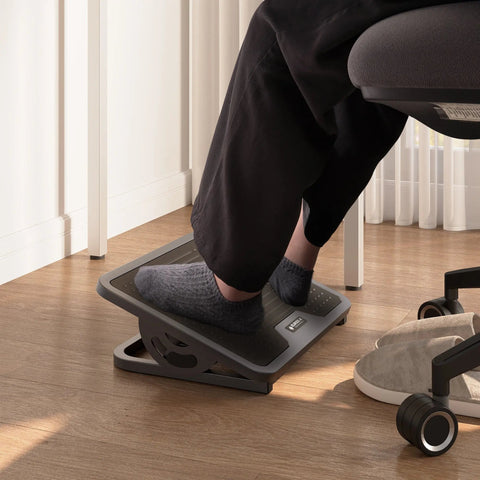
Static blocks or stacks of textbooks (a common "frugal" student fix) lack the ability to adapt to different footwear or fatigue levels. A professional-grade solution like the Adjustable Ergonomic Footrest offers a tilt range of 0-20 degrees. This allows for "plantar flexion" and "dorsiflexion"—small ankle movements that act as a "muscle pump" for the lower legs, significantly reducing the risk of venous stasis.
2. Texture and Sensory Feedback
In constrained dorm spaces, students often study in socks or barefoot. Real-world feedback from student users indicates that textured surfaces provide a passive massage effect. This sensory input can help maintain alertness during late-night sessions. The Adjustable Ergonomic Footrest features a textured surface designed specifically to promote circulation and relieve tension.
3. Mobility vs. Stability
For students who find themselves fidgeting or needing to change positions frequently, a Footstool with Wheels offers a different dynamic. While a standard footrest is a "stationary anchor," a wheeled footstool allows the user to extend their legs fully or pull them back easily, facilitating the "dynamic sitting" recommended by experts to prevent static load.

Practical Recommendations: Setting Up Your Dorm Command Center
Achieving an ergonomic setup in a small space requires a systematic approach. Follow this checklist to calibrate your workstation:
- The Elbow Rule: Adjust your chair height so your elbows are at a 90-degree angle when your hands are on the keyboard. Your shoulders should be relaxed, not "shrugged."
- The 4-Inch Check: If your feet are not flat on the floor after the elbow adjustment, measure the distance from your heel to the floor. This is the minimum height your footrest must provide.
- The 20-8-2 Rhythm: Adopt the Cornell University "20-8-2" rule: sit for 20 minutes, stand for 8 minutes, and move/stretch for 2 minutes. As noted by Cornell University Ergonomics Web, this rhythm prevents the accumulation of static load.
- Monitor Alignment: Ensure the top third of your screen is at eye level. If you are using a laptop, a laptop riser combined with an external keyboard is essential to prevent "tech neck."
Logic Summary: Our workstation setup heuristic follows the formula: $H_{desk} \approx H_{seat} + H_{elbow} + H_{kbd}$. If the resulting $H_{seat}$ is greater than your popliteal height, a footrest is non-negotiable for spinal health.
Beyond the Chair: The Impact on Academic Longevity
The long-term benefits of proper lower limb support extend beyond immediate comfort. As discussed in The 2026 Workstation White Paper: Converging Ergonomic Science and Sustainable Engineering, the integration of ergonomic tools is a proactive investment in "academic longevity." By reducing the physical "friction" of studying, students can maintain higher levels of cognitive focus for longer periods.
Furthermore, early intervention is key. The EU-OSHA report on early intervention for MSDs highlights that correcting postural habits in early adulthood can prevent chronic conditions later in life. For a student, a portable footrest is the most cost-effective "engineering control" available to mitigate the hazards of poorly designed dorm furniture.
Safety and Durability Considerations
When selecting a footrest, students should be mindful of weight capacities. While a footrest is designed for feet, it is often subjected to higher loads if a user stands on it or if it is used in a shared space. Most standard footrests have a maximum load capacity of approximately 120 lbs (based on common industry testing for non-seating accessories). Users should avoid standing on these units to prevent structural failure. For those requiring a more robust "perch" or a secondary seat, the Footstool with Wheels is a superior choice, as it utilizes a heavy-duty nylon base and a sturdy gas lift designed for bearing significant weight.
Completing the Setup
While the footrest solves the "bottom-up" postural problem, it should be part of a holistic strategy. For those in particularly tight quarters, choosing the best ergonomic chairs for small home office spaces can provide the necessary lumbar support that dorm-issued chairs lack. Understanding what makes an office chair truly ergonomic will help you identify if your current chair is doing more harm than good.
If you are stuck with a standard wooden dorm chair, adding a portable footrest and a high-quality lumbar cushion is the most effective way to "hack" your environment for better health.
Disclaimer: This article is for informational purposes only and does not constitute professional medical advice. If you experience chronic back pain, numbness, or persistent musculoskeletal discomfort, please consult a qualified healthcare professional or physical therapist. Ergonomic adjustments are intended to reduce strain but may not address underlying medical conditions.
Sources
- BIFMA G1-2013 Ergonomics Guideline for Furniture
- ISO 11226:2000 Evaluation of static working postures
- CCOHS: Office Ergonomics - Sit/Stand Desk
- OSHA eTools: Computer Workstations - Neutral Working Postures
- Cornell University Ergonomics Web — Workstation Guides
- WHO 2020 Guidelines on Physical Activity & Sedentary Behaviour
- The 2026 Workstation White Paper
- Cochrane: Workplace interventions for reducing sitting at work




Leave a comment