

The Dorm Room Workspace Crisis: Physical Toll and Spatial Constraints
For the average college student, the dormitory desk serves as a multi-functional hub for academic research, digital entertainment, and social connection. However, these spaces are frequently characterized by cramped dimensions—often limited to a 24-inch depth—and fixed furniture that fails to accommodate the diverse anthropometric needs of the student population. This spatial deficit often forces a compromise between necessary academic tools, such as physical textbooks and notebooks, and digital hardware.
The result is a phenomenon often observed in student health centers: a surge in musculoskeletal discomfort during midterms and finals. When desk space is limited, students typically push their monitors toward the back of the desk, often at an incorrect height, or hunch over laptops placed on stacks of books. These improvised setups violate fundamental ergonomic principles, leading to a cascade of physiological issues that can impact academic performance and long-term well-being.
The Physiology of Study: Understanding Musculoskeletal Disorders (MSDs)
To understand why a cramped desk leads to physical pain, one must examine the physiological principles of "static load" and "neutral position." According to the U.S. Occupational Safety and Health Administration (OSHA), core risk factors for Musculoskeletal Disorders (MSDs) include repetitive tasks and poor posture.
When a student hunches forward to view a low-placed screen, the cervical spine loses its natural curve, increasing the effective weight of the head on the neck muscles. This static working posture, if maintained for hours, restricts blood circulation and leads to muscle fatigue. The European Agency for Safety and Health at Work (EU-OSHA) notes that prolonged static sitting is directly linked to chronic back pain and lower limb disorders.
The goal of an ergonomic workstation is to maintain a "neutral position," where joints are naturally aligned and muscle tension is minimized. For the upper body, this means:
- Neck: Straight and aligned with the torso, with the top of the monitor at or slightly below eye level.
- Shoulders: Relaxed, not hunched or pulled forward.
- Elbows: Close to the body, bent at an angle between 90 and 120 degrees.
- Wrists: Straight and neutral, not bent up or down.
When a desk is cluttered, the student is often forced into "non-neutral" positions to reach for a mouse or view a screen behind a pile of notes. This creates a "static load" on the trapezius and levator scapulae muscles, which are not designed for long-term isometric contraction.
Engineering a Solution: The Mechanics of Clamp-On Monitor Arms
In the "hierarchy of controls" defined by OSHA, engineering controls—which physically change the environment—are significantly more effective than administrative controls, such as simply "taking more breaks." A clamp-on monitor arm is a primary engineering control for the dorm environment.
By elevating the monitor and removing the bulky factory stand, a student can reclaim between 60 to 100 square inches of desk real estate. While the clamp base itself occupies approximately 15 to 25 square inches, the net gain of 35 to 85 square inches provides the necessary clearance for textbooks and notebooks directly in front of the user. This allows the student to maintain a neutral spine while referencing physical and digital materials simultaneously.
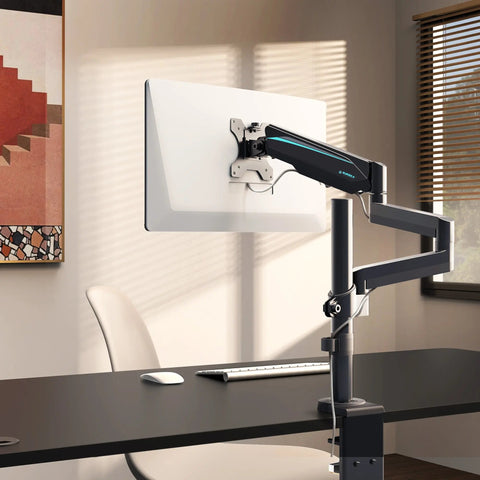
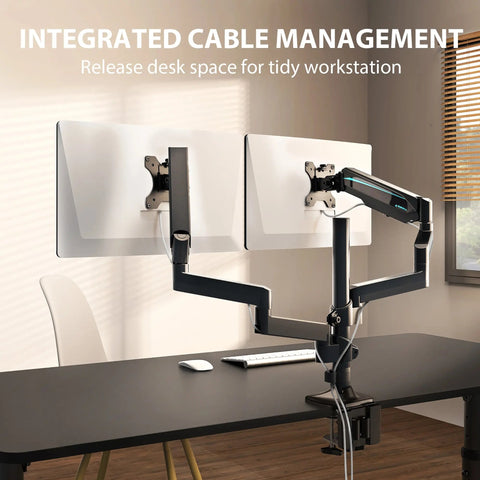
The Dual Monitor Arm exemplifies this solution, offering a max extension of 27.3 inches and a swivel range of ±90°. This adjustability is critical because, as noted in the BIFMA G1-2013 Ergonomics Guideline, furniture must accommodate the 5th to 95th percentile of the population. A fixed stand rarely meets the eye-level requirements for a tall engineering student or a more petite humanities student.

Technical Analysis: Modeling the Student Workspace
To demonstrate the impact of these ergonomic interventions, we modeled a specific high-stress scenario: "The Engineering Student with a Dual-Monitor Setup." This profile represents a tall (185cm) student performing intensive CAD work and coding in a standard 8-foot deep dorm room.
Modeling Note (Method & Assumptions)
Logic Summary: This analysis utilizes ANSI/HFES 100-2007 anthropometric ratios and BIFMA X5.5 load safety factors. These are scenario-based models, not controlled laboratory studies.
Parameter Value Unit Rationale User Stature 185 cm 75th percentile male profile Desk Height 29 in Standard fixed dorm desk height Monitor Config 2 x 34" count Ultrawide monitors for productivity Room Depth 96 in Typical 8-foot dorm depth Productivity Coeff 0.15 ratio Estimated ergonomic improvement impact
Run 1: Anthropometric Desk Height Mismatch
Our modeling indicates that a 185cm student requires an ideal seated desk height of approximately 75.5cm (29.7 inches). A standard 29-inch dorm desk creates a ~0.7-inch deficit. While this seems minor, the cumulative effect over a 4-hour study session leads to "desk height compression," where the user unconsciously slumps to reach the work surface, creating significant shoulder tension.
Run 2: Load Capacity and Safety Margins
Engineering students often use heavy, high-performance monitors. Our simulation of a dual 34-inch ultrawide setup showed that a single-motor or low-capacity arm would reach 91.25% utilization. This is considered a "red zone" where mechanical lifespan is reduced. For such setups, a robust solution like the Dual Monitor Arm is preferred to maintain a safer 60% utilization rate, ensuring stability and preventing "monitor droop."
Run 3: Space and Circulation Fit
In an 8-foot room, a dual-monitor setup fits with only 2 inches of surplus clearance. This "tight" layout status underscores the necessity of a clamp-on arm to keep the monitors from encroaching on the user's immediate workspace or the roommate's circulation path.
Practical Implementation and Dorm-Safe Installation
Selecting a monitor arm for a dorm requires more than just checking VESA compatibility. Based on common patterns from customer support and facility management observations, several "dorm-specific" factors must be addressed.
1. The Desk Thickness "Gotcha"
Many dorm desks feature reinforced lips or thick aprons that exceed the capacity of standard clamps. A practical rule of thumb is to measure the thickest part of the desk edge and add 10mm for clearance. The Dual Monitor Arm supports thicknesses from 0.39" to 2.95", covering most institutional furniture.
2. Protecting Particle Board
Most dorm furniture is constructed from particle board with a thin laminate. To prevent permanent compression marks and distribute pressure evenly, we recommend placing a thin piece of cork or felt between the clamp and the desk surface. This is a critical step to avoid damage charges during end-of-year inspections.
3. Cable Management in Tight Quarters
In cramped spaces, dangling cables are more than an eyesore; they are a functional hazard. Use tools like the Magnetic Cable Tie to route cords along the monitor arm pole. Properly managed cables prevent tangling when adjusting the arm height and keep the limited floor space clear.

4. The "No-Damage" Removal Strategy
When it is time to move out, do not simply rip the clamp off. Loosen the clamp gradually over a 24-hour period. This allows the compressed wood fibers of the desk to decompress slowly, minimizing the risk of surface cracking. Any adhesive residue from cable clips should be cleaned with isopropyl alcohol.
Alternative Solutions for Fixed-Desk Constraints
Some dormitories prohibit clamp-on accessories entirely. In these cases, a freestanding riser is the next best ergonomic intervention. The Carbon Fiber Dual Monitor Stand provides the necessary elevation to achieve eye-level alignment while offering storage space underneath for a keyboard or notebooks. While it does not offer the same "float" as an arm, it effectively addresses the "neck flexion" issue described by Cornell University's Ergonomics Web.

For students who have the flexibility to replace their entire workspace, an electric solution offers the greatest health benefits. The Standing Desk with Drawers, Wood Finish (47'' /55'') allows for the "20-8-2" rhythm recommended by experts: 20 minutes of sitting, 8 minutes of standing, and 2 minutes of moving.
Maximizing Academic Longevity: The ROI of Ergonomics
Investing in ergonomic tools is not a luxury; it is a strategy for academic longevity. Our metabolic modeling suggests that incorporating 4 hours of standing study per day can lead to an extra calorie burn of approximately 168 kcal/day. More importantly, the productivity gain—estimated at 15% based on reduced fatigue and improved focus—yields a rapid "payback period" on the equipment investment.
As detailed in The 2026 Workstation White Paper: Converging Ergonomic Science and Sustainable Engineering, the convergence of mechanical support and sustainable design is the new benchmark for modern workspaces. By reclaiming desk space and optimizing postural alignment, students can transform a cramped dorm room into a high-performance academic environment.
YMYL Disclaimer: This article is for informational purposes only and does not constitute professional medical advice. The ergonomic recommendations provided are based on general industry standards and scenario modeling. Individuals with pre-existing musculoskeletal conditions or chronic pain should consult a qualified physical therapist or medical professional before making significant changes to their workstation setup.
References
- BIFMA G1-2013 Ergonomics Guideline for Furniture
- Canadian Centre for Occupational Health and Safety (CCOHS) - Sit/Stand Desk
- Cornell University Ergonomics Web — Workstation Guides
- ISO 9241-5:2024 Workstation layout & postural requirements
- OSHA eTools: Computer Workstations - Neutral Working Postures
- WHO 2020 Guidelines on Physical Activity & Sedentary Behaviour




Leave a comment