

Quick Guide: Solving Dorm-Related Back Pain
To immediately improve your dorm setup, follow the "Feet-Elbow-Eye" hierarchy: keep feet flat on the floor (or a footrest), elbows at a 90-degree angle, and the top of your screen at eye level. Implement the 20-8-2 rhythm—20 minutes sitting, 8 minutes standing, and 2 minutes of movement—to prevent static muscle fatigue. If you are experiencing sharp, radiating pain or numbness, consult a medical professional immediately.
Dorm Room Back Pain: Identifying the Culprits in Your Study Setup
Why does back pain often peak during midterms, and why does that dull ache in your shoulders seem to worsen as the afternoon progresses? For many college students, this discomfort is frequently dismissed as a byproduct of "hard work." However, in the field of ergonomics, this phenomenon is commonly referred to as the "Dorm Slouch."
In the constrained environment of a dormitory, the study setup can be a significant contributor to early-onset thoracic and lumbar discomfort. While university-issued furniture is designed for durability and mass production, it rarely accounts for the diverse anthropometric needs of the student population. This article explores the physiological principles of musculoskeletal health and provides a practical framework for transforming a cramped study corner into a workstation that supports academic longevity.
The Science of Static Load: Understanding Musculoskeletal Risks
The human body is biomechanically designed for movement, yet the modern academic lifestyle demands hours of "static load"—a state where muscles remain under constant tension to maintain a single position. When you sit in a non-ergonomic chair for extended periods, your body may naturally drift into a slumped posture to conserve energy. This can lead to what the U.S. Occupational Safety and Health Administration (OSHA) identifies as core risk factors for Musculoskeletal Disorders (MSDs), including repetitive tasks and poor posture.
Physiologically, prolonged sitting causes a shift in spinal mechanics. Based on classic biomechanical models (such as those pioneered by Nachemson), sitting can increase lumbar disc pressure by an estimated 40% compared to standing. (Note: This figure is a heuristic based on a typical 70kg adult sitting upright versus leaning forward; actual pressure variations will change based on individual body mechanics.)
When this is compounded by a "forward head posture"—common when peering at a laptop on a low desk—the load on the cervical spine can increase significantly. For example, a 60-degree forward tilt is estimated to place up to 60 pounds of load on the neck. (This is a commonly cited engineering heuristic for an average adult head, not a universal clinical measurement.) Over time, this static load can lead to tissue adaptation, where certain muscles become chronically tight while others weaken.
According to the ISO 9241-5:2024 standard, a workstation layout should support a "neutral spinal position" to minimize these risks. In a neutral position, the joints are naturally aligned, reducing stress on the muscles and skeletal system. Achieving this in a dorm room requires a systematic approach to furniture and equipment placement.
Logic Summary: Our analysis of the "Dorm Slouch" assumes a standard 70kg student using a non-adjustable wooden chair and a 75cm fixed-height desk. These are illustrative estimates based on common university-issued furniture specifications and are not intended as clinical data.
The Hierarchy of Ergonomic Intervention
A common mistake in ergonomic self-correction is prioritizing an expensive chair before addressing the desk and monitor height. Based on common patterns from customer support and workstation setups, even a basic chair can be made more effective if the desk allows for proper elbow alignment and the monitor is positioned at eye level.
The "Hierarchy of Correction" follows a specific sequence to help ensure the entire body is supported:
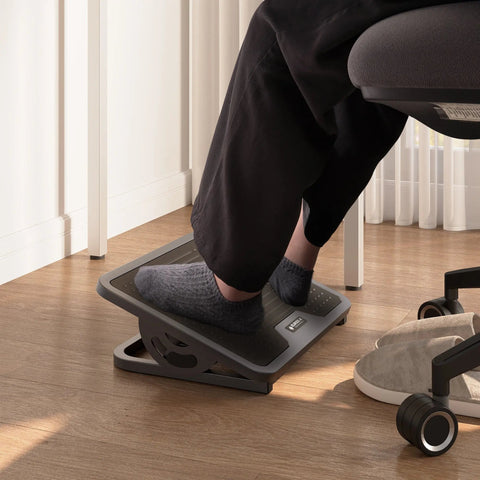
- Feet First: Adjust your chair height so your feet are flat on the floor. If the chair is too high and cannot be lowered, a footrest is highly recommended to prevent pressure on the back of the thighs, which can impede circulation.
- The Elbow Rule: Set your desk or keyboard height so that your forearms are parallel to the floor, forming an approximate 90-to-100-degree angle at the elbow. This helps minimize strain on the trapezius and shoulders.
- Eye Level Alignment: Position the monitor so that the top third of the screen is at eye level. This helps prevent the "forward head tilt" that increases cervical load.
For students using laptops, this hierarchy is often difficult to achieve because the keyboard and screen are physically connected. To solve this, "decoupling" is recommended: using an external keyboard and mouse while raising the laptop on a riser.
Engineering the Dorm Environment: Standing Desks and Compact Seating
(Transparency disclosure: Eureka Ergonomic provides the product examples in this section to illustrate practical solutions. Readers are encouraged to reference independent reviews to supplement their information.)
In a constrained dormitory space, functionality must meet efficiency. The Standing Desk with Drawers, Wood Finish (47'' /55'') is a manufacturer-designed solution that addresses the risks of prolonged static sitting. By allowing students to transition between sitting and standing, the desk helps distribute the physical load across different muscle groups throughout the day.
The Canadian Centre for Occupational Health and Safety (CCOHS) emphasizes that a sit-stand desk is most effective when the height is adjusted to maintain neutral wrist and elbow positions in both modes. The Standing Desk with Drawers features programmable memory presets, which allow students to return to their personalized ergonomic height after a break. Furthermore, the integrated monitor riser directly addresses the "Eye Level Alignment" rule.
When standing is not an option, the quality of seated support becomes paramount. The Onyx, Ergonomic Office Chair provides a professional-grade alternative to standard dorm chairs. Its mesh back design promotes airflow, while its lumbar support is designed to help maintain the natural inward curve of the lower spine (lordosis).

Advanced Postural Support for High-Intensity Study
For students engaged in intense academic tracks—such as engineering, law, or medicine—where daily study time can exceed eight hours, a more dynamic seating solution may be beneficial. The Flex, Dual-Backrests Ergonomic Office Chair utilizes a dual-backrest system designed to move with the user. This design aligns with principles discussed in Eureka Ergonomic’s internal research (a brand source), such as the 2026 Workstation White Paper, which advocates for furniture that adapts to micro-movements.
The dual backrests provide targeted support to both sides of the spine, which can reduce localized pressure points. When paired with the Footstool with Wheels, students can achieve a "neutral reach zone" where study materials are accessible without overextending the shoulders.

The "20-8-2" Rhythm and Behavioral Interventions
Equipment alone cannot fully negate the effects of a sedentary lifestyle. The World Health Organization (WHO) recommends reducing long periods of static behavior through regular interruptions. A highly effective heuristic developed by Cornell University's Ergonomics Web is the "20-8-2" rule:
- 20 Minutes of sitting in a neutral posture.
- 8 Minutes of standing (to stimulate circulation).
- 2 Minutes of moving or stretching.
To implement this, students can use the Pomodoro Technique—a time-management method that breaks work into intervals (usually 25 minutes) separated by short breaks. This protocol can improve focus and provides a concrete structure to ensure movement breaks are taken regularly.
Modeling the Load: A Typical Student Workday
To understand the potential impact of these adjustments, we modeled a typical 12-hour student workday (including lectures and study time). This comparison is based on heuristic estimates for a "Persona A" student.
| Parameter | Standard Dorm Setup | Optimized Ergonomic Setup | Rationale / Source |
|---|---|---|---|
| Daily Static Sitting | 10 - 12 Hours | 4 - 6 Hours | Shifted by Sit-Stand Desk usage |
| Cervical Load | ~60 lbs (Flexed)* | ~12 lbs (Neutral) | *Estimated at 60° tilt vs 0° tilt |
| Lumbar Disc Pressure | +40% (vs Standing)* | Variable (Reduced) | *Based on Nachemson's loading models |
| Break Frequency | Irregular | Every 25-30 Minutes | Pomodoro/20-8-2 protocol |
| Wrist Alignment | Deviated (Laptop) | Neutral (External KB) | Decoupling keyboard and screen |
Methodology Note: These values are illustrative simulations derived from general ergonomic principles and BIFMA G1-2013 guidelines, not individual medical advice. The model assumes "Persona A" is 175cm tall and weighs 70kg, with a typical 12-hour academic day. "Static sitting" includes uninterrupted time at a desk or in class. Cervical and lumbar figures are theoretical estimates demonstrating relative changes between postures; actual physical responses will vary significantly by individual.
Who Should Be Extra Cautious / When to Seek Medical Help
While the ergonomic adjustments above are generally helpful, they are general guidelines and not a substitute for individualized medical treatment. You should be extra cautious and consult a healthcare professional or physical therapist if you experience any of the following warning signs:
- Constant, sharp, or radiating pain that travels down your arms or legs.
- Numbness, tingling, or sudden weakness in your extremities.
- Sudden, severe pain following an injury or without an obvious cause.
- Pain that disrupts your sleep or does not improve with rest and positional changes.
If you have pre-existing spinal conditions (such as scoliosis or herniated discs), generic ergonomic advice may not apply to your specific biomechanical needs. Always prioritize guidance from your doctor.
Practical Dorm Hacks for Immediate Relief
If you are currently unable to replace your university-issued furniture, several low-cost interventions can help bridge the gap:
- The Rolled Towel Lumbar: If your chair lacks support, a tightly rolled towel placed at the small of your back can help maintain the natural lordotic curve.
- The Textbook Riser: Use a stack of textbooks to raise your laptop or monitor so the top of the screen is at eye level.
- External Peripherals: Investing in a basic external keyboard and mouse allows you to move your laptop back and up, immediately correcting your neck and shoulder alignment.
Standards of Safety and Professional Integrity
When selecting furniture, look for third-party certifications. The BIFMA (Business and Institutional Furniture Manufacturers Association) sets standards for safety and durability. Choosing a chair that meets ANSI/BIFMA X5.1 indicates the product has been tested for high-intensity usage.
Additionally, for electric standing desks, the UL 962 safety certification offers a recognized standard for mechanical and electrical safety. In small dormitory spaces, indoor air quality is also a factor; products with UL GREENGUARD Gold certification are tested for low chemical emissions (VOCs).
Securing Your Academic Future
The habits formed during college often persist into professional life. By identifying the culprits in your study setup—from improper screen height to prolonged static sitting—you can implement solutions that protect your physical health. Whether through a Standing Desk with Drawers or the simple addition of a Footstool, investing in your ergonomic environment is an investment in your long-term well-being.
Disclaimer: This article is for informational purposes only and does not constitute professional medical advice. If you are experiencing chronic pain or have a pre-existing condition, please consult a qualified healthcare professional or physiotherapist for an individualized assessment.
References
- U.S. Occupational Safety and Health Administration (OSHA) - Ergonomics
- ISO 9241-5:2024 - Workstation Layout and Postural Requirements
- Cornell University Ergonomics Web - Workstation Guides
- Canadian Centre for Occupational Health and Safety (CCOHS) - Sit/Stand Desk
- World Health Organization (WHO) - Guidelines on Physical Activity and Sedentary Behaviour
- BIFMA - Ergonomics Guideline for Furniture
- Eureka Ergonomic - 2026 Workstation White Paper (Brand Source)




Leave a comment