

The Hidden Infrastructure of the Shared Workspace
The transition to a dual-desk environment—whether for a professional remote-working couple or a high-performance content creation duo—is often viewed through the lens of aesthetics and furniture layout. However, the most significant risks to productivity and equipment longevity lie beneath the surface. When two high-powered workstations are concentrated in a single residential room, the cumulative electrical load and cable complexity can quickly exceed the design limits of standard household infrastructure.
Managing the power needs of two full workstations is not merely an organizational task; it is a safety and engineering requirement. A cluttered "cable nest" is more than an eyesore; it creates thermal traps, increases the risk of mechanical tension during desk adjustments, and can lead to circuit overloads that trip breakers during critical work or gaming sessions. This guide examines the technical requirements for a safe, organized, and ergonomic dual-station setup, grounded in electrical safety standards and musculoskeletal health principles.
The Electrical Load: Why Two Desks Can Trip a Breaker
A common misconception in home office design is that a standard wall outlet can handle an unlimited number of devices as long as enough power strips are available. In reality, most residential rooms in North America are wired on a single 15-amp circuit. According to the National Electrical Code (NEC), a continuous load on a circuit should not exceed 80% of its total capacity to prevent overheating and nuisance tripping.
For a 15-amp/120V circuit, this "safe zone" is approximately 1,440 watts. In a dual-desk scenario, the math becomes precarious very quickly. A high-performance gaming PC with a modern GPU (such as an RTX 4080 or 4090) can draw 600–700 watts during peak load. When you multiply this by two users and add four to six monitors (drawing 30–60 watts each), plus speakers, lighting, and peripherals, the total draw often hovers around 1,500 watts. This exceeds the 80% safety margin and places the circuit at risk of failure.
The Danger of Daisy-Chaining and Undersized Strips
When outlets are scarce, users often resort to "daisy-chaining"—plugging one power strip into another. This practice is a primary fire hazard because it creates a single point of failure where the total current of both desks passes through the first strip's internal wiring. Furthermore, many budget power strips are rated for only 1,000–1,200 watts, which is insufficient for even a single high-end workstation.
To protect sensitive electronics, practitioners should utilize high-capacity surge protectors with a minimum rating of 2,000 joules. For setups containing multiple high-value PCs, a unit rated at 4,320 joules is a more robust choice for long-term protection against voltage spikes.
Modeling Note (Electrical Load): Our scenario modeling for a dual-gaming setup assumes two 600W PCs and four 50W monitors. This yields a 1,400W base load, representing 97% of a 15A circuit's 80% safety limit. This model highlights why high-draw appliances (like space heaters or laser printers) should never share a circuit with a dual-desk setup.
Cable Management for Height-Adjustable Desks
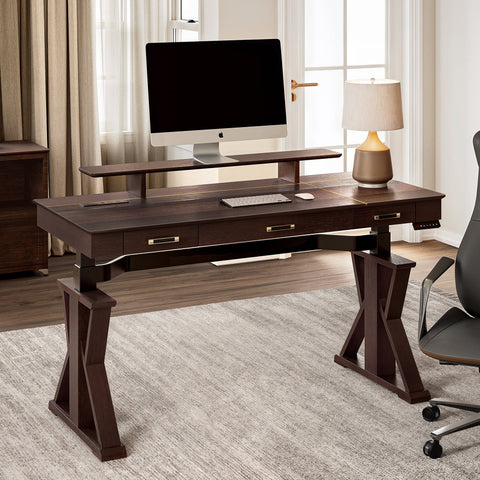
The introduction of sit-stand desks adds a mechanical dimension to cable management. As the desk moves from a seated height (typically ~29 inches) to a standing height (up to ~52 inches), every cable connected to the floor or a wall outlet is subjected to tension.
The "Service Loop" Principle
The most common cause of connector damage in ergonomic setups is insufficient cable slack. Expert installers utilize a "service loop"—an extra 12 to 18 inches of cable length—to ensure that the desk can reach its maximum extension without pulling on the PC ports or the wall outlet.
For a desk with a 52-inch maximum height and a PC located on the floor, a standard 6-foot (72-inch) power cable is often insufficient once horizontal routing and desk-frame curves are accounted for. Our analysis suggests that 10-foot cables are the practical baseline for dual standing desk configurations to maintain safety margins.

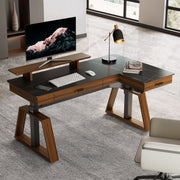
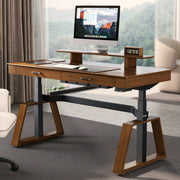
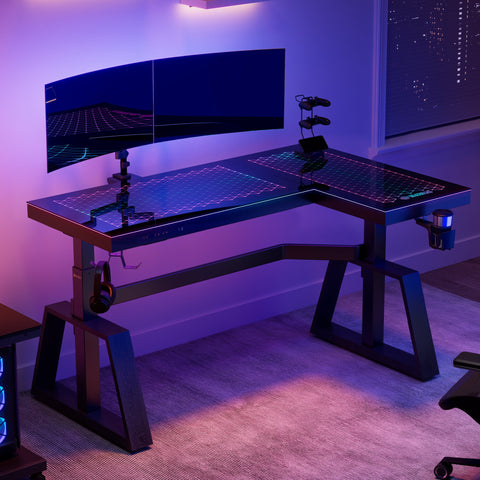
The Gaming Desk with Z Shaped Legs (61"x25") provides a stable foundation for this infrastructure. Its Z-shaped frame is designed to handle the dynamic loads of high-end equipment while offering routing paths that keep cables away from the user's legs. When setting up a dual station, placing two of these desks side-by-side allows for shared cable pathways, which can be further organized using dedicated tools.
Durable Routing Solutions
Experience in high-traffic workspaces shows that adhesive-backed cable clips often fail within six months due to the combined effects of heat from electronics and the weight of thick power cables. For lasting stability, screw-mounted under-desk trays or heavy-duty magnetic solutions are preferred.
The Magnetic Cable Tie is an effective alternative to traditional Velcro or plastic zip ties. Unlike Velcro, these do not accumulate dust or pet hair—which can become a thermal insulator over time—and they allow for quick re-routing when equipment is upgraded. For dual setups, using a color-coded tagging system at both ends of every cable (e.g., "Left PC - Monitor 1") can save hours of troubleshooting during hardware failures.
Ergonomic Integration: Beyond the Desk Surface
A dual setup must also account for the physical well-being of both users. Managing cables and power is part of a broader strategy to maintain a "neutral position," a concept emphasized by the Occupational Safety and Health Administration (OSHA). A neutral position reduces the static load on muscles and tendons, minimizing the risk of Musculoskeletal Disorders (MSDs).
Visual Ergonomics and Lighting
In a shared room, lighting becomes a collaborative challenge. Glare on one partner's screen from the other's lamp is a frequent source of eye strain. According to ISO 9241-5:2024, workstation lighting should be adjustable to prevent reflections on display surfaces.

The Soho Art Lighting system offers a modern solution for dual setups. By using smart RGB LED wall lights, couples can create localized ambient lighting that enhances the "vibe" of the room without the clutter of multiple desk lamps. These lights can be controlled via an app, allowing each user to adjust their environment's brightness and color temperature independently, which is crucial for reducing visual fatigue during long sessions.
Lower Limb Support and Circulation
While much attention is paid to the upper body, the lower limbs are equally susceptible to the risks of prolonged static posture. The World Health Organization (WHO) recommends interrupting long periods of sitting with movement. For those sharing a space, a footrest can provide the necessary postural change without requiring a full standing break every few minutes.
The Footstool with Wheels is particularly useful in dual setups where floor space may be shared. It allows users to maintain an ergonomic 90-degree angle at the knees, even if the chair height must be adjusted for a non-standard desk height. This supports blood circulation and reduces the pressure on the underside of the thighs, a common complaint in "static sitting" scenarios.
Spatial Planning: The "Tight Fit" Reality
When placing two desks in a standard 12' x 12' room, spatial constraints often dictate the layout. However, ergonomics should not be sacrificed for floor space. Our "Streamer-Ready" room depth model indicates that a dual-desk setup with 30-inch deep desks and proper circulation requires nearly the entire depth of a standard room.
| Variable | Standard Value | Requirement for Dual Setup |
|---|---|---|
| Desk Depth | 24 - 30 inches | 30 inches (for ultrawide monitors) |
| Chair Clearance | 36 inches | 42 inches (for dynamic movement) |
| Walkway | 18 - 24 inches | 36 inches (two-way traffic) |
| Total Depth | ~80 inches | ~108 - 120 inches |
Logic Summary: This spatial model assumes standard ADA Standards for Accessible Design clearances to ensure that both users can enter and exit their stations without disturbing the other, which is a key factor in long-term shared-office harmony.
Practical Recommendations for a Safe Dual Setup
To achieve a benchmark-level setup that aligns with the principles found in The 2026 Workstation White Paper: Converging Ergonomic Science and Sustainable Engineering, follow this technical checklist:
- Map Your Circuits: Identify which outlets are on the same breaker. Avoid placing two high-end gaming PCs on the same 15A circuit if you also plan to run high-draw devices like a laser printer or a localized AC unit.
- Invest in High-Joule Protection: Use a surge protector with a rating of at least 2,000 joules. For dual setups, two separate surge protectors (one for each desk) are preferred over one large unit to distribute the physical cable load.
- Implement the 12-Inch Slack Rule: Ensure every cable spanning from the floor to a sit-stand desk has at least 12 inches of slack at the desk's highest point. Test the full range of motion slowly before final cable tie-down.
- Use Screw-Mounted Trays: Avoid adhesive clips for heavy power bricks. Secure power strips to the underside of the desk using screws or heavy-duty brackets to prevent them from dangling and straining the connectors.
- Label Everything: Use a simple tag system. Troubleshooting a "no signal" error on a monitor is significantly faster when you can immediately identify which of the 12 identical black cables belongs to that specific display.
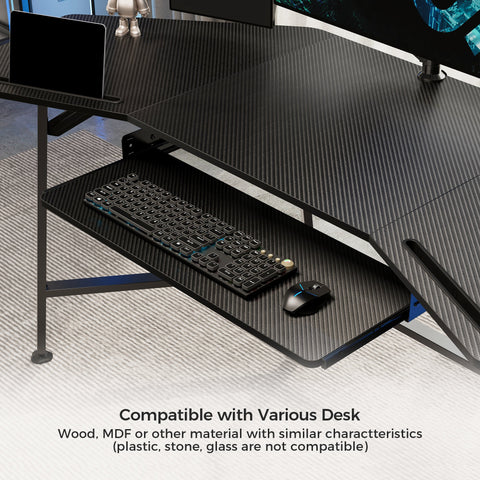
- Optimize Viewing Distance: For 34-inch ultrawide monitors, aim for a viewing distance of approximately 42–45 inches. If your desk is only 25–30 inches deep, consider using monitor arms to push the screens back or a keyboard tray to move the user further from the desk edge.
Methodology and Assumptions
The recommendations in this article are derived from scenario modeling based on high-performance dual-user environments.
- Modeling Type: Deterministic parameterized model for electrical load and spatial clearance.
-
Key Assumptions:
- Standard North American residential wiring (120V/15A).
- High-performance hardware (RTX 40-series GPUs or equivalent).
- Standard room dimensions (12' x 12').
- Boundary Conditions: These calculations may not apply to low-power laptop-only setups or commercial office spaces with 20A dedicated circuits and 240V infrastructure.
A Note on Long-Term Wellness
While professional ergonomic furniture like the Gaming Desk with Z Shaped Legs (61"x25") provides the necessary engineering controls to reduce risk, behavioral interventions are equally important. Following the "20-8-2" rhythm—20 minutes of sitting, 8 minutes of standing, and 2 minutes of movement—as recommended by Cornell University Ergonomics Web, is the most effective way to maintain musculoskeletal health over a long career or gaming lifestyle.
By treating the "under-desk" infrastructure with the same rigor as the hardware on top, couples can create a workspace that is not only visually stunning but also electrically safe and ergonomically sound.
Disclaimer: This article is for informational purposes only and does not constitute professional electrical, legal, or medical advice. Always consult with a certified electrician for home wiring modifications and a healthcare professional for chronic musculoskeletal issues.
References
- BIFMA G1-2013 Ergonomics Guideline for Furniture
- HSE: Working safely with display screen equipment (DSE)
- OSHA eTools: Computer Workstations - Neutral Working Postures
- WHO 2020 Guidelines on Physical Activity & Sedentary Behaviour
- Canadian Centre for Occupational Health and Safety (CCOHS) - Sit/Stand Desk
- The 2026 Workstation White Paper: Converging Ergonomic Science and Sustainable Engineering
Leave a comment