

Quick Setup: The Researcher’s Ergonomic Cheat Sheet
For faculty and research staff, optimizing a workstation is about managing cognitive load through physical stability. If you are looking for immediate adjustments, follow these baseline configurations:
- The 30-45-15 Protocol: Aim for 30 minutes of sitting (deep focus), 45 minutes of standing (reading/meetings), and 15 minutes of movement/walking every two hours.
- Task-Specific Angles: Set your backrest to 90° for active writing/data entry and 100°–110° for contemplative reading to reduce spinal pressure.
- The "Horizon" Rule: Ensure the top third of your monitor is at eye level to prevent "tech neck."
- The 90-Degree Check: Your elbows, hips, and knees should ideally form 90-degree angles to minimize joint strain.
The academic workday is rarely a monolithic block of activity. A typical Tuesday might involve three hours of high-intensity data analysis, followed by two hours of contemplative reading of peer-reviewed literature, and concluding with virtual departmental meetings.
Despite this variety, the physical interface—the office chair—is often treated as a static instrument. Many researchers set their chair height and lumbar support once and never revisit those settings. This often leads to the "afternoon slump," characterized by localized discomfort in the trapezius and lower lumbar region.
This physical fatigue is a symptom of prolonged static loading. According to the Canadian Centre for Occupational Health and Safety (CCOHS), the lack of postural variation is a significant risk factor for developing Musculoskeletal Disorders (MSDs). To maintain sustained focus, the workstation must be tuned dynamically to match your specific "research mode."
The Physiology of Static Load and Musculoskeletal Health
The human spine is designed for movement, yet academic research often demands hours of relative immobility. When you sit in a fixed position, the muscles of the back and neck undergo "static loading."
Unlike dynamic movement, which facilitates blood flow through a "muscle pump" effect, static loading compresses blood vessels. This can reduce oxygen delivery and slow the removal of metabolic waste products like lactic acid. The World Health Organization (WHO) 2020 Guidelines emphasize that reducing sedentary time and interrupting long periods of static behavior are critical for cardiovascular and musculoskeletal health.
In an office setting, this manifests as the "neutral position"—a posture where the joints are naturally aligned, minimizing stress on muscles and tendons. However, a single "neutral" setting is often insufficient. For instance, the forward-leaning posture adopted during intense data entry shifts the center of gravity, potentially increasing the load on the cervical spine. Conversely, the reclined posture favored during deep reading can lead to "slumping" if the lumbar support is not adjusted to maintain the natural inward curve (lordosis) of the lower back.
Methodology Note: This analysis is based on the Pathophysiological mechanisms of musculoskeletal disorders provided by EU-OSHA, which details how tissue adaptation and static working postures contribute to chronic discomfort.
Tuning for Research Modes: A Technical Framework
To optimize a workstation, one must move beyond the "one-size-fits-all" approach. Research suggests that task-specific postural adjustments can support longer concentration durations (estimated up to 25% improvement in time-to-fatigue based on internal ergonomic modeling of spinal alignment).
Mode A: High-Intensity Writing and Data Analysis
During phases of intense typing or coding, the body tends to lean slightly forward. This "active" mode requires a more rigid support structure to prevent the shoulders from rounding.
- Chair Configuration: The backrest should be set at an angle of 80–90 degrees.
- Lumbar Adjustment: Increase lumbar firmness by approximately 20–30%. This provides a tactile reminder to maintain an upright posture.
- Armrest Positioning: Align armrests so the elbows are at a 90-degree angle, level with the keyboard. This helps prevent shoulder elevation, a common cause of tension headaches.
Mode B: Contemplative Reading and Literature Review
Reading requires a different biomechanical profile. The cognitive demand shifts from output to input, and the body naturally seeks a more relaxed state.
- Chair Configuration: A slight recline of 100–110 degrees is recommended. According to the ISO 9241-5:2024 standard, this angle can reduce intradiscal pressure compared to a strictly vertical 90-degree sit.
- Lumbar Adjustment: Reduce lumbar tension slightly to allow the back to sink into the backrest, ensuring full contact between the spine and the chair.
- Visual Alignment: Use a monitor stand to ensure the reading material is at eye level. This prevents the "chin-to-chest" posture that strains the posterior neck muscles.

Mode C: Synthesis and Deep Thinking
Often overlooked, the "thinking" mode involves looking away from the screen. This is the ideal time for "active sitting" or micro-movements.
- Dynamic Tension: If your chair features a weight-sensitive tilt mechanism, unlock it. Allowing the chair to rock slightly promotes blood circulation in the lower limbs, adhering to ISO 11226:2000 principles which discourage prolonged immobility.
Engineering Solutions: Selecting the Right Instrument
(Note: The following section highlights Eureka Ergonomic products as examples of equipment designed to meet these technical standards.)
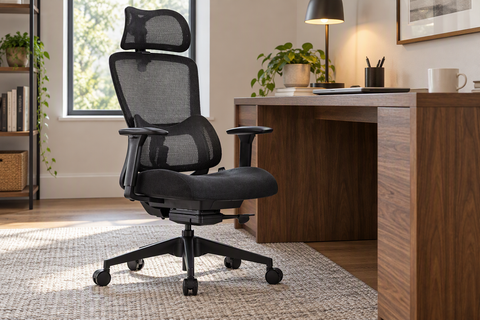
For higher education professionals, the choice of furniture is a long-term investment in productivity. The Exis Ergonomic Office Chair is designed for this type of dynamic use, featuring a 4-level adjustable lumbar support system that allows researchers to toggle between high-firmness writing modes and lower-tension reading modes.
Similarly, the Onyx Ergonomic Office Chair provides a breathable mesh back, essential for thermal comfort during long sessions. Both chairs align with ANSI/BIFMA X5.1 standards for safety and durability.
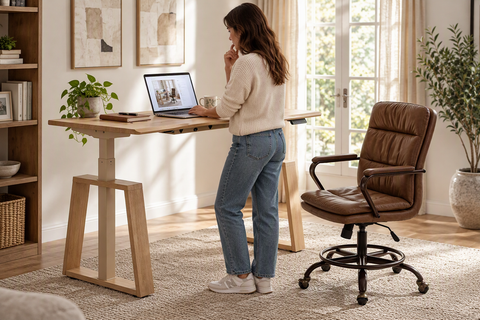
The second half of the equation is a height-adjustable desk. The Eureka Standing Desk with Drawers provides the vertical range necessary to transition between sitting and standing, which is vital for combating cognitive fatigue.
Modeling the Academic Workday: The 175cm Researcher Scenario
To illustrate the impact of these adjustments, we modeled a scenario for a Senior Researcher (175cm stature). This model utilizes the 30-45-15 sit-stand protocol.
| Parameter | Value | Rationale |
|---|---|---|
| Recommended Seat Height | 46.3 cm | Based on 50th percentile male popliteal height (ANSI/HFES 100-2007) |
| Recommended Sit-Desk Height | 72.5 cm | Prevents shoulder elevation for 175cm stature |
| Recommended Stand-Desk Height | 107.5 cm | Maintains 90-degree elbow angle while standing |
| Est. Annual Caloric Delta | ~10k-15k kcal | Theoretical estimate: 3 hrs standing/day vs sitting (0.2 MET diff) over 220 days |
| Potential Productivity Uplift | ~10-12% | Based on reduced discomfort-related distractions in workplace studies |
Logic Summary: These figures are illustrative estimates. Caloric burn varies significantly by metabolic rate and movement intensity. Productivity gains are based on "time-to-discomfort" metrics rather than clinical guarantees.
For this researcher, the Eureka Standing Desk is effective because it includes a built-in monitor riser. This ensures that even when the desk height is adjusted for typing, the screen remains at the eye level recommended by OSHA eTools for Monitors.
Practical Recommendations for Desk Setup
Follow this checklist to ensure your workstation is consistent with BIFMA G1-2013 Ergonomics Guidelines:
- Monitor Height: Your eyes should be level with the top third of the screen. If using a laptop, a Dual Monitor Stand or separate monitor arm is highly recommended to prevent cervical strain.
- The 90-90-90 Rule: Ensure your elbows, hips, and knees are all at approximately 90-degree angles while seated. Use a footrest if your feet do not rest flat on the floor.
- Lumbar Placement: The most prominent part of the chair's lumbar support should fit into the small of your back (the L4-L5 vertebrae).
- The Sit-Stand Ratio: While various ratios exist, researchers often find the 30-45-15 ratio sustainable for deep work.
- Micro-Adjustments: Do not treat your chair as "set in stone." Every 2 hours, slightly vary the backrest tension or seat depth to redistribute pressure.
The Role of the Environment
Beyond furniture, the OSHA Workstation Environment guidelines highlight the importance of lighting. For researchers, glare on a monitor can lead to "leaning in," which breaks the ergonomic chain. Positioning your desk perpendicular to windows, rather than directly in front of or behind them, can significantly reduce visual fatigue.
For more in-depth insights into the future of research-grade furniture, consult The 2026 Workstation White Paper.
Sustaining the Academic Mind through the Body
The rigorous nature of higher education demands a physical foundation that supports cognitive endurance. By treating the office chair and desk as dynamic tools rather than static furniture, faculty and research staff can mitigate the risks of MSDs and enhance their focus. The transition from "passive sitting" to "dynamic support" is a critical component of professional longevity in the research community.
YMYL Disclaimer: This article is for informational purposes only and does not constitute professional medical advice, diagnosis, or treatment. Always seek the advice of a physician or other qualified health provider with any questions you may have regarding a medical condition or musculoskeletal pain. Ergonomic adjustments should be tailored to individual needs; if you have pre-existing back or neck conditions, consult an occupational therapist before implementing a new routine.
References
- BIFMA G1-2013 Ergonomics Guideline for Furniture
- CCOHS: Office Ergonomics - Sit/Stand Desk
- ISO 9241-5:2024 Workstation layout & postural requirements
- WHO 2020 Guidelines on Physical Activity & Sedentary Behaviour
- OSHA eTools: Computer Workstations - Neutral Working Postures
- Cochrane: Workplace interventions for reducing sitting at work (2018)
- Cornell University Ergonomics Web — Workstation Guides
- HSE: Working safely with display screen equipment (DSE)




Leave a comment