

The ROI of Ergonomic Chairs for Your Business
In the modern corporate landscape, human capital is often a firm’s most significant asset and its most substantial risk. While facility managers and HR directors frequently focus on the upfront cost of office furniture, a more critical metric is the cost of inaction. Musculoskeletal disorders (MSDs) are among the leading causes of lost work time and decreased productivity globally. According to the EU-OSHA 2019 Report on MSDs, these conditions represent a massive economic burden, impacting not just healthcare costs but also the "hidden" expenses of presenteeism—where employees are physically present but cognitively impaired by discomfort.
For B2B decision-makers, the transition from "standard" seating to high-performance ergonomic solutions is not a luxury purchase; it is a strategic capital investment. This article examines the physiological principles of ergonomic seating, the quantifiable return on investment (ROI) through productivity and retention, and the technical standards that should govern procurement.
The Physiology of the Seated Worker: Why Design Matters
To understand the business case for ergonomics, one must first understand the physical toll of the "static load." When an employee sits in a poorly designed chair, the body is forced into a series of compensations. The lumbar spine flattens, increasing intradiscal pressure, while the neck protrudes forward to maintain eye level with the monitor—a phenomenon often called "tech neck."
The Occupational Safety and Health Administration (OSHA) identifies excessive force, repetitive tasks, and awkward postures as the primary risk factors for work-related musculoskeletal disorders (WMSDs). Prolonged static sitting restricts blood circulation and leads to tissue adaptation that can eventually become chronic. The ISO 11226:2000 standard provides a quantitative framework for evaluating these static working postures, emphasizing that any position held without movement for extended periods—even one that feels "comfortable" initially—increases the risk of injury.
Ergonomic chairs are engineered to facilitate a "spinal neutral position." This is achieved through adjustable lumbar support that maintains the natural S-curve of the spine and dynamic components that encourage micro-movements. By reducing the physical effort required to sit, these chairs allow the brain to dedicate more glucose and oxygen to cognitive tasks rather than managing localized pain signals.

Quantifying the ROI: Productivity, Absenteeism, and Retention
The financial justification for ergonomic intervention is often supported by three primary pillars: productivity gains, reduced healthcare/compensation costs, and improved employee retention.
1. Productivity Gains
Research consistently indicates that ergonomic improvements lead to measurable performance increases. A meta-analysis by Santos et al. (2025) confirms that ergonomic interventions significantly reduce musculoskeletal pain, which directly correlates with higher task completion rates. Industry observations suggest that recaptured productivity can range from 7% to 23% depending on the baseline level of discomfort in the workforce.
Logic Summary: Productivity Modeling Our analysis assumes that an employee experiencing moderate back discomfort loses approximately 30–50 minutes of focused work time per day due to stretching, shifting, and cognitive distraction. Reducing this by 50% via high-quality seating yields roughly 100 hours of "found" productivity per employee per year.
2. Reduction in WMSD Costs
The OSHA hierarchy of controls positions engineering controls—such as adjustable furniture—as more effective than administrative controls like "taking more breaks." By addressing the root cause of the hazard (the chair), businesses can lower the frequency of workers' compensation claims. The World Health Organization (WHO) 2020 Guidelines emphasize reducing sedentary time and interrupting static behavior, a goal that is fundamentally easier to achieve with chairs that support postural transitions.
3. Retention and Employer Branding
In a competitive talent market, the physical environment serves as a tangible signal of corporate culture. Investing in professional-grade equipment like the Royal II, Silicone & Leather Executive Ergonomic Office Chair demonstrates a commitment to employee well-being that aids in both recruitment and long-term retention.
Navigating Technical Standards: BIFMA, ISO, and Beyond
For a procurement professional, "ergonomic" can be a vague marketing term. To ensure a verifiable ROI, chairs must meet recognized international and industry-specific standards.
- BIFMA G1-2013: This industry guideline provides recommended dimensions for furniture to fit the 5th to 95th percentile of the population. Ensuring a chair aligns with the BIFMA Ergonomics Guideline is essential for a diverse workforce.
- ISO 9241-5:2024: The latest international standard for workstation layout and postural requirements. It specifies the necessary adjustment ranges for seat height, depth, and backrest angles to accommodate modern VDT (Video Display Terminal) work.
- ANSI/BIFMA X5.1: This standard defines the safety, durability, and structural adequacy of office chairs. A chair that passes these tests is built to withstand the rigors of a 24/7 office environment, directly impacting its lifespan and Total Cost of Ownership (TCO).
| Feature | Standard Requirement (Heuristic) | Business Value |
|---|---|---|
| Seat Height | 15" to 22" (approx. range) | Accommodates users of varying heights. |
| Lumbar Support | Vertical & Depth Adjustment | Reduces spinal compression and fatigue. |
| Armrests | 4D Adjustment (Height, Width, Depth, Pivot) | Minimizes shoulder strain and carpal tunnel risk. |
| Durability | BIFMA X5.1 Certified | Lowers replacement frequency (5-7 year lifespan). |
Strategic Procurement: Avoiding the "Cheap Chair" Trap
A common mistake in B2B procurement is prioritizing upfront cost over long-term durability and adjustability. A chair that lacks independent seat depth or 4D armrests will inevitably fail a significant portion of the workforce. If an employee cannot adjust the chair to their specific anthropometric needs, the "ergonomic" investment is negated.
For high-use environments, the Flex, Dual-Backrests Ergonomic Office Chair offers a unique solution. Its dual backrest design moves independently to adapt to the user's natural movements, providing continuous support even during postural shifts. This "dynamic" support is critical for knowledge workers who alternate between focused typing and collaborative discussion.

When rolling out new seating, we recommend starting with a pilot group in a high-discomfort department, such as a call center or design team. By tracking self-reported pain scores and task completion rates over 90 days, facilities managers can generate internal data to justify a wider deployment. This evidence-based approach is further detailed in our guide on what makes an office chair truly ergonomic.
The Executive Suite: Balancing Aesthetics and Support
In executive offices, the requirement for ergonomic support must often be balanced with professional aesthetics. The Forma, Ergonomic Executive Office Chair addresses this by utilizing a durable aluminum alloy frame and top-grain leather while maintaining high-level adjustability, including seat depth and a self-adapting headrest.
For managers who prefer a more traditional aesthetic without sacrificing spinal health, the Royal II, Silicone & Leather Executive Ergonomic Office Chair provides the necessary high-back support and lumbar alignment required for long hours of strategic planning. Understanding the aesthetics of ergonomics is key to ensuring that executive spaces are as functional as they are impressive.
Practical Implementation: The 20-8-2 Rule
Simply providing a high-quality chair is only half the battle; employees must also know how to set up their workstation. Following the Safe Work Australia Workstation Set-up Guide, we recommend the following baseline for all employees:
- Monitor Height: The top of the screen should be at or slightly below eye level to reduce neck extension.
- Elbow Angle: Armrests should be adjusted so elbows are at a 90-degree angle, with shoulders relaxed.
- Foot Placement: Feet should be flat on the floor or a footrest to prevent pressure on the back of the thighs.
- Movement Rhythm: Adopt the "20-8-2" rule (20 minutes sitting, 8 minutes standing, 2 minutes moving) as suggested by Cornell University's Ergonomics Web.
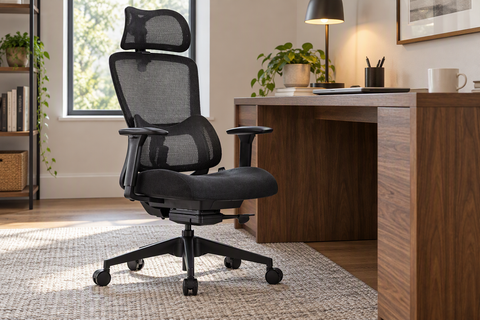
For organizations utilizing sit-stand desks, the Exis, Ergonomic Office Chair is a versatile choice. Its breathable mesh backrest and 4-level adjustable lumbar support make it an ideal companion for the "sitting" portion of the sit-stand cycle, ensuring the user remains cool and supported.

Total Cost of Ownership (TCO) Comparison
When evaluating the budget, consider the following hypothetical model comparing a budget chair to a professional ergonomic chair over a 6-year period.
Modeling Note (Scenario Analysis)
- Budget Chair: Upfront cost $150. Expected lifespan 2 years. Requires 3 replacements over 6 years. Total cost: $450 + administrative procurement time.
- Professional Ergonomic Chair (e.g., Exis): Upfront cost $400. Expected lifespan 6-8 years. Total cost: $400.
- Hidden Savings: The professional model reduces the risk of a single WMSD claim, which can cost a company thousands in insurance premiums and lost time.
This math demonstrates that the "expensive" chair is often the more fiscally responsible choice. For further reading on the business case for workplace wellness, refer to The 2026 Workstation White Paper: Converging Ergonomic Science and Sustainable Engineering.
Summary of Procurement Best Practices
To maximize the ROI of your furniture investment, facilities managers should adhere to these data-backed principles:
- Prioritize Adjustability: Ensure chairs have independent seat height, depth, and 4D armrest adjustments.
- Verify Certifications: Look for BIFMA X5.1 and ISO 9241-5 compliance to ensure safety and durability.
- Support Dynamic Movement: Select chairs like the Flex, Dual-Backrests Ergonomic Office Chair that respond to the user's micro-movements.
- Employee Education: Provide training on proper workstation setup to ensure the hardware is used effectively.
Investing in ergonomic seating is a rare "win-win" in corporate strategy. It simultaneously protects the health of the workforce while safeguarding the bottom line through enhanced productivity and reduced operational risk. By shifting the perspective from "office furniture as an expense" to "ergonomics as a performance multiplier," businesses can create a sustainable, high-output work environment.
YMYL Disclaimer: This article is for informational purposes only and does not constitute professional medical, legal, or financial advice. The ergonomic recommendations provided are based on general industry standards and may not be suitable for individuals with pre-existing medical conditions. Always consult with a qualified healthcare professional or a certified ergonomist before making significant changes to your workstation or physical activity routine.
References
- BIFMA G1-2013 Ergonomics Guideline for Furniture
- OSHA eTools: Computer Workstations - Purchasing Guide
- EU-OSHA: Work-related musculoskeletal disorders: prevalence, costs and demographics (2019)
- ISO 11226:2000 Evaluation of static working postures
- WHO 2020 Guidelines on Physical Activity & Sedentary Behaviour
- Safe Work Australia: Workstation set-up infographic (2023)
- Santos et al., 2025 – Ergonomic Interventions & Work-Related Musculoskeletal Pain (Meta-analysis)




Leave a comment