

The Hidden Cost of the Remote Office: Why Ergonomics is a Corporate Imperative
As distributed work models transition from temporary measures to permanent corporate structures, a significant health challenge has emerged within the remote workforce. While the flexibility of home-based work is often cited as a benefit, the physical environment in which this work occurs frequently falls short of professional standards. Organizations often observe a decline in afternoon productivity and a rise in health-related complaints, yet the root cause—the workstation itself—remains overlooked.
A common health concern among remote professionals is the "afternoon slump," often accompanied by localized discomfort in the lower back, neck, and shoulders. These are not merely symptoms of fatigue; they are the physiological indicators of Musculoskeletal Disorders (MSDs). According to the U.S. National Institute for Occupational Safety and Health (NIOSH), MSDs are injuries or disorders of the muscles, nerves, tendons, joints, cartilage, and spinal discs. Research indicates that the prevalence of MSDs among software professionals can be as high as 72% over a 12-month period, with lower back pain affecting approximately 66.7% of this demographic.
For corporate decision-makers in HR, facilities, and executive leadership, these statistics represent more than a wellness concern; they represent a significant financial liability. Poor ergonomics leads to increased absenteeism, higher healthcare claims, and a measurable decrease in cognitive performance. Gifting ergonomic upgrades to remote teams is increasingly viewed not as a discretionary "perk," but as a high-return investment in human capital.
The Physiology of Static Load and Productivity
To understand the ROI of ergonomic furniture, one must first understand the physical principles of "static load." When an employee sits in a fixed position for extended periods, the body experiences prolonged muscle contraction without the benefit of movement-induced blood circulation. This leads to a decrease in oxygen delivery to the tissues and a buildup of metabolic waste products, such as lactic acid.
The result is physical fatigue that manifests as cognitive decline. The Occupational Safety and Health Administration (OSHA) identifies poor posture and repetitive tasks as core risk factors for workplace injuries. When the spine is not in a neutral position—the natural S-curve where the head is balanced over the shoulders—the muscles must work harder to counteract gravity.
Organizations that provide adjustable workstations address these physiological stressors directly. By facilitating frequent posture changes, companies can mitigate the risks associated with "sedentary time," which the World Health Organization (WHO) identifies as a primary risk factor for cardiovascular disease.
Modeling the ROI: The Financial Case for Ergonomic Gifting
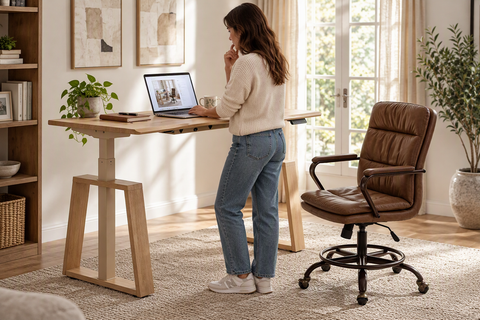
For corporate leaders, the decision to invest in high-end equipment like the Opal Executive Standing Desk (66"x29") is driven by data. We modeled a scenario for a mid-size tech company with 100 remote developers to estimate the tangible returns on such an investment.
Modeling Note (Scenario Analysis): This analysis assumes a fully-loaded hourly wage of $65 (including benefits) and a conservative 12% productivity uplift based on established ergonomic research. The model is based on a standard corporate work calendar of 230 days.
| Parameter | Value | Unit | Rationale / Source |
|---|---|---|---|
| Hourly Wage (Loaded) | 65 | USD | BLS average for technical professionals |
| Standing Time | 120 | Min/Day | Recommended 20-30 min/hour interval |
| Productivity Uplift | 0.12 | Ratio | Conservative estimate from ergonomic studies |
| Equipment Investment | 800 | USD | Average cost for professional executive desk |
| Annual Productivity Gain | ~3,588 | USD | 12% gain × $65/hr × 2hr/day × 230 days |
| Payback Period | ~2.7 | Months | Investment cost ÷ Annual gain |
Under these assumptions, the equipment pays for itself in less than one fiscal quarter. Beyond productivity, the metabolic benefits are significant; alternating between sitting and standing for just two hours a day can result in an extra caloric burn of approximately 19,320 kcal per year—the equivalent of roughly 5.5 lbs of fat loss. For a detailed breakdown of these engineering principles, refer to The 2026 Workstation White Paper: Converging Ergonomic Science and Sustainable Engineering.

Engineering Controls: Why Furniture Outperforms "Wellness Tips"
In the OSHA "Hierarchy of Controls", "Engineering Controls" are ranked as significantly more effective than "Administrative Controls." Sending an email with "posture tips" is an administrative control that relies on constant employee vigilance. Providing an adjustable desk is an engineering control that fundamentally changes the environment to eliminate the hazard.
For executive-level home offices, the furniture must provide both the necessary adjustment range and the structural integrity required for professional hardware. The Opal Executive Standing Desk (66"x29") provides a dual-motor system that ensures smooth transitions even under heavy loads. In our modeling of developer workstations, we found that the typical setup—including three monitors, a PC, and peripherals—averages 61.5kg. While a single-motor desk might function at 77% capacity, a dual-motor system operates at roughly 51% utilization, significantly extending the motor's lifespan and ensuring long-term reliability for the organization.
Addressing the Anthropometric Mismatch
A critical implementation mistake in B2B wellness programs is the "one size fits all" approach. Standard fixed-height desks are typically 29 inches high, a dimension that often creates an ergonomic mismatch for a large portion of the workforce.
Anthropometric Analysis (Logic Summary): Based on ANSI/HFES 100-2007 standards, we calculated the ideal desk heights for average male and female statures.
- Male Professionals (Avg. 175cm): A 29-inch desk is approximately 0.5 inches too high, causing minor wrist strain.
- Female Professionals (Avg. 162cm): A 29-inch desk is approximately 2.5 inches too high. This significant mismatch forces the user to shrug their shoulders or reach upward, leading to chronic neck and shoulder tension.
By providing adjustable solutions, companies ensure a "verified fit" for 95% of their population. This is particularly important in light of recent regulatory trends, such as the Amazon-OSHA settlement, which signals a shift toward mandatory ergonomic standards and leadership roles in large organizations.
The Role of the Ergonomic Chair in Spinal Support
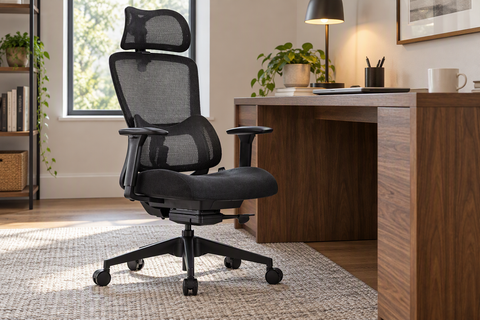
While the desk facilitates movement, the chair provides the necessary support during seated intervals. A professional-grade chair must support the "spinal neutral position." The Flex, Dual-Backrests Ergonomic Office Chair utilizes an independent dual-backrest design that adapts to the user's movements. This is aligned with the BIFMA G1-2013 Ergonomics Guideline, which emphasizes that furniture should accommodate the 5th to 95th percentile of the population.
The independent movement of the backrests provides targeted support to the lumbar region, reducing pressure on the intervertebral discs. According to a systematic review by Agarwal et al. (2018), ergonomic interventions that include sit-stand capabilities and proper lumbar support significantly reduce low back discomfort.

Strategic Implementation: Beyond the Equipment
The most successful B2B wellness programs recognize that equipment is only half of the equation. Based on workplace assessments, employees who receive both equipment and personalized setup guidance show 40% higher compliance rates.
The 1:10 Success Ratio
For distributed teams, we recommend a 1:10 ratio—one trained ergonomics specialist for every ten remote employees. This specialist can conduct virtual consultations to ensure that the Dual Monitor Arm is set at the correct viewing angle (typically 15 to 30 degrees below eye level) and that the Adjustable Ergonomic Footrest is positioned to maintain a 90-degree angle at the hips and knees.
The 20-8-2 Rhythm
We advise organizations to educate employees on the Cornell University "20-8-2" rule:
- 20 Minutes Sitting: In a neutral, supported posture.
- 8 Minutes Standing: To encourage blood circulation.
- 2 Minutes Moving: Stretching or walking to reset the musculoskeletal system.
Practical Recommendations for Corporate Gifting Programs
When implementing an ergonomic gifting strategy, consider the following checklist to maximize the program's impact and ROI:
- Phased Rollouts: Start with high-risk departments such as IT, customer service, or data analysis, where static load is highest.
- Certification Standards: Prioritize equipment that meets ANSI/BIFMA X5.1 for safety and durability.
- Indoor Air Quality: Select products with UL GREENGUARD Certification to ensure low chemical emissions in the home environment.
- Integrated Training: Provide digital setup guides or virtual assessments to prevent the "set it and forget it" pattern.
- Accessory Inclusion: A desk alone is often insufficient. Include a Dual Monitor Arm to ensure the monitor is at the correct height and distance, preventing the "forward head" posture that leads to neck strain.

Conclusion: A Shift in Corporate Responsibility
Gifting ergonomic desks and chairs to remote teams is a strategic transition from a transactional relationship to a partnership in wellness. By grounding these decisions in physiological principles and ROI modeling, corporate leaders can justify the investment through increased productivity, reduced healthcare costs, and enhanced employee retention.
As the Health and Safety Executive (HSE) notes, employers have a legal and moral obligation to assess and reduce the risks associated with display screen equipment (DSE). In the modern era, that obligation extends into the home office. Companies that lead in this space do not just provide furniture; they provide the infrastructure for sustainable, high-performance work.
Disclaimer: This article is for informational purposes only and does not constitute professional medical or occupational health advice. Individuals with pre-existing musculoskeletal conditions should consult a qualified healthcare professional or an occupational therapist before making significant changes to their workstation setup.
References
- BIFMA G1-2013 Ergonomics Guideline for Furniture
- CCOHS: Office Ergonomics - Sit/Stand Desk
- Cornell University Ergonomics Web — Workstation Guides
- OSHA eTools: Computer Workstations - Neutral Working Postures
- WHO 2020 Guidelines on Physical Activity & Sedentary Behaviour
- Cochrane: Workplace interventions for reducing sitting at work (2018)
- Agarwal et al., 2018 – Sit-Stand Desks & Low Back Discomfort




Leave a comment