

The Winter Ergonomic Gap: How Seasonal Clothing Disrupts Postural Alignment
As temperatures drop, remote workers in colder climates instinctively reach for heavy sweaters, fleece-lined hoodies, and layered knits to maintain thermal comfort. While effective for heat retention, this shift in attire introduces a significant, yet often overlooked, variable into the ergonomic equation: the "clothing gap." A standard ergonomic setup is typically calibrated for a user wearing light, professional attire. When thick winter layers are introduced, they fundamentally alter the body’s silhouette and its interaction with the workstation's contact points.
The primary concern is not merely the added warmth but the mechanical displacement of the spine. A heavy wool sweater can add between 1.5 to 3 inches of bulk to the torso's circumference. This additional material creates a physical barrier that prevents the user from fully engaging with the chair's lumbar support. Consequently, the spine is pushed forward, away from the intended neutral position, often leading to increased muscle fatigue and localized discomfort by mid-afternoon. Understanding the physiological principles behind this seasonal shift is the first step toward maintaining productivity and well-being throughout the winter months.
Physiological Principles: Static Load and Blood Circulation in Cold Environments
The human body’s response to cold environments involves peripheral vasoconstriction—the narrowing of blood vessels to preserve core body temperature. In a sedentary office environment, this physiological response is exacerbated by "static load," which refers to the physical effort required to maintain a posture without movement. According to the ISO 11226:2000 standard for the evaluation of static working postures, prolonged static positions can lead to rapid musculoskeletal fatigue and increased risk of Musculoskeletal Disorders (MSDs).
In winter, the combination of reduced ambient temperature and static sitting creates a "double-jeopardy" scenario for blood circulation. When a worker remains stationary for hours, the lack of muscle pump activity in the lower limbs reduces venous return. This is why many workers experience cold feet and legs, even when the upper body is warmly dressed. Furthermore, the World Health Organization (WHO) 2020 Guidelines on Physical Activity and Sedentary Behaviour emphasize that interrupting long periods of static behavior is critical for cardiovascular health.
The presence of bulky clothing further complicates this by altering the center of gravity. As the torso is pushed forward by a thick sweater, the head and neck often compensate by leaning toward the monitor, leading to "text neck" or cervical strain. This misalignment disrupts the "Neutral Position"—the posture where joints are naturally aligned, and muscle strain is minimized.
Logic Summary: Physiological Modeling
- Assumption: Ambient temperature < 20°C (68°F); Clothing thickness > 20mm.
- Mechanism: Vasoconstriction + Static Muscle Loading = Reduced Oxygenation to Soft Tissues.
- Model Type: Scenario-based heuristic (not a clinical study).
- Boundary Condition: Model applies to sedentary desk work; high-activity tasks mitigate these effects.
The Lumbar Mismatch: Addressing the "Clothing Gap"
The most common mistake users make when wearing winter layers is over-tightening the lumbar support. The intuitive reaction to a gap between the back and the chair is to crank the support forward. However, based on common patterns observed in ergonomic assessments and customer feedback, this often creates concentrated pressure points rather than distributed support.
When a user wears a thick knit, the fabric does not compress uniformly. Over-tightening a focused lumbar dial can cause the support to "dig in" to a specific vertebra, potentially leading to bruising or localized inflammation. A more effective approach involves transitioning from focused support to a broader, contoured support system.
Research into Work-related musculoskeletal disorders and prolonged static sitting suggests that the goal should always be to maintain the natural S-curve of the spine. For winter layering, this often means reducing the forward protrusion of the lumbar support while increasing its vertical coverage. This allows the chair to cradle the broader area of the lower back, accommodating the extra fabric without sacrificing spinal integrity.
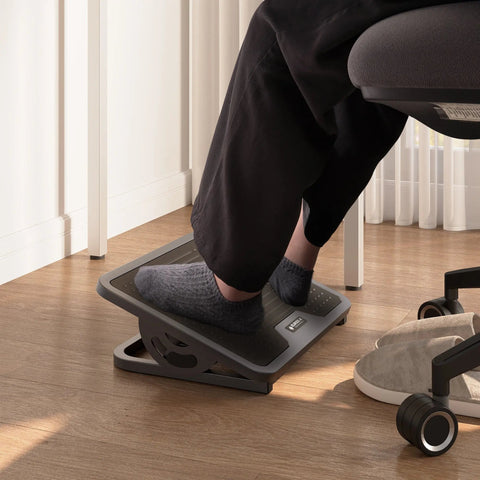
An adjustable ergonomic footrest positioned under a desk, demonstrating the correct angle for foot support to improve circulation and comfort.
Adjusting Seat Depth: The 2-Inch Rule
Another critical adjustment often neglected during the winter transition is seat depth. Standard ergonomic guidelines, such as those provided by BIFMA G1-2013, recommend leaving a gap of 2 to 4 inches between the front edge of the seat and the back of the knees to ensure proper circulation.
However, thick trousers or thermal leggings compress at the back of the knee, effectively increasing the "functional" length of the thigh. If the seat pan is too deep, the edge will press against the popliteal fossa (the area behind the knee), restricting blood flow and potentially causing numbness or tingling.
Heuristic: The Winter Seat Depth Adjustment
- Action: Increase seat depth by approximately 1 to 2 inches (25–50mm) when wearing heavy winter fabrics.
- Rationale: This accounts for the compressed fabric at the back of the knees and ensures that the user can still sit fully back in the chair to engage the lumbar support.
- Verification: Ensure you can still fit three fingers between the seat edge and your calf while your back is firmly against the backrest.
Thermal Regulation and the Sit-Stand Rhythm
One of the most effective ways to combat winter-induced stiffness is the strategic use of height-adjustable furniture. Standing desks are not just tools for posture; they are essential for thermoregulation. The act of transitioning from sitting to standing activates the "muscle pump" in the calves, which significantly improves blood circulation and generates internal body heat.
According to a Cochrane systematic review on workplace interventions for reducing sitting time, sit-stand desks can reduce sedentary time by over 80 minutes per day. In a cold climate, this movement is vital. However, users must avoid the pitfall of "static standing." Standing for too long in a cold room can lead to lower limb swelling and increased pressure on the veins.
The Cornell University Ergonomics Web recommends the 20-8-2 Rule:
- 20 Minutes Sitting: In a neutral, supported posture.
- 8 Minutes Standing: To encourage circulation and heat generation.
- 2 Minutes Moving: Stretching or walking to reset the musculoskeletal system.
In winter, this rhythm can be enhanced by using accessories such as an adjustable footrest. Elevating the feet while sitting helps reduce the static load on the lower back and improves venous return, which is particularly helpful when the legs feel heavy due to cold-induced circulation issues.
Environmental Factors: Static Electricity and Air Quality
Beyond physical posture, the winter environment introduces two secondary ergonomic hazards: static electricity and dry air. Synthetic layers (like polyester fleece) rubbing against chair upholstery in a low-humidity environment can generate significant static charges. This is not just a nuisance; sudden static shocks can cause "micro-startle" responses, leading to sudden muscle contractions and potential neck or back twinges.
Furthermore, indoor air quality often suffers in winter as buildings are sealed tight. The use of furniture with UL GREENGUARD Gold Certification ensures that your equipment is not contributing to indoor air pollution via volatile organic compounds (VOCs).
Mitigation Strategies for the Winter Workspace:
- Humidity Control: Maintain a relative humidity of 40-60% using a humidifier. This reduces static buildup and prevents the drying of mucous membranes, which can lead to eye strain.
- Static Grounding: If using synthetic layers, occasionally touch a grounded metal object or use a chair with natural leather or microfiber surfaces, which tend to generate less static than pure synthetics.
- Thermal Surfaces: For those working in particularly cold rooms, desks with integrated heating elements or stone surfaces that retain heat can provide a stable thermal environment without the need for excessive clothing layers.
Practical Recommendations for a Winter-Ready Workstation
To ensure your home office remains a bastion of health and productivity during the cold months, follow this technical checklist for seasonal adjustment.
| Parameter | Standard Adjustment | Winter Layering Adjustment | Rationale |
|---|---|---|---|
| Lumbar Support | Focused at L3-L4 | Lower protrusion, higher vertical range | Distributes support across bulky fabric |
| Seat Depth | 2-3 inch knee gap | 1-2 inch increase in depth | Accounts for fabric compression at the knee |
| Armrest Height | Elbows at 90° | Lower by 0.5–1 inch | Prevents shoulder shrugging caused by thick sleeves |
| Monitor Height | Top of screen at eye level | Re-verify after seat adjustments | Changes in seat depth often shift eye level |
| Sit-Stand Ratio | 30:30 or 40:20 | 20:8:2 (Cornell Rule) | Prioritizes frequent movement for circulation |
Methodology Note: Adjustment Heuristics
- Source: Derived from OSHA eTools for Computer Workstations.
- Logic: Adjustments are designed to maintain a "Neutral Working Posture" despite changes in external body dimensions.
- Boundary: These are starting points; individual anthropometry (e.g., shorter vs. longer limbs) requires fine-tuning.
For a deeper exploration of how these engineering principles align with sustainable workplace design, refer to The 2026 Workstation White Paper: Converging Ergonomic Science and Sustainable Engineering.
The Long-Term Value of Seasonal Ergonomics
Maintaining an ergonomic workspace is not a "set-and-forget" task. It is a dynamic process that must adapt to the user's changing environment and attire. By understanding that winter clothing is a physical component of your workstation, you can make the necessary adjustments to seat depth, lumbar tension, and movement rhythms that protect your musculoskeletal health.
Investing in furniture with high adjustability—such as chairs with dual-backrest designs or desks with precision height control—provides the flexibility needed to accommodate these seasonal shifts. Ultimately, the goal is to ensure that your workspace supports you, regardless of the temperature outside or the layers you wear inside.
Disclaimer: This article is for informational purposes only and does not constitute professional medical advice. The ergonomic recommendations provided are based on general industry standards and heuristics. Individuals with pre-existing musculoskeletal conditions, chronic back pain, or circulatory issues should consult a qualified healthcare professional or a certified ergonomist before making significant changes to their workstation setup.
Sources
- BIFMA G1-2013 Ergonomics Guideline for Furniture
- ISO 9241-5:2024 Workstation layout & postural requirements
- OSHA eTools: Computer Workstations - Neutral Working Postures
- Cochrane: Workplace interventions for reducing sitting at work
- Cornell University Ergonomics Web — Workstation Guides
- WHO 2020 Guidelines on Physical Activity & Sedentary Behaviour
- ISO 11226:2000 Evaluation of static working postures




Leave a comment