

Quick Action Guide: Winterizing Your Workspace
For professionals working in sealed winter environments, maintaining a high-performance office requires balancing thermal comfort with air quality and physical movement.
Top 3 Immediate Actions:
- Verify Materials: Ensure your desk is EPA TSCA Title VI or GREENGUARD Gold certified to minimize formaldehyde spikes when the heat is on.
- Strategic Placement: Keep furniture at least 24 inches (60 cm) away from radiators or vents to prevent "thermal forcing" of chemical off-gassing.
- The 20-8-2 Rhythm: To combat cold-induced muscle stiffness, sit for 20 minutes, stand for 8, and move for 2.
Summary: In winter, "sealed-box" offices trap Volatile Organic Compounds (VOCs) and increase musculoskeletal strain. By selecting low-emission materials like solid wood or sintered stone and utilizing height-adjustable infrastructure, you can neutralize the "Winter Spike" in indoor pollutants and maintain cognitive clarity.
The Winter Health Paradox: Why Indoor Air and Ergonomics Converge
During the colder months, the home office undergoes a fundamental transformation. As external temperatures drop, windows are sealed, central heating is activated, and the volume of fresh air circulation significantly decreases. While these measures are essential for thermal comfort, they inadvertently create a "sealed box" environment that can amplify the impact of furniture materials on respiratory health and cognitive performance.
Many professionals report a peculiar onset of afternoon fatigue, persistent headaches, or "brain fog" starting in late November—symptoms often dismissed as "winter blues." However, environmental modeling and practitioner observations suggest a more tangible culprit: the concentration of Volatile Organic Compounds (VOCs) and the physiological strain of prolonged static loading in poorly ventilated spaces.
The Science of the "Winter Spike": VOCs and Thermal Forcing
The primary concern in a sealed office is the emission of formaldehyde and other VOCs from composite wood products. Most standard office furniture utilizes Medium-Density Fiberboard (MDF) or particleboard bonded with resins. While these materials are ubiquitous, their chemical behavior changes when the environment is heated.
Chemical Kinetics and Temperature Dependence
VOC emissions are not constant. Research indicates that the emission rate of formaldehyde follows specific chemical kinetics. According to The effect of temperature on VOCs and carbonyl compounds emission from wooden flooring, emission rates are highly sensitive to ambient heat.
In winter, a unique phenomenon occurs. While the overall room temperature might remain a steady 70°F (21°C), heating systems—particularly underfloor heating or radiators—create localized "hot spots." When a desk is positioned directly over or in front of a heating vent, the surface temperature of the material can rise. Technical Note: Based on the Arrhenius equation applied to indoor air chemistry, a 10°C (18°F) rise in surface temperature can approximately double the formaldehyde emission rate from composite wood. This creates a concentrated plume of irritants exactly in the user's breathing zone.
The Ventilation Deficit
The World Health Organization (WHO) 2020 Guidelines emphasize that reducing sedentary time must be paired with a healthy environment. In summer, open windows provide multiple air changes per hour (ACH). In winter, for modern energy-efficient homes, this dilution efficiency can drop significantly.
- Heuristic Observation: In "tight" homes without mechanical ventilation (HRVs/ERVs), air exchange can drop from 0.5 ACH to below 0.1 ACH, leading to a theoretical 80% accumulation of pollutants compared to ventilated states.
Pathophysiology of Musculoskeletal Disorders in Cold Environments
The health risks of a winter workspace are not limited to air quality. There is a documented synergy between cold environments and Musculoskeletal Disorders (MSDs).
Static Load and Blood Circulation
When the body is cold, peripheral blood vessels constrict to preserve core heat. This reduced circulation makes muscles and tendons more susceptible to strain. According to ISO 11226: Evaluation of static working postures, maintaining a fixed position for extended periods—known as static loading—is a primary risk factor for MSDs.
In winter, workers tend to move less. The instinct to "huddle" for warmth often leads to a rounded shoulder posture and a collapsed lumbar spine. The Canadian Centre for Occupational Health and Safety (CCOHS) notes that alternating between sitting and standing is a critical intervention to maintain circulation and reduce the physical toll of sedentary work.
The "Double Bind" of the Tall Professional
For taller individuals, the winter ergonomic challenge is compounded. Most standard fixed-height desks (typically 29 inches) are architecturally mismatched for the 95th percentile of the population.
Modeling Case Study: 190cm User in a Sealed Room We modeled a 190cm (approx. 6'3") professional to analyze the ergonomic requirements.
Parameter Value Unit Logic / Source User Stature 190 cm 95th Percentile Male (CDC/NCHS) Recommended Standing Height 115 cm ANSI/HFES 100-2007 Ratio Standard Desk Deficit ~41 cm Difference vs. 29" fixed desk Target Humidity 40–50 % Mucous membrane protection (Heuristic) Methodology: This scenario uses deterministic anthropometric modeling based on ANSI/HFES 100-2007 ratios. Boundary Conditions: Assumes standard residential room depth and primary circulation requirements. Results for petite users or different room geometries will vary.
Navigating Regulatory Standards: EPA, CARB, and TSCA Title VI
To mitigate the "Winter Spike," professionals should prioritize specific certifications that govern material safety.
The 2018 Enforcement Gap
A common misconception is that all "compliant" furniture is equally safe. While the California Air Resources Board (CARB) Phase II standards were established in 2007, the U.S. Environmental Protection Agency (EPA) only began strict federal enforcement of the TSCA Title VI standards on June 1, 2018.
Furniture manufactured before this date may allow for higher emission levels (up to 0.09 ppm for plywood) compared to the current, more stringent TSCA Title VI limit (0.05 ppm). For a winter workspace, verifying that a desk meets the latest EPA TSCA Title VI or GREENGUARD Gold standards—which also tests for over 360 other VOCs—is essential.
Sustainable vs. Low-Emission
It is vital to distinguish between "sustainable" and "healthy." A bamboo desk might have a low carbon footprint, but if it is bonded with urea-formaldehyde resins, it remains a liability in a sealed winter room. Prioritize materials labeled as NAF (No Added Formaldehyde) or ULEF (Ultra-Low Emitting Formaldehyde), which utilize soy-based or MDI binders.

The Solution: Engineering a Health-First Winter Workspace
Addressing the intersection of ergonomics and air quality requires a multi-layered approach using the OSHA hierarchy of controls.
1. Height-Adjustable Infrastructure
A height-adjustable desk is a tool for metabolic and respiratory health. According to ISO 9241-5:2024, the workstation must accommodate postural changes. In winter, transitions between sitting and standing generate internal body heat, improving circulation and counteracting cold-induced stiffness.
2. Thermal and Chemical Comfort Synergy
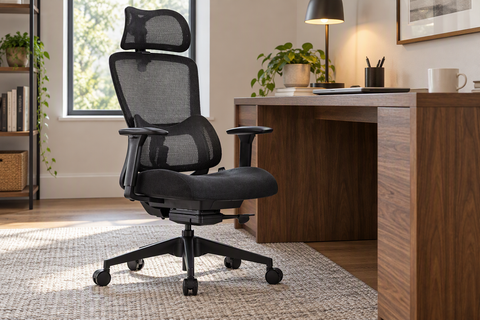
Pairing a low-emission desk with a mesh-back chair is a common practitioner recommendation. While solid leather chairs provide warmth, they can trap moisture. A mesh back allows for passive thermal regulation while providing the firm lumbar support required to maintain an open chest and optimal lung capacity for deep breathing in oxygen-limited winter rooms.
3. Material Selection: Sintered Stone and Solid Wood
For the highest level of safety, non-porous materials like sintered stone or solid wood with water-based finishes are superior. Sintered stone is chemically inert and does not off-gas, even when placed near heating vents. Solid wood surfaces avoid the resin-heavy cores of composite boards, making them ideal for individuals with chemical sensitivities or asthma.

Practical Recommendations for the Winter Professional
The 20-8-2 Rule
Cornell University’s Ergonomics Web recommends: for every 30 minutes of work, sit for 20, stand for 8, and move/stretch for 2. This prevents the "static freeze" of the musculoskeletal system while ensuring the body doesn't become over-fatigued from standing on cold floors.
Ventilation and Off-Gassing Protocols
- The 72-Hour Rule (Heuristic): Based on the initial decay curve of surface-level VOCs, allow new furniture to off-gas in a well-ventilated secondary room or with an active air purifier for 48–72 hours before use.
- Strategic Placement: Ensure your desk is at least 24 inches (60 cm) away from direct heat sources. This distance typically keeps the material surface temperature within a range that prevents exponential increases in off-gassing.
- Humidity Management: Maintain room humidity between 40% and 50%. Humidity below 30% dries out mucous membranes, making you more vulnerable to VOC irritation and airborne viruses (Source: Environmental health heuristics for indoor comfort).
The "Air Purifier Gap"
In a typical home office, a deeper desk (30 inches) provides necessary clearance behind the desk for air circulation and the placement of HEPA/Activated Carbon air purifiers. These units are most effective when they can draw air from the "breathing zone" without obstruction.

Towards a Healthier Professional Standard
Investing in low-emission, highly adjustable furniture is a strategic decision to protect cognitive performance. As outlined in The 2026 Workstation White Paper, the future of the workspace lies in the integration of physical support and chemical safety. By understanding the unique challenges of the winter environment, professionals can create a workspace that remains a source of health, even when the world outside is sealed away.
YMYL Disclaimer: This article is for informational purposes only and does not constitute professional medical, legal, or environmental health advice. Recommendations are based on general industry standards and modeling. Individuals with pre-existing respiratory conditions or chronic pain should consult with a qualified healthcare professional or occupational therapist.
Sources and Authoritative References
- BIFMA G1-2013: Ergonomics Guideline for Furniture. Link
- U.S. EPA: Formaldehyde Emission Standards for Composite Wood Products. Link
- ISO 9241-5:2024: Workstation layout and postural requirements. Link
- Cornell University Ergonomics Web: Workstation Setup Guides. Link
- WHO 2020 Guidelines: Physical Activity and Sedentary Behaviour. Link
- OSHA: Ergonomics - Solutions to Control Hazards. Link
- ResearchGate: The effect of temperature on VOCs and carbonyl compounds emission. Link
- CCOHS: Office Ergonomics - Sit/Stand Desk. Link





Leave a comment