

The 15-Minute Fallacy: Why Short Meetings Demand Ergonomic Rigor
A common misconception in corporate space planning is the "transient immunity" theory—the belief that because a meeting lasts only 15 to 20 minutes, the ergonomic quality of the seating is negligible. Decision-makers often prioritize aesthetics or "agile" branding over physiological support in huddle rooms, assuming that the short duration prevents any meaningful physical strain. However, research into Musculoskeletal Disorders (MSDs) suggests that the cumulative effect of frequent, poorly supported short-duration bouts can be as detrimental as long-term static sitting.
In a typical agile workday, an employee may cycle through four to six "quick" huddles. If these environments lack proper support, the body is subjected to repeated micro-stresses. According to the U.S. Occupational Safety and Health Administration (OSHA), poor posture and repetitive tasks are core risk factors for workplace injuries. When a team gathers around a high table without foot support or hunches over a low coffee table, they are not just "collaborating"—they are engaging in high-risk static loading.
The challenge for office managers lies in selecting seating that facilitates rapid transitions and high engagement without sacrificing the neutral spinal positions required for long-term health. This article examines the physiological impact of short-duration meetings and provides a framework for selecting the optimal mix of stools and task chairs to maximize both team productivity and employee well-being.
The Physiology of Transience: Static Load and Blood Circulation
The primary acute risk in a 15-minute meeting is not structural spinal damage, but rather a significant drop in calf muscle pump activity and cerebral blood flow. When seated in a traditional, non-adjustable chair, the lower limbs often remain static. This leads to blood pooling in the lower extremities, which can reduce the oxygenated blood flow reaching the brain, potentially diminishing cognitive sharpness during critical decision-making moments.
Scientific evaluations of static working postures, such as those outlined in ISO 11226:2000, specify acceptable limits based on duration and joint angles. In short-duration huddles, the goal is to maintain a "neutral position"—a posture where the joints are naturally aligned, minimizing stress on muscles, tendons, and the skeletal system.
The Mechanism of the "Perch-Lean" Posture
For meetings under 30 minutes, a hybrid "perch-lean" posture is often superior to traditional sitting. This involves using a high stool or a height-adjustable perch that allows the user to maintain a hip angle of 110 to 135 degrees. This open-hip angle:
- Preserves Lumbar Lordosis: It naturally encourages the lower back to maintain its inward curve without requiring active muscular effort.
- Engages the Core: Minimal engagement of the abdominal and leg muscles keeps the metabolism active and prevents the "sedentary shutdown" associated with deep sitting.
- Facilitates Movement: It allows for an instant transition to full standing, supporting the "20-8-2" rhythm (20 minutes sitting, 8 minutes standing, 2 minutes moving) recommended by the Cornell University Ergonomics Web.
Logic Summary: Our analysis of collaboration spaces assumes that posture transitions occur every 15–20 minutes. This model prioritizes "active readiness" over "passive relaxation" to maintain blood circulation and cognitive engagement.

Sit vs. Stand: Evaluating Seating Tools for Agile Zones
The choice between traditional task chairs and high-perch stools should be driven by the intended "meeting culture" and the physical constraints of the space. Equipping a room entirely with one type of seating is a frequent procurement error that can alienate users with different physical needs.
The Case for Ergonomic Task Chairs
For huddles that involve intense screen-sharing or document review, a task chair remains the gold standard. However, in a collaborative setting, the requirements differ from a dedicated workstation. The ability to quickly adjust seat height and armrests is more valuable than a complex recline mechanism.
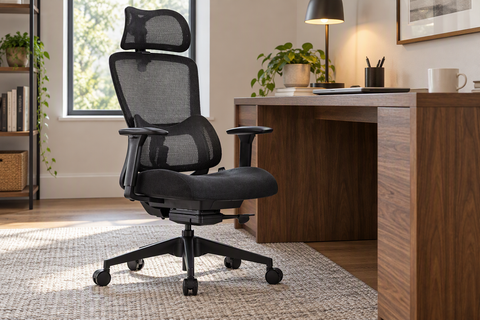
The Flex, Dual-Backrests Ergonomic Office Chair is particularly effective in these settings. Its dual-backrest design moves independently to adapt to the user's movements as they shift between looking at a central screen and their colleagues. This dynamic support is crucial because collaboration is rarely a static activity; it involves constant torso rotation and shifting, which a single, rigid backrest cannot accommodate.
The Case for Perching Stools
High stools are the preferred choice for "stand-up" meetings or agile zones where the goal is brevity. According to Cochrane (2018), sit-stand interventions can significantly reduce total sitting time. However, a stool's success is dependent on two non-negotiable features: a footring and a slight backward tilt. Without a footring, users experience "perched discomfort" within 10 minutes due to pressure on the underside of the thighs (the popliteal arch), which restricts blood flow.
The 70/30 Rule: A Strategic Seating Mix
Based on common patterns from corporate procurement and employee feedback (not a controlled lab study), a 70/30 mix of chairs to stools typically works best for agile zones. This ratio allows for natural self-selection based on the individual's current physical state or the specific nature of the meeting.
Modeling the Impact: Seating Style vs. Engagement
| Metric | Traditional Task Chair | High-Perch Stool | Standing (No Seating) |
|---|---|---|---|
| Max Comfort Duration | 60+ Minutes | 20–30 Minutes | 10–15 Minutes |
| Transition Speed | Slow (Low Center of Gravity) | Fast (High Center of Gravity) | Instant |
| Spinal Alignment | Neutral (if adjusted) | Neutral (Open Hip Angle) | Neutral (if active) |
| Cognitive Alertness | Moderate | High | Very High |
| Space Efficiency | Lower (larger footprint) | Higher (vertical focus) | Highest |
Methodology Note: This comparison is a scenario model based on standard ergonomic heuristics. "Transition Speed" refers to the time and physical effort required to move from a seated/perched position to a standing position to interact with a whiteboard or screen.
Professional Insight: Avoiding the "Aesthetic Trap"
A common mistake in B2B furnishing is selecting "designer" stools that lack ergonomic basics. From experience in office auditing, we often observe that stools without backrests or footrings lead to "C-slumping," where the user collapses their midsection to find stability. This posture increases intradiscal pressure and can lead to acute lower back pain even in short sessions.
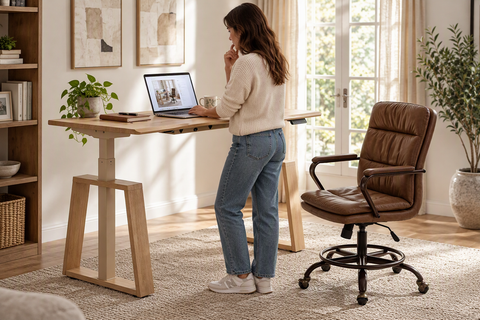
When selecting seating for executive-level huddle rooms, the Serene, Napa Leather Executive Office Chair offers a solution that balances professional aesthetics with technical support. For decision-makers who must move between high-stakes boardrooms and quick huddles, the use of genuine Napa leather provides the necessary tactile comfort, while the adjustable frame ensures that the "quick 15 minutes" do not result in a stiff neck or shoulders.
Practical Recommendations for Huddle Room Setup
To build a truly functional collaboration space, seating must be integrated with the surrounding technology and environment. As discussed in The 2026 Workstation White Paper: Converging Ergonomic Science and Sustainable Engineering, the workstation is an ecosystem where every component affects the user's health.
1. Optimize Visual Ergonomics
In short meetings, users rarely take the time to adjust monitor heights. To solve this, use a Single Monitor Arm. This allows the screen to be repositioned instantly for different users, ensuring the top of the screen stays at eye level, which is a key recommendation from the Canadian Centre for Occupational Health and Safety (CCOHS).
2. Prioritize Mobility and Flex Space
Collaboration spaces need to be reconfigurable. Integrating a 23" Rolling File Cabinet with Drawer allows for mobile storage that can be moved to clear floor space for standing huddles. This flexibility ensures the room can adapt to the group size without creating a cluttered, high-risk environment.
3. Implement the "Sit-Stand" Hierarchy
Align your room setup with the OSHA hierarchy of controls. Engineering controls (like providing height-adjustable stools and desks) are significantly more effective than administrative controls (like "reminding" employees to stand).
Checklist for Collaborative Seating Selection:
- Adjustability: Does the chair offer at least 4 inches of height adjustment? (Aligned with BIFMA G1-2013 recommendations).
- Foot Support: Do all high-perch stools include a dedicated footring?
- Lumbar Integrity: Does the chair provide firm support for the lower back? (e.g., the dual-backrest system of the Flex chair).
- Safety Compliance: Does the seating meet ANSI/BIFMA X5.1 standards for safety and durability?
Summary of Ergonomic Principles for Short Meetings
The goal of ergonomic seating in short-duration meetings is to facilitate a "dynamic neutral" state. By providing a mix of high-performance task chairs and ergonomically sound perching stools, organizations can reduce the risks of sedentary behavior while fostering a culture of movement and high engagement.
Investment in these tools is not merely a matter of comfort; it is a strategic decision to protect the company's most valuable asset—its human capital. By following established industry standards from BIFMA, ISO, and OSHA, office managers can ensure that their agile zones are as healthy as they are productive.
Disclaimer: This article is for informational purposes only and does not constitute professional medical advice. Individuals with pre-existing musculoskeletal conditions or chronic back pain should consult a qualified healthcare professional or an ergonomics specialist before adopting new seating routines or workstations.
Sources and References
- BIFMA G1-2013 Ergonomics Guideline for Furniture. Link
- CCOHS: Office Ergonomics - Sit/Stand Desk. Link
- Cochrane: Workplace interventions for reducing sitting at work (2018). Link
- Cornell University Ergonomics Web — Workstation Guides. Link
- ISO 9241-5:2024 Workstation layout & postural requirements. Link
- OSHA eTools: Computer Workstations - Neutral Working Postures. Link
- The 2026 Workstation White Paper: Converging Ergonomic Science and Sustainable Engineering. Link




Leave a comment