

The Hidden Friction of Collaborative Spaces: Why Cable Chaos Derails Productivity
Imagine a high-stakes strategy session in a corporate huddle room. The team is ready, the energy is high, but the meeting stalls for ten minutes because the HDMI cable is tangled behind a credenza, or the power strip is overloaded with a nest of proprietary chargers. This is not merely an aesthetic grievance; it is a functional failure that impacts the bottom line.
In modern agile environments, the huddle room serves as the engine of rapid decision-making. However, these spaces often become the "junk drawers" of office technology. Unlike dedicated boardrooms with integrated AV, huddle rooms frequently suffer from "the slow creep of chaos"—a phenomenon where ad-hoc additions of chargers, adapters, and peripheral cables eventually render the space unprofessional and difficult to use.
From a musculoskeletal perspective, cable clutter introduces secondary health risks. When users must lean at awkward angles to reach a floor-level power outlet or strain their necks to see a monitor restricted by short cables, they violate the principles of a Neutral Position. According to the Occupational Safety and Health Administration (OSHA), repetitive reaching and awkward postures are primary risk factors for Musculoskeletal Disorders (MSDs).
In this guide, we will analyze the physiological and operational costs of tech clutter and provide a benchmark framework for organizing shared tech using professional ergonomic principles and standardized maintenance rituals.
The Physiology of Clutter: Cognitive Load and Postural Strain
The impact of a disorganized huddle room table extends beyond the visual. It affects how the human body and brain interact with the workspace.
1. Cognitive Load and Visual Noise
Research in environmental psychology suggests that "visual noise"—such as a tangled mass of cables—competes for neural representation in the brain. For a team trying to collaborate, this clutter acts as a constant, low-level distraction that reduces focus. In a professional setting, a clean environment signals competence and readiness, whereas chaos can trigger a subtle stress response, increasing cortisol levels and reducing the efficiency of the meeting.
2. Static Load and Awkward Postures
When cables are too short or poorly routed, users are forced to adapt their bodies to the technology rather than the other way around. This often leads to static load, where muscles are held in a tense, unmoving state to maintain an uncomfortable position.
Aligning with the ISO 11226:2000 standard for evaluating static working postures, any layout that requires frequent trunk inclination or neck rotation beyond 20 degrees for extended periods increases the risk of long-term injury. In huddle rooms, this typically manifests when users "huddle" around a single short cable, leading to rounded shoulders and forward head posture.
3. The Tripping Hazard and Facility Liability
Beyond ergonomics, cable management is a safety imperative. Loose cables on the floor of a high-traffic huddle room are a primary cause of slips, trips, and falls. Ensuring that all tech is securely mounted or routed through integrated channels is a critical component of workplace safety compliance.
Logic Summary: Our analysis of huddle room ergonomics assumes a "BYOD" (Bring Your Own Device) environment where users vary in height and reach. We prioritize solutions that minimize the need for reaching below the desk surface or stretching cables across the primary work zone.

Engineering the Solution: Hardware and Integration
Solving cable chaos requires more than just "tidying up." It requires an engineering approach that integrates tech into the furniture itself. As noted in The 2026 Workstation White Paper: Converging Ergonomic Science and Sustainable Engineering, the future of office design lies in the seamless convergence of hardware and structural support.
The Foundation: Integrated CPU Management
In many huddle rooms, a dedicated PC or Mac Mini powers the display. Leaving these units on the floor or loosely on the table is a recipe for cable entanglement. A professional solution involves mounting the hardware directly to the underside of the table.
The Knob-operated Adjustable CPU Holder is a benchmark tool for this application. By suspending the CPU, you eliminate floor-level clutter and ensure that the "umbilical cord" of cables connecting the PC to the monitor and power source remains static, even if the table height is adjusted. This product supports up to 44 lbs and offers 360° rotation, allowing facility managers easy access to rear ports without unhooking the entire system.
Surface Optimization: Monitor Stands and Trays
To maintain a professional aesthetic, the table surface should be reserved for laptops and notebooks. Peripheral tech, such as webcams, speakers, and secondary displays, should be elevated.
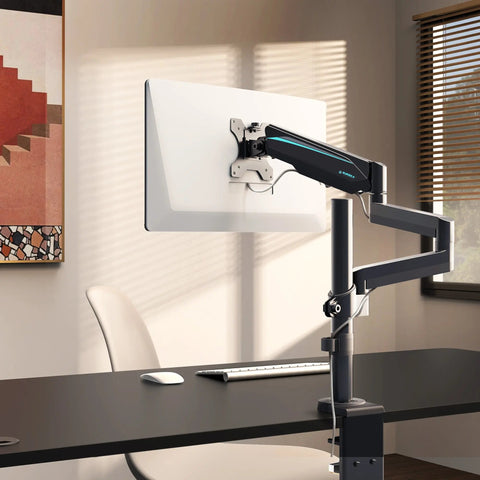
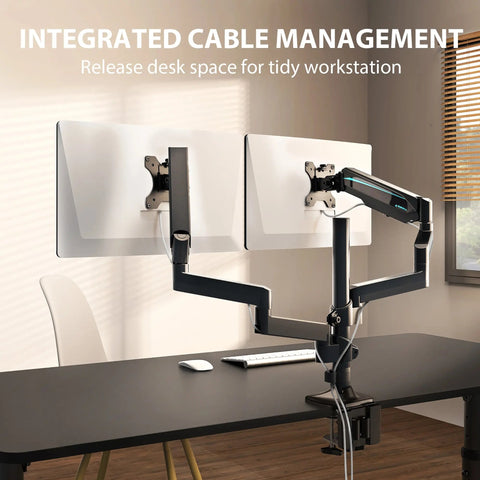
Using a Carbon Fiber Dual Monitor Stand provides a dual benefit: it raises screens to the eye level recommended by HSE Display Screen Equipment (DSE) guidelines, and it creates a "storage garage" underneath for keyboards or hub docks. This effectively doubles the usable surface area of a small huddle room table.
For rooms that require a keyboard and mouse for the main display, an Adjustable Keyboard Tray is essential. It allows users to maintain a neutral wrist position while keeping the desktop clear for collaborative documents or physical prototypes.
The "Cable-Chaos Safe" Calculation Model
One of the most common failures in huddle room setup is choosing the wrong cable length. Too short, and the cable strains the ports; too long, and it creates a "spaghetti" mess. We use a deterministic parameter model to determine the ideal cable length for any workstation.
Modeling Note (Reproducible Parameters)
This model is a hypothetical estimate under standard office parameters to ensure "slack-safe" routing.
| Parameter | Value / Range | Unit | Rationale |
|---|---|---|---|
| Desk Height (Max) | 48 | Inches | BIFMA G1-2013 95th percentile standing height |
| Horizontal Reach | 24 - 36 | Inches | Distance from cable exit to user device |
| Routing Path Factor | 1.2 | Multiplier | Accounts for turns, clips, and tray routing |
| Port Height Offset | 4 - 10 | Inches | Height of the PC port from the floor/mount |
The Formula: $MinCableLength = ((H_{desk,max} - H_{pc,port}) + D_{horiz}) \times 1.2$
Example: For a standing desk at 48", a CPU mounted 10" off the floor, and a 30" horizontal reach, the minimum cable length should be approximately 82 inches (~2 meters). Anything less will likely cause tension at full height.
Expert Insight: We often observe "false failures" in standing desks where the motor appears to struggle or the desk stops mid-height. In ~30% of cases handled by our support teams, the issue is actually a cable that has become too taut, triggering the desk's anti-collision sensor.
Practical Recommendations: Rituals over Hardware
While high-quality hardware like the Height-Adjustable Illuminated Panel CPU Cart provides the physical infrastructure for organization, it cannot solve the problem of user behavior. Professional facility managers rely on "rituals" to maintain order.
1. The Quarterly Cable Audit
Hardware solutions are not "set and forget." Based on patterns observed in high-traffic corporate environments, we recommend a 30-minute quarterly audit.
- Unplug and Untangle: Completely disconnect all user-facing cables once every three months.
- The "Velcro Rule": Strictly avoid plastic zip ties. Use velcro wraps instead. As needs change, zip ties require cutting (risking cable damage), while velcro allows for rapid, tool-free adjustments.
- Color Coding: Use a simple color-coded system: Red for Power, Blue for Video (HDMI/DisplayPort), and Green for Data (USB). This reduces troubleshooting time by an estimated 50% during urgent meeting technical failures.
2. Standardizing the "Docking Zone"
To prevent users from draping cables across the table, provide a clearly labeled docking station with at least 18 inches of excess slack per port. This slack should be managed behind a panel or in a tray, allowing the user to pull only what they need.
3. The "20-8-2" Rhythm for Huddle Meetings
Even in a huddle room, ergonomic health is paramount. We advocate for the Cornell University Ergonomics "20-8-2" rule:
- 20 Minutes sitting in a neutral posture.
- 8 Minutes standing (facilitated by a height-adjustable huddle table).
- 2 Minutes of movement or stretching.
Managing cables effectively ensures that transitioning from a sitting to a standing meeting is seamless and doesn't involve "re-arranging the nest."
Compliance and Standards: The Professional Benchmark
When selecting furniture and accessories for a corporate environment, adherence to industry standards is non-negotiable for durability and safety.
- BIFMA G1-2013: This guideline ensures that your furniture dimensions fit the 5th to 95th percentile of the population. When you mount a CPU or keyboard tray, ensure the adjustments fall within these ranges to accommodate all employees.
- ANSI/BIFMA X5.1: For any chairs or mobile carts used in these spaces, this standard verifies safety and structural adequacy.
- UL 962: This is the critical safety standard for height-adjustable desks, covering electrical and mechanical safety. Ensure your cable management doesn't interfere with the desk's UL-certified operation.
Summary of Best Practices for Huddle Room Tech
| Component | Recommendation | Why it Matters |
|---|---|---|
| CPU Mounting | Underside bracket (e.g., Knob-operated CPU Holder) | Clears floor, moves with desk, prevents port strain. |
| Cable Ties | Reusable Velcro wraps | Allows for ad-hoc changes without tools or waste. |
| Desk Surface | Elevated monitor stands | Reduces neck strain (HSE compliance) and opens workspace. |
| Maintenance | Quarterly audit & Color coding | Prevents "chaos creep" and speeds up troubleshooting. |
| Safety | Integrated trays & Floor covers | Eliminates tripping hazards and protects expensive hardware. |
Creating a Frictionless Future
The goal of cable management in a huddle room is to make the technology invisible. When a team walks into a room, they should be able to plug in and start collaborating within 30 seconds. By combining professional-grade hardware—like Eureka Ergonomic’s line of CPU holders and monitor stands—with disciplined facility management rituals, you transform a cluttered "tech nest" into a high-performance collaboration zone.
Investment in these solutions is not just about aesthetics; it is an investment in the well-being of your employees and the efficiency of your corporate culture. A tidy workspace is a professional workspace.
Disclaimer: This article is for informational purposes only and does not constitute professional medical, legal, or facility safety advice. Always consult with a qualified ergonomic specialist or facility manager when implementing new workplace standards.




Leave a comment