

The All-Nighter Checklist: Ergonomics for Late-Night Study
Ensure your body survives the marathon of finals week and late-night study sessions. This checklist covers the essential ergonomic adjustments every student should consider before an all-nighter.
Why does back discomfort often peak in the afternoon, or worse, at 3:00 AM when you are halfway through a term paper? Many students view physical fatigue as an inevitable part of academic life. However, the "burning" sensation between the shoulder blades or the dull ache in the lower back is frequently a physiological signal. Prolonged static posture, especially in setups not designed for long-term use, leads to what experts call static loading. This occurs when muscles are held in a constant state of tension to support the body against gravity, which can impede blood flow and lead to premature fatigue.
The Physiology of the "All-Nighter" Slump
To understand why a study session can feel as exhausting as a workout, we must look at Musculoskeletal Disorders (MSDs). According to the U.S. Occupational Safety and Health Administration (OSHA), MSDs are associated with risk factors such as repetitive tasks, forceful exertions, and, quite commonly for students, awkward or static postures.
When you sit hunched over a laptop, your spine may lose its "neutral position"—the natural S-curve that allows for optimal weight distribution. The ISO 11226:2000 standard specifies limits for static working postures, noting that the risk of discomfort increases based on the duration and the angle of the joints. For students, a frequent deviation is "Forward Head Posture."
Based on biomechanical heuristics for an average adult, a human head weighs approximately 10–12 pounds in a neutral position. However, clinical models (such as those by Hansraj, 2014) suggest that for every inch the head tilts forward, the effective load on the cervical spine can increase significantly—potentially doubling for every inch of forward excursion. During a late-night study session, a student leaning toward a screen may be placing 20–30 pounds of additional estimated strain on their neck and upper trapezius muscles. Over several hours, this can contribute to tension headaches and reduced cognitive focus as physical discomfort becomes a primary distraction.
Engineering the Solution: The Ergonomic Workstation
The transition from a standard desk to a dedicated ergonomic environment is centered on "Engineering Controls." As outlined in the OSHA hierarchy of controls, physical changes to the workstation are generally more effective than simply relying on self-reminders to "sit up straight" (an administrative control).
For students in compact living spaces, a dual-purpose setup that handles both intensive study and high-performance gaming is a practical solution. The Zen Pro Series, 87"/72" Executive Standing Desk with Cabinets Set represents a benchmark in this category. By providing a height-adjustable surface, it allows students to transition between sitting and standing, which is a highly recommended way to combat the risks of prolonged static sitting identified by EU-OSHA.
Logic Summary: The Efficiency of Engineering Controls Our analysis of student workflow is based on a model where cognitive load is estimated to be highest during the 2nd and 4th hours of a study block. By using a sit-stand desk (an engineering control), the user can change their physiological state without necessarily breaking their mental "flow state." In contrast, taking a traditional break often results in a 15–20 minute "re-entry" period to regain focus, a common heuristic in attention-interruption research.

The Monitor Height Trap and Visual Fatigue
A common mistake is setting a monitor too low, often relying on the default stand. This forces the gaze downward, which can lead to collapsing the chest and rounding the shoulders.
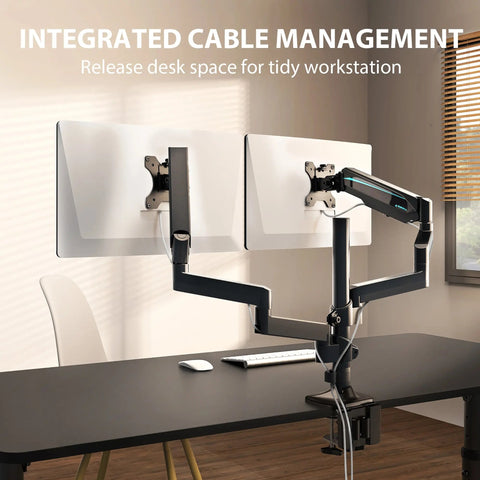
To achieve a "Neutral Working Posture," as defined by OSHA eTools, the top of the screen should be at or slightly below eye level. This helps ensure the neck remains in a neutral, upright position. If you are using a dual-monitor setup, the Carbon Fiber Dual Monitor Stand acts as an effective riser, elevating the screens to the correct viewing geometry while freeing up desk space.
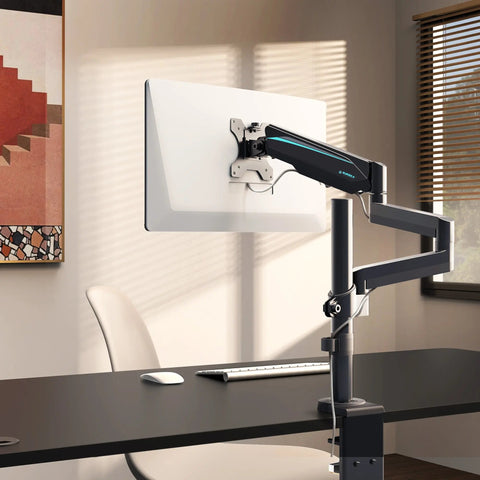
For those requiring more dynamic adjustment—such as switching between a focused "study mode" and a relaxed "gaming mode"—a Single Monitor Arm is a versatile choice. According to Cornell University Ergonomics Web, the screen should be approximately an arm's length away (20–30 inches). If the screen is too close, the eyes must work harder to converge (accommodation), which is a leading factor in digital eye strain.

The 50-10 Rule: Adapting Rhythms for Deep Work
Traditional ergonomic advice often cites the 20-8-2 rule (20 minutes sitting, 8 minutes standing, 2 minutes moving). While this is a useful guideline for office environments, it can be difficult to maintain for students during "deep work" sessions.
Research into digital eye strain and cognitive focus suggests that for time-pressed marathons, a 50-10 block is often a more sustainable heuristic. This involves:
- 50 Minutes: Focused sitting in a slightly reclined position (105–110 degrees). This recline angle, as discussed in The 2026 Workstation White Paper, helps distribute weight across the backrest and reduces estimated spinal disc pressure compared to sitting at a strict 90-degree angle.
- 10 Minutes: A mandatory reset involving standing, stretching, and looking at an object 20 feet away to relax the ocular muscles.
This rhythm aims to balance blood circulation with the requirements of a cognitive flow state. A systematic review by Cochrane concluded that sit-stand desks can significantly reduce sitting time, which is vital for mitigating the long-term risks associated with sedentary behavior, as noted by the World Health Organization (WHO).
Lower Body Support and the "Popliteal" Problem
While much attention is paid to the back and neck, the lower body is frequently neglected. When sitting, the seat depth of your chair is critical. A common pattern observed in home office setups is the "perch" or the "slump," both of which can restrict blood flow in the legs.
A practical heuristic for seat adjustment: you should generally be able to fit 2–3 fingers between the back of your knees and the edge of the seat. If the seat is too deep, it can press against the popliteal area (the space behind the knee), which may lead to discomfort or circulation issues during long periods of immobility.
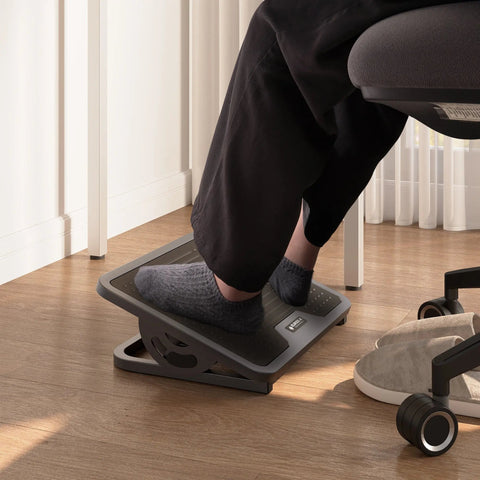
Furthermore, if your feet do not rest flat on the floor, your lower back may compensate by arching. An Adjustable Ergonomic Footrest is a helpful tool here. It ensures that the hips and knees remain at comfortable angles, providing a stable base for the spine.
The All-Nighter Ergonomic Checklist
Before your next marathon session, use this checklist to audit your environment. These parameters are aligned with general ergonomic principles found in the BIFMA G1-2013 Ergonomics Guideline.
| Component | Target Adjustment (Heuristic) | Why It Matters |
|---|---|---|
| Monitor Height | Top of screen at eye level | Reduces forward head posture and neck strain. |
| Viewing Distance | 20–30 inches (arm's length) | Minimizes ocular accommodation stress. |
| Keyboard/Mouse | Elbows at 90–110°, wrists neutral | Reduces risks of repetitive strain. |
| Seat Depth | 2–3 finger gap behind the knee | Promotes circulation to the lower limbs. |
| Lumbar Support | Matches the natural curve of the lower back | Helps prevent slouching and disc pressure. |
| Lighting | Indirect, ambient light (side/behind) | Minimizes screen glare and squinting. |
Modeling the "Student Battlestation" Scenario
To demonstrate the impact of these adjustments, we modeled a typical 8-hour study/gaming hybrid session for a standard adult user.
| Parameter | Value/Range | Unit | Rationale |
|---|---|---|---|
| Session Duration | 8 | Hours | Typical "all-nighter" or marathon gaming block. |
| Sit-Stand Ratio | 3:1 | Ratio | Based on 50-10 blocks with movement breaks. |
| Lumen Output | 300–500 | Lux | Recommended for task work to reduce eye strain. |
| Monitor Tilt | 10–20 | Degrees | Matches the natural downward gaze of the eye. |
| Ambient Temp | 68–72 | °F | Optimal range for maintaining alertness. |
Modeling Note: This scenario is an illustrative estimate based on industry heuristics and HSE DSE guidelines. It assumes a user within the 5th to 95th percentile of height and weight as defined by BIFMA standards, utilizing standard hardware. Results and comfort levels will vary based on individual physical needs and pre-existing conditions.
Lighting and Space Management in Tight Quarters
In a dorm or small apartment, two factors often degrade the study environment: poor lighting and cable clutter.
- The Lighting Paradox: Using a bright desk lamp for reading can often create reflections on the monitor. According to the Open University's guide on screen wellbeing, you should position your monitor perpendicular to windows and use indirect light to avoid glare.
- Cable Management: When using a height-adjustable desk like the Zen Pro Series Executive Standing Desk, cable tension is a critical factor. If cables are too short, they can pull on hardware or restrict the desk's range. Using adhesive-backed channels under the desk allows for smoother transitions.
Summary of Best Practices
A successful all-nighter is not just about caffeine; it is about managing your physical energy. By implementing "Engineering Controls"—such as using a Single Monitor Arm and an Adjustable Ergonomic Footrest—you can remove much of the friction that leads to pain.
The "20-8-2" or "50-10" rhythms are strongly recommended as key physiological strategies. As noted in the Safe Work Australia workstation infographic, frequent posture changes are among the most effective defenses against the development of musculoskeletal discomfort.
By treating your study space with technical rigor, you help ensure that your body remains an asset rather than a liability during critical academic moments.
Disclaimer: This article is for informational purposes only and does not constitute professional medical advice. If you experience chronic pain or have pre-existing musculoskeletal conditions, please consult a qualified healthcare professional or physical therapist before making significant changes to your workstation or routine.
References
- BIFMA G1-2013 Ergonomics Guideline for Furniture
- CCOHS: Office Ergonomics - Sit/Stand Desk
- Cochrane: Workplace interventions for reducing sitting at work (2018)
- Cornell University Ergonomics Web — Workstation Guides
- ISO 9241-5:2024 Workstation layout & postural requirements
- OSHA eTools: Computer Workstations - Neutral Working Postures
- WHO 2020 Guidelines on Physical Activity & Sedentary Behaviour
- The 2026 Workstation White Paper: Converging Ergonomic Science and Sustainable Engineering




Leave a comment