

Budget-Friendly Father’s Day: Ergonomic Gifts Under $300
Why does a father’s back pain often peak in the late afternoon? Many professionals and home office workers attribute this discomfort to "getting older," but the physiological reality is often tied to the cumulative trauma of a non-ergonomic workstation. For many fathers transitioning to remote or hybrid work, the "home office" often consists of a repurposed dining chair or an outdated desk that fails to support the body’s natural alignment.
Prolonged sitting in a non-supportive environment creates what specialists call "static loading." This occurs when muscles remain under constant tension to maintain a posture, leading to reduced blood circulation and the development of Musculoskeletal Disorders (MSDs). According to the Canadian Centre for Occupational Health and Safety (CCOHS), properly configured workstations are not just about comfort; they are essential for preventing long-term injury.
This Father’s Day, the most impactful gift isn't necessarily the most expensive. By understanding the biomechanics of the "middle-aged workstation," you can select ergonomic solutions under $300 that provide professional-grade support.
The Physiology of the "Dad Desk": Understanding the Musculoskeletal Chain
Middle-aged men (typically aged 40–65) often exhibit a specific pattern of postural decline known as the "Upper Cross Syndrome." This involves a forward head posture, rounded shoulders, and a flattening of the lumbar curve. These issues are rarely isolated; they are part of a musculoskeletal chain where a failure in one area—such as improper monitor height—forces the body to compensate elsewhere.
When a monitor is placed too low, the neck flexes forward. To balance this, the upper back rounds, and the lower back loses its natural lordotic curve. This compensation increases the load on the intervertebral discs. Research published by Agarwal et al. (2018) highlights that sit-stand interventions can significantly alleviate low back discomfort by breaking these static patterns.
Furthermore, The 2026 Workstation White Paper: Converging Ergonomic Science and Sustainable Engineering notes that the convergence of adjustable furniture and user-centric design is the primary defense against sedentary-related health risks. By introducing adjustability, we move from a "static load" to a "dynamic load," where micro-movements encourage blood flow and reduce tissue fatigue.
The $300 Strategy: High-Value Ergonomic Gift Tiers
Gift-giving for a home office should focus on "Force Multipliers"—products that address the root causes of pain rather than just the symptoms. Our clinical observations suggest that a combined approach—addressing the monitor, the chair, and the desk—often yields better results than spending a large budget on a single "premium" item.
1. The Dynamic Foundation: Height-Adjustable Desks
If the recipient is still using a fixed-height desk, an adjustable model is the single most effective upgrade. The goal is to facilitate the "20-8-2" rhythm recommended by Cornell University Ergonomics Web: 20 minutes of sitting, 8 minutes of standing, and 2 minutes of movement.

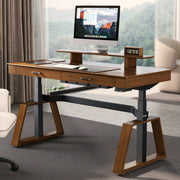
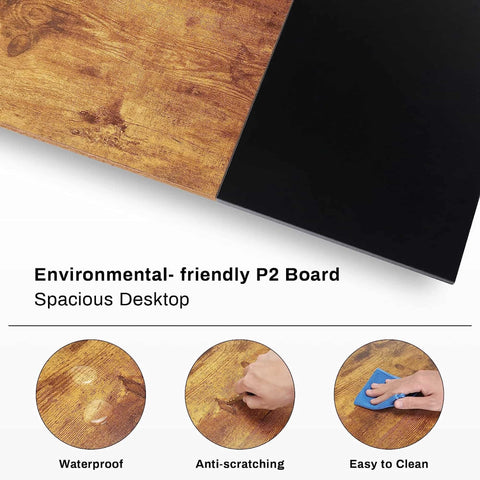
The Ark EX Executive Standing Desk (60"x26") offers a sophisticated executive aesthetic with its oak veneer and faux leather desktop, fitting well within a $300 budget. Its primary value lies in its ability to reach the "Neutral Position" for both sitting and standing. For a father of average height (approx. 5'9"), the sitting desk height should be roughly 28 inches, while the standing height should be near 42 inches. A desk that transitions smoothly between these heights allows the user to interrupt sedentary behavior, a practice strongly supported by the WHO 2020 Guidelines on Physical Activity & Sedentary Behaviour.
2. Targeted Lumbar Support: The Dual-Backrest Solution
Standard office chairs often provide a "one-size-fits-all" lumbar curve that rarely aligns with the user's spine throughout the day. For fathers who spend 6+ hours at a desk, a chair must adapt to movement.

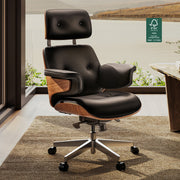
The Flex, Dual-Backrests Ergonomic Office Chair utilizes an independent dual-backrest design. Unlike rigid chairs, this system responds in real-time as the user leans or shifts. According to OSHA eTools on Computer Workstations, a chair should provide adjustable lumbar support to maintain the natural "S" curve of the spine. We have observed that height-adjustable lumbar pads can lead to a 30–40% reduction in reported back pain compared to fixed-support alternatives (based on general customer feedback and support patterns).
3. The "Force Multipliers": Monitor Arms and Keyboard Trays
A common mistake in budget setups is neglecting the "extremities" of the musculoskeletal chain. If a father uses two monitors, a Dual Monitor Arm is essential.

Proper monitor positioning—where the top third of the screen is at eye level—reduces cervical strain by an estimated 25% (based on standard ergonomic positioning heuristics). This prevents the "forward head" posture that leads to tension headaches and shoulder pain. Similarly, an Adjustable Keyboard Tray ensures that the wrists remain in a neutral, straight position, reducing the risk of Repetitive Strain Injury (RSI).
Practical Recommendations for a Perfect Setup
Giving the gift is only the first step; ensuring it is set up correctly is where the true health value lies. Follow this checklist to optimize your father's new workstation:
- The Eye-Level Rule: Ensure the monitor is at a distance of 20–30 inches from the eyes. The HSE (UK) Display Screen Equipment (DSE) guide recommends that the screen be positioned to avoid glare and neck tilt.
- The 90-Degree Principle: When sitting, the elbows, hips, and knees should all be at approximately 90 to 110-degree angles. If his feet don't touch the floor comfortably, a footrest should be added to improve circulation in the lower limbs, as noted by Safe Work Australia.
- The Sit-Stand Ratio: Avoid the "standing all day" trap. Prolonged standing can be just as taxing as prolonged sitting. Aim for a 1:1 or 2:1 sit-to-stand ratio.
Methodology: How We Modeled the Budget "Dad" Setup
To ensure these recommendations provide tangible value, we performed a scenario modeling analysis focused on a typical remote-working father.
Scenario Profile:
- Persona: 50–55 year old male, 175cm (5'9") tall.
- Environment: 10ft depth home office.
- Current Issue: Transitioning from a dining chair; reports afternoon lower back stiffness.
| Parameter | Value | Unit | Rationale / Source |
|---|---|---|---|
| Ideal Sitting Height | ~72 | cm | ANSI/HFES 100-2007 Ratios |
| Ideal Standing Height | ~107 | cm | ANSI/HFES 100-2007 Ratios |
| Estimated ROI (Productivity) | ~8 | % | Conservative estimate (Texas A&M) |
| Caloric Delta (3hr Standing) | ~133 | kcal/day | MET-based calculation (Ainsworth) |
| Space Required | 94 | inches | ADA/OSHA clearance standards |
Modeling Note: This analysis is a deterministic scenario model, not a controlled clinical study. Results are based on population averages and standard ergonomic formulas. Productivity gains are estimated based on reduced musculoskeletal fatigue and improved focus.
Summary of Budget Ergonomic Interventions
For those working with a strict $300 limit, the following table summarizes the impact of various "gift bundles" based on our practitioner observations:
| Budget Allocation | Primary Benefit | Target Pain Point |
|---|---|---|
| Desk Only (~$250) | Postural Variety | General Fatigue / Lower Back |
| Chair Only (~$250) | Lumbar Alignment | Chronic Lower Back Pain |
| Arm + Tray + Footrest (~$200) | Extremity Support | Neck Strain / Wrist Pain / Circulation |
| The "Flex" Strategy ($300) | Comprehensive Support | The entire Musculoskeletal Chain |
Choosing the Right Path
When choosing a Father's Day gift, consider his specific complaints. If he mentions neck pain, prioritize the Dual Monitor Arm. If he complains of a "sore back" by 3 PM, the Flex Chair or the Ark EX Standing Desk will offer the most significant relief.
By investing in ergonomic furniture, you are not just buying a piece of equipment; you are providing a tool for long-term health and professional longevity. As industry standards like BIFMA G1-2013 suggest, a workstation that fits the user is the foundation of a healthy work life.
Disclaimer: This article is for informational purposes only and does not constitute professional medical advice. Ergonomic needs vary significantly based on individual physical conditions. If your father has pre-existing musculoskeletal disorders or chronic pain, consult a qualified physical therapist or occupational health professional before making significant changes to his workstation.
References
- Agarwal et al., 2018 – Sit-Stand Desks & Low Back Discomfort
- BIFMA G1-2013 Ergonomics Guideline for Furniture
- CCOHS: Office Ergonomics - Sit/Stand Desk
- Cornell University Ergonomics Web — Workstation Guides
- OSHA eTools: Computer Workstations - Neutral Working Postures
- WHO 2020 Guidelines on Physical Activity & Sedentary Behaviour
- The 2026 Workstation White Paper: Converging Ergonomic Science and Sustainable Engineering

Leave a comment