

High-end ergonomic furniture for home office design succeeds when technical specifications take priority over surface-level style. Professionals who specify pieces with proper height ranges, stable mechanisms, and integrated systems gain both refined appearance and reliable support for long sessions. These investments can also qualify for tax-advantaged programs when supported by appropriate medical documentation.

Professionals who upgrade from basic setups often face desks that wobble at standing height or chairs that fail to maintain alignment. The right specifications solve these problems. Designers who lead with performance metrics build workspaces that support productivity and health over years of use.
Technical Performance Requirements for Executive Grade Standing Desks
Designers begin specification work by confirming that each desk meets core performance thresholds. This step prevents later regrets when a beautiful piece proves unstable under real loads.
Height Range Considerations
BIFMA G1-2013 sets a practical range from 22.6 to 48.7 inches. This span accommodates most adults from the 5th percentile female to the 95th percentile male. Desks outside this window limit usability for some team members or family members who share the space.
Measure the primary user first. Check seated elbow height and standing eye level. Confirm the desk travels the full distance smoothly. Dual-motor systems usually deliver the torque needed for heavy tops without drift or sway.
Load Capacity and Stability
Executive setups often carry multiple monitors, docking stations, and accessories. A 300-pound capacity offers a useful benchmark for these loads. Horizontal stability at full height remains the more important test. Single-motor desks frequently flex or rock under these conditions.
The chart below helps visualize the typical performance gap.
Home Office Desk vs Executive BIFMA Benchmarks
A bounded comparison of common home-office desk specs versus stricter BIFMA-oriented executive benchmarks. The chart highlights typical performance gaps in height range, load handling, and stability expectations.
View chart data
| Category | Standard home office desk | Executive BIFMA benchmark |
|---|---|---|
| Height range | 2.0 | 3.0 |
| Load capacity | 2.0 | 4.0 |
| Stability testing | 1.0 | 3.0 |
This visual clarifies where standard desks often fall short on stability and load handling. Executive specifications close that gap in most weekday use cases.
Premium desks that satisfy these metrics support heavy equipment without compromise. They also reduce vibration that can distract during calls or focused work.
Mechanical Specifications for High Performance Ergonomic Office Seating
Seating forms the daily foundation of any command center. Proper mechanics maintain posture across hours of mixed sitting and standing.
Synchro-Tilt and Recline Mechanics
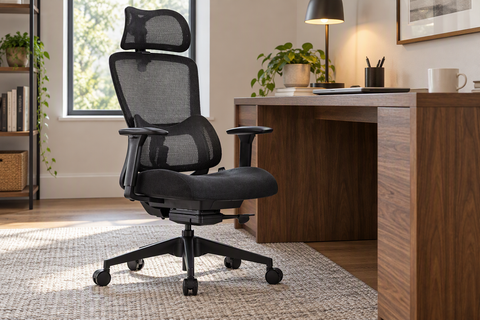
Synchro-tilt systems typically hold a 2:1 ratio between backrest and seat movement. This ratio keeps spinal alignment stable as the user reclines. The mechanism should move smoothly and lock at multiple points.
Seat Depth and Lumbar Support
Adjustable seat depth prevents pressure behind the knees. Leave a two-finger gap for proper circulation. Lumbar support needs independent height and depth controls so each user can dial in exact placement.
Material choice affects comfort too. Breathable leathers or performance fabrics manage heat during long video calls. Test samples in the actual room lighting before final selection.
High-performance seating that meets these details reduces fatigue. It also projects quiet confidence that matches the rest of a luxury workspace.
Integration of Technical Ecosystems into Luxury Workspace Design
Furniture alone does not complete the picture. Integrated systems keep technology invisible while remaining accessible.
Cable Management and Power Access
Concealed channels route cords under the desktop or inside legs. Integrated power modules supply charging ports exactly where needed. These details preserve clean lines that designers value.
Monitor Arms and Lighting
Monitor arms with precise tension adjustment hold screens at eye level for any height setting. This placement limits neck strain. Ambient lighting with strong color rendering reduces eye fatigue during extended screen time.
The following table summarizes integration priorities.
| Component | Key Specification | Benefit for Designers |
|---|---|---|
| Cable channels | Fully concealed, tool-free access | Maintains minimalist aesthetic |
| Power modules | Multiple USB-C and AC outlets | Supports high-wattage devices cleanly |
| Monitor arms | Gas-lift with micro-adjustment | Consistent ergonomics at every height |
| Task lighting | CRI above 90 | Accurate color and reduced glare |
These elements turn a collection of furniture into a seamless command center. They also simplify daily maintenance for busy professionals.

Health Investment Justification through Tax Advantaged Benefit Programs
Premium ergonomic furniture can function as a health investment. IRS Publication 502 outlines criteria for medical expense deductions. Tax-advantaged accounts such as HSA or FSA may cover qualifying items when a licensed provider determines medical necessity.
A Letter of Medical Necessity usually serves as the core documentation. Plan administrators make the final decision based on individual rules and the specific diagnosis. Eligibility therefore varies and requires direct confirmation with the plan.
Professionals who document clear needs can offset costs through these programs. This approach frames the purchase as a strategic health decision rather than discretionary spending. Always consult a tax advisor or plan administrator before assuming coverage.
Specify Premium Solutions for Your Next Executive Project
Technical excellence turns a home office into a true high-performance command center. Designers who prioritize these specifications create spaces that support both health and output for years. The process rewards attention to detail at every stage.
Take time to measure the room, test adjustment ranges, and verify integration details before ordering. This careful approach leads to results that satisfy both aesthetic and performance goals.
Call to Action
Review the specifications against your current project. Identify the first element that falls short of executive standards. Address that gap with the appropriate high-performance option. Professionals who act on these criteria build offices that deliver lasting value and refined presence. (58 words)
Q1: What height range should an executive standing desk cover?
Most executive standing desks should adjust from 22.6 to 48.7 inches. This range fits the majority of adult users from the 5th to 95th percentile. Confirm the specific model travels the full distance under load before purchase.
Q2: How does synchro-tilt improve ergonomic seating performance?
Synchro-tilt with a 2:1 ratio maintains spinal alignment during recline. The mechanism coordinates backrest and seat movement so pressure stays balanced. Users experience less fatigue across long workdays when this feature is present.
Q3: Can cable management systems preserve a luxury office aesthetic?
Concealed cable channels and integrated power modules eliminate visible clutter. These systems route cords cleanly beneath surfaces or inside legs. The result supports minimalist design while keeping technology fully accessible.
Q4: Are premium ergonomic items eligible for hsa or fsa funds?
Many premium ergonomic items qualify when supported by a Letter of Medical Necessity. Final eligibility depends on individual plan rules and provider assessment. Contact the plan administrator early to verify requirements and documentation standards.
Q5: What load capacity matters most for executive standing desks?
A 300-pound capacity provides a reliable benchmark for multi-monitor setups and accessories. Stability at full height often proves more important than raw weight rating. Dual-motor systems typically deliver the needed rigidity under these conditions.




Leave a comment