

L-Desk Sizing for Gamers vs. Remote Workers: A Scientific Approach to Spatial Ergonomics
The choice of a workstation is often reduced to aesthetics or available floor space. However, for those spending eight to twelve hours a day in a digital environment, the dimensions of a desk are less about furniture and more about musculoskeletal health. Whether you are navigating a high-stakes competitive match or managing complex project workflows, the physical interface between your body and your equipment determines your long-term physical well-being.
The L-shaped desk has emerged as a preferred solution for both gamers and remote professionals due to its ability to maximize corner space and provide distinct "zones" for different tasks. Yet, a "one size fits all" approach to L-desk sizing often leads to ergonomic friction. A gamer’s need for expansive monitor arrays and wide-radius peripheral movement frequently conflicts with a remote worker’s requirement for document proximity and task-focused concentration.
In this guide, we analyze the physiological principles behind L-desk configuration, leveraging industry standards such as BIFMA G1-2013 Ergonomics Guideline for Furniture and the latest findings from The 2026 Workstation White Paper: Converging Ergonomic Science and Sustainable Engineering, to help you determine the optimal dimensions for your specific use case.

The Physiology of the L-Shape: Neutral Reach and Static Load
The primary ergonomic advantage of an L-shaped desk is its ability to keep more equipment within the "Neutral Reach Zone." According to the U.S. Occupational Safety and Health Administration (OSHA), a neutral posture is one where joints are naturally aligned, reducing stress and strain on the muscles, tendons, and skeletal system.
When using a standard straight desk, reaching for a peripheral or a secondary monitor often requires "trunk rotation" or overextension of the shoulder. Repeated thousands of times, these micro-movements contribute to Musculoskeletal Disorders (MSDs). The L-shape allows the user to pivot their chair rather than stretch their body.
However, the effectiveness of this pivot depends entirely on the desk's depth and wing length. If the "return" (the shorter side of the L) is too deep, it may force the user to lean forward, violating the spinal neutral position. Conversely, if the primary surface is too shallow, the viewing distance to high-resolution monitors may be insufficient, leading to digital eye strain and "turtling"—the habit of leaning the neck forward to see detail.
Gamer-Specific Sizing: The "Battlestation" Requirements
For gamers, the desk is a high-performance platform. The ergonomic challenges here are unique: extended periods of "static load" (holding a single position) combined with high-velocity repetitive movements of the wrists and arms.
1. The Primary Zone Width (60–72 Inches)
Modern gaming often involves triple-monitor setups. To accommodate three 27-inch monitors at a proper eye level with a 20–30° viewing angle—as recommended to reduce neck rotation—a primary desk width of 60 to 72 inches is typically required. A desk like the GTG - L60, L-Shaped Glass LED Gaming Desk (60"x40") provides the necessary 60-inch span to support dual or triple monitor configurations while maintaining a stable, scratch-resistant surface.
2. Surface Depth (25–30 Inches)
Depth is the most overlooked factor in gaming ergonomics. Gamers need at least 25 inches of depth to ensure their keyboard and mouse are placed at elbow height (a 90° angle) without their monitors being too close. According to ISO 9241-5:2024 Workstation layout & postural requirements, the viewing distance should be adjustable to accommodate the user's visual acuity, typically ranging from 20 to 40 inches.
3. The Secondary Wing (40+ Inches)
The secondary wing in a gaming context usually houses "off-task" peripherals: streaming decks, consoles, or audio interfaces. A wing length of 40 inches or more ensures these items remain within a 15-inch reach radius from the pivot point, preventing the need for the user to leave their ergonomic "pocket" during a session.
Logic Summary: Gaming Dimension Heuristics Our sizing recommendations assume a standard "P95" adult male/female reach envelope and the use of 27-inch monitors. These figures are heuristics designed to prevent excessive neck rotation and shoulder abduction.
Parameter Recommended Value Unit Rationale Primary Width 60 - 72 Inches Accommodation of triple 27" monitors Surface Depth 25 - 30 Inches Proper focal length & elbow support Return Length 40+ Inches 15" reach radius for secondary peripherals Height Range 28 - 48 Inches Alignment with BIFMA sitting/standing ranges
Remote Work Sizing: The "Productivity Hub" Requirements
Remote workers face a different set of ergonomic stressors. While gamers deal with high-intensity bursts, remote workers deal with the "marathon" of static sitting. The focus shifts from peripheral spread to document management and multi-device switching.
1. Dual Monitor and Document Zones
A remote worker’s primary zone typically requires 55 to 65 inches. This accommodates dual monitors plus a dedicated 12-inch "document zone." Proper document placement is critical; using a document holder or a dedicated desk area prevents the neck flexion associated with looking down at papers on a flat surface.
2. Task Concentration Depth (26–30 Inches)
Remote work often involves "analog" tasks—signing papers, reviewing blueprints, or using a tablet. A depth of 26 to 30 inches allows for document stacking behind the keyboard, preventing the user from leaning forward. This depth also facilitates the use of tools like the Carbon Fiber Dual Monitor Stand, which elevates screens to eye level while reclaiming the space underneath for storage, effectively increasing the "functional depth" of the desk.
3. The Multitasking Return
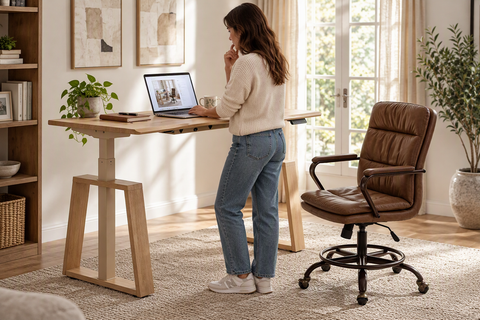
For professionals, the L-shaped return often serves as a "docking station" for a laptop or a secondary workstation. The Blossom Dynamics® Office Standing Desk (70"x46") illustrates this well; its 70-inch irregular shape provides ample surface area for a primary computer setup while the extended wing handles secondary devices or physical filing, keeping the main workspace clutter-free.
A remote worker using the Blossom Dynamics Office Standing Desk in a bright, modern home office.
The "Irreconcilable Conflict": Reach vs. Spread
A key insight from ergonomic field observations is the conflict between "viewing distance" and "reach distance." Gamers often want their monitors further back to take in a wide field of view (requiring depth), while remote workers need their peripherals and documents closer (requiring a shallower profile).
If you are using one desk for both activities, the solution lies in adjustability. Using a Dual Monitor Arm allows you to pull the monitors forward for focused work and push them back for immersive gaming. This flexibility is essential for maintaining the "spinal neutral position" across different tasks.
Mitigating Musculoskeletal Risks through Sizing
Failure to match desk size to activity often results in specific physiological issues:
- Cervical Strain: Caused by monitors placed too far apart on an undersized L-desk, forcing the user to rotate their head beyond the safe 20° limit.
- Trapezius Fatigue: Occurs when a desk is too shallow, forcing the user to "shrug" their shoulders to place their arms on the surface.
- Repetitive Strain Injury (RSI): Often linked to "peripheral sprawl," where the mouse or keyboard is outside the 15-inch optimal reach zone.
According to a meta-analysis by Santos et al. (2025), ergonomic interventions—including proper furniture sizing and layout—significantly reduce work-related musculoskeletal pain.
The Hidden Ergonomic Factor: Cable Management
Expert ergonomists note that cable clutter is more than an aesthetic issue; it is a physical hazard and a psychological stressor. For gamers, who average 12 or more cables (monitors, peripherals, audio, power), integrated trays are a necessity. Awkward bending to reach a floor-level power strip is a common cause of acute lower back strain.
Desks like the GTG - L60 address this with dedicated power strip holders and cable management systems. By keeping cables organized and accessible, you eliminate the need for "ergonomic gambles"—those moments where you twist your body into a dangerous position to plug in a device.
Implementation: How to Measure and Set Up
Before selecting an L-desk, follow this professional setup protocol:
- Map Your Reach: Sit in your chair and sweep your arms in a circle. Your primary tools (keyboard/mouse) must stay within the "inner circle" (elbows at sides). Your secondary tools (phone, stream deck) should stay within the "outer circle" (arms extended but shoulders not reaching).
- Verify the 20-8-2 Rhythm: As recommended by Cornell University Ergonomics Web, the ideal work rhythm is 20 minutes of sitting, 8 minutes of standing, and 2 minutes of moving. Ensure your L-desk's height adjustment mechanism is smooth enough to encourage these transitions.
- Check Legroom: Ensure the L-desk frame doesn't obstruct your legs. According to ANSI/BIFMA X5.5, desks must provide adequate knee and foot clearance to allow for posture changes throughout the day.
Summary of Dimensional Comparisons
| Feature | Gaming Optimized | Remote Work Optimized |
|---|---|---|
| Primary Width | 60" - 72" (Triple Monitors) | 55" - 65" (Dual + Documents) |
| Primary Depth | 25" - 30" (Focal Length) | 26" - 30" (Analog Tasks) |
| Wing Length | 40"+ (Peripheral Spread) | 30" - 40" (Laptop/Filing) |
| Key Accessory | Dual Monitor Arm | Carbon Fiber Dual Monitor Stand |
| Main Goal | Immersion & Movement | Concentration & Organization |
Final Considerations for Long-Term Health
Choosing the right L-desk size is an investment in your physical longevity. While it may be tempting to compromise on a smaller surface for a tight room, the long-term costs of poor ergonomics—ranging from chronic back pain to reduced productivity—far outweigh the initial space savings.
By aligning your desk dimensions with the scientific principles of neutral reach and viewing distance, you create a workspace that supports your body rather than challenging it. Whether you are building a professional home office or the ultimate gaming setup, let the ergonomics of the L-shape work for you, not against you.
YMYL Disclaimer: This article is for informational purposes only and does not constitute professional medical advice, diagnosis, or treatment. Always seek the advice of a physician or other qualified health provider with any questions you may have regarding a medical condition or musculoskeletal pain.
References
- BIFMA G1-2013 Ergonomics Guideline for Furniture
- CCOHS: Office Ergonomics - Sit/Stand Desk
- Cornell University Ergonomics Web — Workstation Guides
- ISO 9241-5:2024 Workstation layout & postural requirements
- OSHA eTools: Computer Workstations - Neutral Working Postures
- The 2026 Workstation White Paper: Converging Ergonomic Science and Sustainable Engineering
- Santos et al., 2025 – Ergonomic Interventions & Work-Related Musculoskeletal Pain (Meta-analysis). PubMed




Leave a comment