

The Criticality of Spatial Planning in Ergonomic Environments
Purchasing an L-shaped desk is often a pivotal decision for a home office or gaming setup. These units offer expansive surface area and a natural "cockpit" feel that can significantly enhance productivity and focus. However, we often observe that a lack of rigorous pre-purchase measurement leads to the two most common reasons for product returns: "it doesn't fit the room" or "it doesn't fit the user."
In our experience assisting thousands of workspace transformations, a desk that is even two inches too long or three inches too deep can disrupt the entire flow of a room, creating "dead zones" or obstructing vital pathways. Beyond mere aesthetics, improper fit can force users into compromised postures. According to the Canadian Centre for Occupational Health and Safety (CCOHS), the setup of a workstation directly influences the risk of developing Musculoskeletal Disorders (MSDs).
This guide provides a comprehensive, professional-grade checklist designed to move beyond basic length and width. We will explore the structural, ergonomic, and infrastructural measurements required to ensure your L-shaped desk facilitates health and performance rather than creating a spatial bottleneck.

1. Structural Audit: Walls, Corners, and Floor Integrity
The most common mistake in workspace planning is assuming that architectural reality matches the blueprint. Before selecting a model like the GTG - L60, L-Shaped Glass LED Gaming Desk (60"x40"), you must perform a structural audit of your intended corner.
The 90-Degree Myth
Most residential and commercial corners are not perfect 90-degree angles. We frequently encounter "corner drift," where walls deviate by up to 5 degrees. If you purchase a fixed-frame L-desk and your corner is slightly obtuse or acute, you will be left with a widening gap between the desk and the wall, which swallows cables and creates instability.
- Action: Use a digital angle finder or a simple carpenter’s square to verify the corner. If the deviation is significant, consider a desk with a slightly smaller footprint or a reversible frame that allows for more flexible positioning.
Floor Load and Weight Concentration
L-shaped desks, by design, concentrate weight at the corner junction. This is where users typically place heavy items: triple monitor setups, high-performance CPUs, and monitor arms. As noted in The 2026 Workstation White Paper: Converging Ergonomic Science and Sustainable Engineering, sustainable engineering must account for the localized pressure exerted on flooring materials.
Logic Summary: Floor Loading Model Our analysis of professional setups assumes a concentration of equipment at the L-junction. Standard office floor capacity is typically rated at 50 lbs/sq ft. An L-desk with a heavy load can approach this limit in a very small area.
Parameter Estimated Value Unit Rationale Standard Office Floor Capacity 50 lbs/sq ft Building Code Baseline Typical L-Desk Weight (Empty) 80–120 lbs Average for steel/wood construction Equipment Load (Triple Monitor + PC) 60–90 lbs High-end workstation estimate Footprint Concentration Factor 1.5x - Weight clusters in the corner junction
Base Clearance and Baseboards
Do not measure wall-to-wall at waist height only. Baseboards and crown molding can shave 0.5 to 1 inch off your available space. If your measurements are tight, a desk that "fits" at the top might be blocked by the baseboard at the bottom, preventing it from sitting flush against the wall.
2. The Functional Footprint: Navigating the "User Zone"
A desk does not exist in a vacuum; it requires a "User Zone"—the space needed to actually operate the desk.
The Chair Rotation Zone
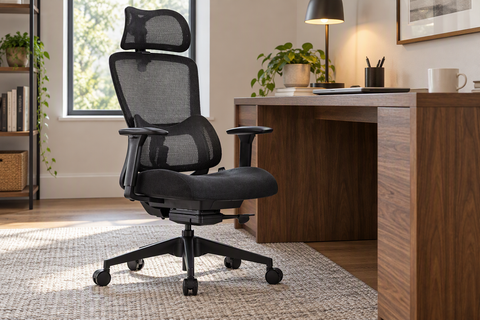
Experienced workspace planners consistently emphasize a critical measurement oversight: forgetting to account for chair movement. We recommend maintaining at least 24 to 30 inches of clearance behind the desk. This allows for comfortable chair rotation, the ability to push back and stand up without hitting a wall, and the use of ergonomic chairs that may have a wider 5-star base.
According to Safe Work Australia, insufficient space behind the workstation is a primary contributor to "constrained posture," where users sit too close to the edge to avoid hitting obstacles behind them.
Assembly Maneuvering Space
For L-desks requiring on-site assembly, you must measure wall-to-wall clearance for the longest arm (often 60–72 inches) plus an additional 12–18 inches for maneuvering. Many L-shaped desks are assembled upside down; if your room is exactly the width of the desk, you may find it impossible to flip the unit over once the legs are attached.
Ceiling Height for Standing Desks
If you are considering a height-adjustable model like the Blossom Dynamics® Office Standing Desk (70"x46"), you must measure your floor-to-ceiling height. This is especially crucial in basement offices or rooms with low-hanging light fixtures.
- The Rule of Thumb: Ensure at least 12 inches of clearance between the top of your monitors (at full desk extension) and any overhead obstructions. This prevents accidental collisions and ensures adequate ventilation for equipment.
3. Ergonomic Geometry: Depth and Orientation
The "L" shape creates two distinct workspace zones. Failing to measure the depth of these zones can lead to severe neck and eye strain.
The Depth Discrepancy
L-desks often have a primary arm and a "return" arm. The primary arm should ideally have a depth of 30 inches to accommodate large monitors while maintaining a proper viewing distance. The return arm, often used for laptops or paperwork, can be shallower (24 inches).
However, if you plan to use a Dual Monitor Arm, you must ensure the desk surface is thick enough (typically 0.4" to 3") and deep enough to allow the arms to articulate without hitting the wall. As suggested by Cornell University Ergonomics Web, the monitor should be at least an arm's length away to minimize visual fatigue.
Left vs. Right Orientation
Unless you choose a reversible model like the GTG - L60, you must decide on a fixed orientation.
- Insight: Right-oriented L-desks typically require 6–8 inches more clearance from right-side walls or doorways. This is because the dominant workspace—where the primary monitor and equipment clusters are located—needs extra access space for cable management and peripheral placement (e.g., a PC tower or speakers).
Corner Dead Zones
L-desks naturally create a "dead zone" in the internal corner. We recommend measuring an 18-inch "corner clearance" radius. This ensures that when you rotate from one arm of the desk to the other, your knees do not strike the support legs or the underside of the desk. This is a quantitative basis for avoiding prolonged static positions, as encouraged by ISO 11226:2000.
4. Infrastructure and Safety: The Invisible Measurements
A desk that fits the room but lacks access to power is a functional failure.
The 6-Foot Power Rule
Desks placed more than 6 feet from electrical outlets often require extension cords. In an L-desk setup, where cables are already complex due to the dual-surface layout, long extension runs create significant tripping hazards and cable clutter.
- Action: Measure the distance from the center of the desk's "corner" to the nearest outlet. If it exceeds 6 feet, plan for an integrated power strip holder or professional cable management solutions.
Tip-Over Safety and Anchoring
For desks with storage components or those used in homes with children, safety is paramount. The CPSC STURDY Act emphasizes anti-tip-over design. While most desks are stable, an L-shape with heavy equipment on the outer edges can become unbalanced.
- Action: If your desk includes a hutch or heavy drawers, measure the wall space to ensure you can use anti-tip anchors into a wall stud.
Environmental Factors
Consider the location of windows and HVAC vents. Placing a desk directly over a floor vent can lead to equipment overheating and user discomfort. Similarly, placing a monitor directly opposite a window without measuring for glare can lead to eye strain. The HSE guide on Display Screen Equipment (DSE) recommends positioning workstations to avoid glare and reflections.
5. The Pre-Purchase L-Desk Checklist
Before clicking "purchase," fill out this checklist to ensure your selected model—whether it's the expansive Blossom Dynamics® or a more compact Aero Pro Wing Shaped Standing Desk (63"x23")—will function perfectly in your space.
| Measurement Item | Your Measurement | Recommended Range / Note |
|---|---|---|
| Wall A Length | _____ inches | Total length of the primary wall. |
| Wall B Length | _____ inches | Total length of the secondary wall. |
| Corner Angle | _____ degrees | Use an angle finder; check for 90° deviation. |
| Baseboard Thickness | _____ inches | Subtract this from wall length for flush fit. |
| Chair Clearance | _____ inches | Minimum 24", ideally 30" behind the desk. |
| Ceiling Height | _____ inches | Crucial for standing desks; check for fixtures. |
| Doorway Width | _____ inches | Ensure the box (and assembled unit) can enter. |
| Outlet Distance | _____ feet | Ideally within 6 feet to avoid extensions. |
| Primary Desk Depth | _____ inches | Minimum 27–30" for monitor ergonomics. |
| Assembly Buffer | _____ inches | Add 12–18" to desk length for floor assembly. |
Maximizing Your Investment
Choosing the right size is the first step in preventing the musculoskeletal strain associated with poor workspace design. For those in tight spaces, understanding L-Shaped Desk Sizes for a Small Home Office can help narrow down the options. If you are debating between configurations, comparing an L-Shaped Desk vs. Straight can clarify which footprint best serves your workflow.
Ultimately, an L-shaped desk should feel like an extension of your professional capabilities. By taking the time to measure not just the furniture, but the room's structural realities and your own ergonomic needs, you create a foundation for long-term health and productivity.
For a deeper dive into how these dimensions interact with human physiology, we recommend reviewing the OSHA eTools on Computer Workstations, which defines the ideal joint angles and neutral postures that your desk should support.
YMYL Disclaimer: The information provided in this article is for educational and informational purposes only and does not constitute professional medical advice, diagnosis, or treatment. Always seek the advice of a qualified health provider or ergonomic specialist with any questions you may have regarding a medical condition or the setup of your workstation, especially if you have pre-existing musculoskeletal issues.
Sources
- BIFMA G1-2013 Ergonomics Guideline for Furniture
- CCOHS: Office Ergonomics - Sit/Stand Desk
- Cornell University Ergonomics Web — Workstation Guides
- OSHA eTools: Computer Workstations - Neutral Working Postures
- ISO 9241-5:2024 Workstation layout & postural requirements
- The 2026 Workstation White Paper: Converging Ergonomic Science and Sustainable Engineering




Leave a comment