

Quick Guide: The 4-Person L-Shaped Pod at a Glance
For small offices or startups, clustering L-shaped desks is an efficient way to balance density with ergonomics. Use this "Answer-First" checklist to determine if a pod fits your space:
| Requirement | Minimum Threshold | Recommended for Comfort |
|---|---|---|
| Minimum Room Depth | 100 inches | 120+ inches |
| Individual Desk Width | 60 inches | 72 inches |
| Dynamic Chair Zone | 36 inches (Tight) | 48 inches (Standard) |
| Walkway Clearance | 28 inches (OSHA Exit Min*) | 36 inches (Flow) |
| Primary Goal | High-density collaboration | Balanced focus & flow |
*Note: The 28-inch threshold is derived from OSHA 1910.37 regarding emergency exit routes; for daily comfort in high-traffic areas, 36 inches is preferred.
Methodology Note: These recommendations are based on Eureka Ergonomic’s internal spatial modeling using 2D CAD layouts. Our models account for standard desk dimensions (60"-72"), a 24" chair radius, and typical "dynamic zones" required for 360-degree swiveling.
Clustering L-Shaped Desks: Creating 4-Person Pods in Tiny Offices
Imagine walking into your office on a Monday morning and feeling a sense of order rather than clutter. Your team is settled into a rhythmic flow, their movements fluid and their focus steady. This isn't just a luxury for large corporations; it is an attainable reality for startups and small businesses operating in compact urban footprints.
By mastering the art of the 4-person "pod" using L-shaped desks, you can transform a cramped room into a Workspace Sanctuary—a place where deep work and spontaneous collaboration can coexist. The challenge of the modern micro-office is balancing density with dignity. The answer lies in the geometry of the L-shape. When clustered correctly, these desks create "collaboration triangles" that allow team members to swivel toward one another for a quick sync and then pivot back into their private "thinking mode" with ease.
The Vision: From Chaos to Collaborative Flow
In many small offices, we observe the "Wall-Hugger" mistake: desks lined up against the perimeter, leaving a dead, unused "island" in the middle of the room. Based on our observations in customer support and workspace planning, this layout often forces team members to work with their backs to each other, which can create a psychological barrier to communication.
Instead, consider a central cluster. By positioning four L-shaped desks—such as the Ark Pro L-Shaped Standing Desk (Sintered Stone, 63"x23")—at 90-degree angles to one another, you create a powerhouse of productivity. This "pod" configuration maximizes the "secondary circulation" of the room, leaving the perimeter free for storage, greenery, or movement.
The Blueprint of the 4-Person Pod
Creating an effective pod requires an understanding of spatial math and ergonomic thresholds. Based on our internal modeling for high-density environments, a 4-person L-shaped pod typically requires a room depth of at least 100 inches to maintain functional walkways and chair clearance.
1. The 90-Degree Rule
The most effective pods position desks at precise 90-degree angles. This creates a natural "hub" where the corners meet. In this configuration, each person has a dedicated wing for "execution" (their computer) and a secondary wing for "administration" or "thinking" (notebooks or tablets).
2. The 4-Foot Buffer (Heuristic Rule)
A common mistake in tiny offices is placing desks too close together. As a practical rule of thumb, we recommend maintaining a spacing of 4 to 5 feet between the center points of adjacent workstations. This provides acoustic and psychological "breathing room." According to the Canadian Centre for Occupational Health and Safety (CCOHS), providing sufficient space for chair movement is a fundamental requirement for preventing musculoskeletal strain.
3. The Collaboration Triangle
When desks are clustered, team members can swivel 45 degrees to face a colleague. This "triangle" of interaction encourages "micro-collaboration"—the kind of quick communication that can often resolve minor issues in seconds rather than through scheduled meetings.
Methodology Note: How We Modeled the Tiny Office Pod
To ensure these recommendations are practical, we performed a spatial fit analysis based on a typical 120-inch deep urban office space. Our model uses a 2D CAD approach to calculate the "Dynamic Chair Zone" needed for a standard ergonomic office chair.
| Parameter | Value | Unit | Rationale |
|---|---|---|---|
| Room Depth | 120 | in | Standard urban "micro-office" depth |
| Desk Wing Depth | 30 | in | Standard depth for L-shaped executive wings |
| Dynamic Chair Zone | 40 | in | Space for 360-degree chair swivel (Assumes 24" chair radius) |
| Required Pod Depth | 100 | in | (Desk Depth x 2) + 40" shared chair zone |
| Spatial Surplus | 20 | in | Buffer for perimeter circulation |
Calculation Basis: This model assumes a "compact dynamic zone." While a 48-inch chair clearance is ideal for maximum comfort, we use a 40-inch clearance as a functional minimum for seed-stage startups. This ensures the layout remains compliant with OSHA 1910.37, which requires a minimum of 28 inches for emergency exit routes.
Linking Functionality with Emotion: The Aesthetic of Success
A workspace should be more than just functional; it should be an inspiration. Choosing materials like the Lauren Black Gold Sintered Stone found in the Zen Pro Series, 87"/72" Executive Standing Desk with Cabinets Set makes a statement about the value of the work being done.
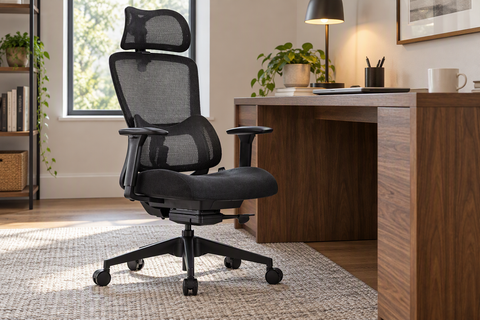
Natural textures—wood grains, stone tops, and fabric panels—help reduce visual "noise." When your team sits in a high-performance chair like the Flex, Dual-Backrests Ergonomic Office Chair, the physical support of the dual backrests can improve comfort during demanding work sprints.
The Science of the "Sit-Stand" Rhythm
One of the most effective ways to support a team's well-being is to incorporate height adjustability. The WHO 2020 Guidelines on Physical Activity emphasize that adults should reduce sedentary time and interrupt long periods of static behavior.
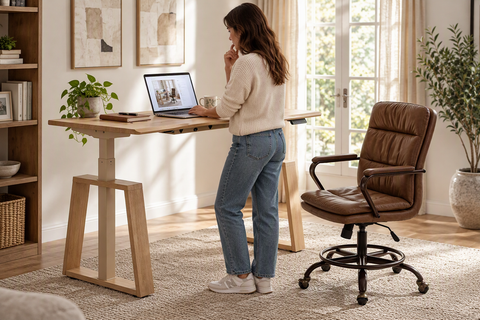
In a pod of L-Shaped Standing Desks with Accessories Set (60"x23"), the transition from sitting to standing can become a shared team ritual. We often observe that when one person stands, others follow, creating a "standing meeting" atmosphere that can be more concise and energetic.
Estimated Productivity & Health ROI (Illustrative Example)
The following estimates are heuristic examples intended for illustrative purposes. Actual results vary based on individual metabolic rates, salary levels, and specific business workflows.
-
Estimated Annual Caloric Burn: ~18,900 kcal.
- Assumption: Based on a 175lb adult standing for 120 mins/day vs. sitting, resulting in an additional ~75 kcal/day over 252 working days. (Source: General metabolic averages).
-
Potential Productivity Value Gain: Estimated ~$3,600 annual value gain per employee.
- Assumption: Assumes a 10-15% increase in alertness and collaborative efficiency for an employee with a $50,000 annual salary. This is a heuristic estimate based on common workplace efficiency benchmarks.
- Investment Payback: The cost of a premium standing desk can potentially be recouped within 3 to 6 months through these estimated efficiency gains, depending on the specific business use case.
Solving the "Friction Points" of Pod Life
Even a well-designed pod can face challenges if practical details aren't addressed.
Cable Chaos
In a 4-person cluster, you have multiple power cables and monitor leads converging in a small area. "Cable spaghetti" can be a distraction and a safety hazard. We recommend using under-desk cable trays to route all wires to central floor boxes, maintaining clean sightlines.
The Viewing Distance Deficit
In compact pods, monitors are often placed too close to the eyes. For a standard 27-inch monitor, THX and SMPTE visual standards suggest an optimal viewing distance of approximately 42 inches for cinematic clarity. While 20-30 inches is the standard for general office work, maximizing distance helps reduce eye strain.
- The Fix: Use monitor arms. By mounting the screen and pushing it back or angling it across the "L" corner, you can reclaim valuable depth, potentially reducing eye fatigue.
Acoustic Mindfulness
Open pods are excellent for collaboration but can be challenging for deep work. Strategic placement of fabric panels can help dampen sound. While not a substitute for ISO 23351-1 certified acoustic pods, these panels can reduce ambient noise and help create "focused silence" in a busy room.
Personal Tips for Atmosphere Building
Based on our experience designing these configurations, small tweaks often make the biggest impact:
- The "Green Anchor": Place a large plant (like a Monstera) at the center point where the four desks meet. It acts as a visual "anchor" that softens the technical lines of the desks.
- Lighting Layers: Avoid harsh overhead lighting. Task lighting on each desk wing allows team members to control their own environment, which is helpful for maintaining focus.
- The 20-8-2 Rhythm: Encourage the Cornell University Ergonomics recommendation: 20 minutes of sitting, 8 minutes of standing, and 2 minutes of moving. This rhythm is a widely recognized heuristic for maintaining musculoskeletal health.
Ensuring Safety and Compliance
When building pods for a commercial environment, professional standards are essential. Ensure your furniture meets ANSI/BIFMA X5.5 standards for desk stability and ANSI/BIFMA X5.1 for chair durability.
Furthermore, for any storage units included in your pods, ensure they comply with the CPSC STURDY Act (16 CFR Part 1261), which requires anti-tip-over designs for clothing storage units (often applicable to office pedestals used in mixed-use spaces). Safety is the foundation of a reliable workspace.
A Holistic Lifestyle Solution
Clustering L-shaped desks into 4-person pods is more than a spatial hack; it is a strategy for building a more collaborative company culture. It demonstrates a commitment to your team's space, health, and the synergy that happens when people work together.
By following the principles outlined in our 2026 Workstation White Paper, you are engineering an environment where creativity can thrive. Say goodbye to the chaos of a cluttered office and hello to the streamlined, elegant world of the 4-person pod.
YMYL Disclaimer: This article is for informational purposes only and does not constitute professional medical, legal, or financial advice. The ergonomic recommendations and ROI estimates provided are based on general industry standards, population averages, and illustrative heuristics. Individuals with pre-existing musculoskeletal conditions or specific health concerns should consult with a qualified occupational therapist or healthcare professional before implementing new workstation setups.
References
- BIFMA G1-2013: Ergonomics Guideline for Furniture
- CCOHS: Office Ergonomics - Sit/Stand Desk Guide
- WHO: 2020 Guidelines on Physical Activity and Sedentary Behaviour
- OSHA: Computer Workstations eTool - Neutral Working Postures
- Cochrane Library: Workplace interventions for reducing sitting at work
- ANSI/HFES 100-2007: Human Factors Engineering of Computer Workstations
- CPSC: STURDY Act / 16 CFR Part 1261 (Anti-Tip Standards)
- ISO 9241-5:2024: Workstation layout & postural requirements
- Cornell University Ergonomics Web: Workstation Setup Guides
- Eureka Ergonomic Blog: The 2026 Workstation White Paper




Leave a comment