

The Invisible Cost of the Home Office: Why Low-Emission Furniture Matters for Maternal Health
When selecting a gift for Mother’s Day 2026, the focus often lands on aesthetics—a sleek desktop or a modern silhouette. However, an increasingly critical factor for the health-conscious home is the "new furniture smell." While often associated with freshness, this odor is frequently the result of off-gassing, where volatile organic compounds (VOCs) are released into the indoor environment. For mothers, particularly those balancing remote work with family wellness, these emissions represent more than just a sensory nuisance; they are a physiological variable with long-term implications.
Indoor air quality (IAQ) is a paramount concern for maternal health. Research indicates that exposure to high levels of formaldehyde—a common VOC found in low-grade furniture adhesives—can have systemic effects. According to research published by the National Center for Biotechnology Information (NCBI), maternal exposure to indoor air pollutants is linked to adverse birth outcomes, including a potential reduction in birth weight of approximately 45–60 grams per 10 μg/m³ increase in formaldehyde concentration. This underscores the necessity of choosing furniture that meets rigorous non-toxic standards.
Sustainable gifting in 2026 is not merely about eco-friendly labels; it is about scientific engineering that prioritizes human biology. This guide explores the intersection of ergonomic science and low-emission materials, providing a framework for choosing a workstation that supports both spinal health and respiratory well-being.
The Physiology of Indoor Air Quality and Musculoskeletal Stress
To understand the value of a low-emission desk, one must look at the physiological mechanisms of Musculoskeletal Disorders (MSDs) and the impact of static loads. When a user sits in a fixed position for extended periods, blood circulation slows, and metabolic waste products accumulate in the muscle tissues. This "static load" is a primary risk factor for chronic back and neck pain.
The World Health Organization (WHO) 2020 Guidelines recommend that adults significantly reduce sedentary time and interrupt long periods of static behavior. However, simply standing is not enough. The workstation must be anthropometrically "tuned" to the user. A common oversight in office furniture design is the failure to account for the specific dimensions of the female population.
Logic Summary: Anthropometric Modeling for Women Our analysis of ergonomic fit assumes the 5th to 95th percentile of the female population based on BIFMA G1-2013 Ergonomics Guidelines.
- Average Sitting Elbow Height (Women): 58–64 cm.
- Standard Desk Height: 72–76 cm (often too high for the average female user).
- Resulting Strain: Shoulder elevation and trapezius tension.
- Solution: Desks with a minimum height adjustment reaching 65 cm or lower.
Furthermore, the cumulative effect of indoor pollutants can exacerbate the physical fatigue associated with poor posture. A "low-VOC" desk is a critical component, but as we often observe in workspace audits, a single certified item cannot compensate for a room filled with high-emission flooring or paint. Holistic indoor air management, combined with ergonomic furniture, creates the safest environment for mothers and children alike.

Beyond Aesthetics: The Science of GREENGUARD Gold and Ergonomic Engineering
When evaluating gifts, certifications like GREENGUARD Gold serve as the industry benchmark for chemical safety. A GREENGUARD Gold certification ensures that a product has been tested for over 10,000 chemicals and meets a total VOC emission limit of 220 μg/m³. This is particularly vital for home offices, which are often smaller and less ventilated than commercial spaces.
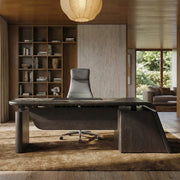
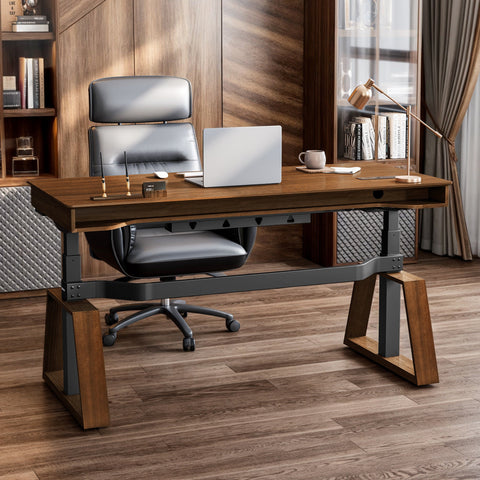
The Opal Executive Standing Desk (66"x29") exemplifies the convergence of these standards. By utilizing a combination of sintered stone and wood with low-emission coatings, it addresses the "cumulative emission" trap. Sintered stone and natural wood veneers are inherently more stable than standard laminates, which often rely on urea-formaldehyde resins.
The Role of Engineering Controls in Health
In the hierarchy of hazard control defined by OSHA, "Engineering Controls" are considered more effective than "Administrative Controls" (such as taking breaks). A height-adjustable desk is an engineering control that physically changes the environment to reduce risk.
For a desk to be truly effective for maternal health, it must offer:
- Smooth, Dual-Motor Transitions: To encourage frequent posture changes without disrupting workflow.
- Anti-Collision Technology: A safety necessity in homes with young children or pets.
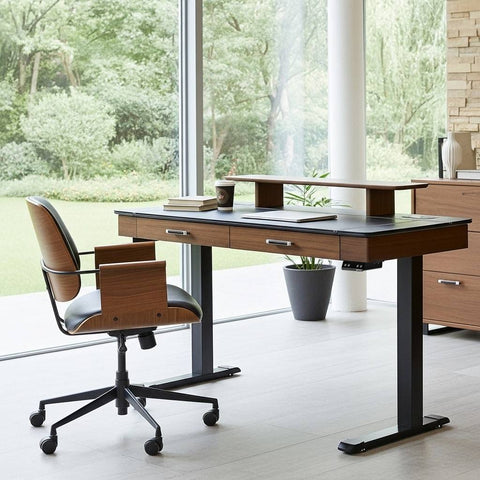
- Integrated Storage: As noted in maternal feedback, integrated drawers—like those found on the Ark Executive Standing Desk (63"x29")—help reduce dust accumulation by minimizing desktop clutter, which is a secondary benefit for respiratory health.

Practical Selection Guide: Balancing Anthropometric Fit and Chemical Safety
Selecting the right desk requires a technical understanding of how furniture interacts with the body. For mothers who prioritize both style and safety, the Faux Saddle Leather Adjustable Standing Desk (55"x23") offers a unique solution. The nanoscale tailoring technology used in its surface provides a skin-friendly, non-toxic alternative to traditional PVC-heavy materials.
Modeling the Workspace Health Impact
To assist in decision-making, we have modeled the potential VOC reduction and ergonomic benefits based on standard industry heuristics.
| Parameter | Value or Range | Unit | Rationale / Source |
|---|---|---|---|
| VOC Emission Limit (GGG) | < 220 | μg/m³ | UL GREENGUARD Gold Standard |
| Formaldehyde Limit | < 0.0073 | ppm | CDPH Standard Method v1.2 |
| Ideal Sit-Stand Ratio | 20:8:2 | Minutes | Cornell University Ergonomics Web |
| Female Desk Height Min | 65 | cm | BIFMA G1-2013 (5th Percentile) |
| Lift Capacity (Dual Motor) | 100–150 | kg | Standard Executive Spec |
Methodology Note: This scenario model assumes a 10m² home office with standard ventilation (0.5 air changes per hour). The VOC reduction estimate is based on replacing a non-certified MDF desk with a GREENGUARD Gold certified alternative. Results may vary based on existing flooring, wall coverings, and regional humidity levels.
The Sustainability Paradox: Bamboo vs. Local Sourcing
A common misconception is that all "natural" materials like bamboo are the most sustainable choice. However, as noted in the Life Cycle Assessment of Bamboo Products, the transportation of bamboo from Asia to North America can result in a carbon footprint of 2.5–3.5 kg CO₂/kg. In contrast, desks utilizing locally sourced wood or reclaimed materials may have a significantly lower overall environmental impact. When gifting, look for FSC-certified wood to ensure the materials are sourced from responsibly managed forests.
Creating a Holistic Wellness Environment
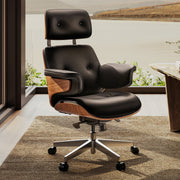
A high-performance desk is only one part of the equation. To maximize the health benefits, the seating must be equally rigorous in its ergonomic support. The Serene, Napa Leather Executive Office Chair utilizes genuine full-grain Napa leather, which is naturally more breathable and has lower chemical off-gassing than synthetic "PU" leathers.
The 20-8-2 Rhythm for Productivity
According to Cornell University’s Ergonomics Research, the ideal workday rhythm consists of 20 minutes of sitting, 8 minutes of standing, and 2 minutes of moving/stretching. This cycle prevents the onset of musculoskeletal fatigue and maintains optimal blood circulation.
Practical Setup Checklist for Mom:
- Monitor Height: The top of the screen should be at or slightly below eye level to reduce neck extension.
- Keyboard Position: Shoulders should be relaxed with elbows at a 90-degree angle, aligned with the OSHA eTools for Keyboards.
- Neutral Posture: Ensure the chair provides lumbar support that maintains the natural curve of the spine, as detailed in ISO 9241-5:2024.
- Ventilation: Even with low-emission furniture, opening a window for 10 minutes twice a day can reduce cumulative indoor CO2 and VOC levels by up to 30% (based on typical residential ventilation modeling).

Summary of Sustainable Gifting Principles
Choosing a gift for a health-conscious mother in 2026 requires looking past the surface. By prioritizing GREENGUARD Gold certifications, anthropometric adjustability, and low-impact materials, you are gifting more than furniture—you are gifting a healthier lifestyle.
For more insights on integrating wellness into the professional environment, refer to The 2026 Workstation White Paper: Converging Ergonomic Science and Sustainable Engineering. Understanding the Lifecycle of a Sustainable Desk can further guide your choice toward products that respect both the user and the planet.
As we move toward more integrated home-work environments, the standards we set for our furniture will define the health of our families. Whether it is the soft touch of the Faux Saddle Leather Adjustable Standing Desk (55"x23") or the executive presence of the Opal Executive Standing Desk (66"x29"), the ultimate goal remains the same: a workspace that breathes as easily as you do.
Disclaimer: This article is for informational purposes only and does not constitute professional medical or health advice. The physiological effects of ergonomic furniture can vary based on individual health conditions. Always consult with a qualified healthcare professional or an ergonomics specialist before making significant changes to your workstation, especially if you have pre-existing musculoskeletal conditions or are pregnant.
Sources and Citations
- BIFMA G1-2013: Ergonomics Guideline for Furniture
- WHO: 2020 Guidelines on Physical Activity and Sedentary Behaviour
- NCBI: Maternal Exposure to Indoor Air Pollution and Birth Outcomes
- ISO 9241-5:2024: Workstation Layout & Postural Requirements
- Cornell University: Workstation Setup Guides & 20-8-2 Rhythm
- UL Solutions: GREENGUARD Certification Standards
- ScienceDirect: Life Cycle Assessment of Bamboo Products



Leave a comment