

Professional First Impressions: The Vision of a Workspace Sanctuary
Imagine walking into a corporate entryway that doesn't just feel like a waiting room, but like a curated introduction to a brand’s soul. The air is calm, the surfaces are pristine, and the person greeting you isn't buried behind a mountain of paperwork. Instead, they sit at an elegant, streamlined workstation that breathes professionalism. This is the "Workspace Sanctuary"—a concept where efficiency meets aesthetic peace.
For facility managers and small business owners navigating the constraints of urban satellite offices or boutique agencies, the entryway is often the most challenging puzzle. You have less than 150 square feet to make a statement, manage visitor flow, and provide a functional hub for administrative tasks. The L-shaped desk is frequently touted as the solution, but as we’ve observed through years of spatial auditing, the difference between a "cramped corner" and a "command center" lies in the nuances of dimension and material.
In this guide, we will transform your perspective on micro-receptions. We’ll move beyond the "one-size-fits-all" approach, grounding our recommendations in the latest ergonomic standards like BIFMA G1-2013 Ergonomics Guideline and the insights from The 2026 Workstation White Paper: Converging Ergonomic Science and Sustainable Engineering.
Space Transformation: From Chaos to Curated Flow
The "Before" state of many micro-receptions is a cautionary tale: a straight desk pushed against a wall, a separate filing cabinet blocking a walkway, and a receptionist constantly twisting to see the door. It feels temporary and disorganized.
The "After" transformation begins with the strategic placement of an L-shaped configuration. By utilizing the corner, you reclaim the "dead space" that straight desks leave behind. However, a common pitfall we see in facility management is underestimating the clearance needed for accessibility.
Methodology Note: Spatial Modeling for Micro-Receptions Our spatial recommendations are based on a deterministic model for high-traffic micro-environments (under 150 sq ft). We assume a single-user occupancy and a minimum visitor dwell time of 5-10 minutes.
Parameter Recommended Value Unit Rationale Primary Desk Length 60–72 Inches Balances task area with spatial footprint Return (Short Leg) Length 48–54 Inches Provides secondary surface without blocking flow Clear Pedestrian Path 36 (Minimum) Inches Aligned with ADA accessibility standards Document Handling Zone 18 Inches Prevents visual clutter near visitor interaction Approach Angle 90 Degrees Ensures receptionist directly faces the entrance
The Golden Rule of 36 Inches
One of the most critical "gotchas" in entryway design is the wheelchair path. Experienced facility managers know that even the most beautiful desk fails if it violates the 36-inch clear path requirement. When installing a desk like the Opal Executive Standing Desk (66"x29"), we recommend placing the longer leg parallel to the entry wall. This creates a natural "guide rail" for visitors, leading them toward the reception point while keeping the primary walkway unobstructed.

Linking Functionality with Emotion: The Power of Movement
A desk in a reception area isn't just a piece of furniture; it’s a tool for managing the emotional energy of the office. We often talk about "Decluttering" the mind, and that starts with the physical workflow.
The "Thinking" vs. "Execution" Modes
Height adjustability is often viewed strictly through a health lens. While the WHO 2020 Guidelines on Physical Activity & Sedentary Behaviour emphasize reducing static behavior, in a B2B reception context, movement serves a psychological purpose.
When a receptionist is in "Execution Mode"—processing deliveries or filing—standing at a desk like the L-Shaped Standing Desk with Accessories Set (60"x23") provides a sense of urgency and alertness. When they transition to "Visitor Engagement," lowering the desk to a seated position can create a more welcoming, eye-level interaction that reduces the perceived power barrier between staff and guests.
Materiality and First Impressions
Research indicates a fascinating truth: professional perception is 87% more dependent on material quality and finish than on the actual shape of the desk. While an L-shape provides the footprint, the texture provides the trust.
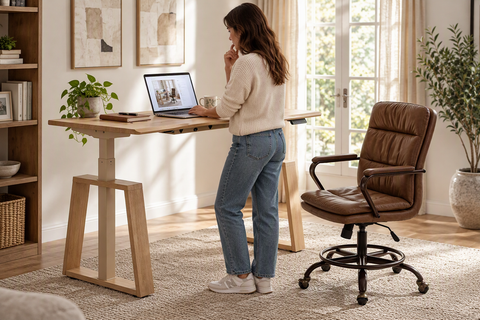
We’ve found that incorporating high-tactile materials, such as the walnut and leather found in the Faux Saddle Leather Adjustable Standing Desk (55"x23"), immediately elevates the "Aesthetic" of a micro-reception. Leather is "Skin-Friendly" and soft to the touch, which can subtly lower visitor anxiety during check-in. It signals that the company values detail and comfort.
Ergonomic Integrity: Solving the "Rotation Risk"
A significant challenge with L-shaped desks is the "torsion trap." According to expert observations in workstation postural requirements (ISO 9241-5), L-shaped designs can inadvertently encourage up to 40% more torso rotation than straight desks if the layout is poor. Receptionists often twist between a computer on the long leg and a visitor on the short leg.
The "Shorter Leg" Monitor Secret
A non-obvious tip from seasoned office designers: place the primary monitor on the shorter leg of the L-shape (the return). Why? This allows the receptionist to maintain a "neutral working posture" while keeping their peripheral vision focused on the entrance.
When the monitor is on the long leg, the staff member is often forced to turn their back or shoulder to the door. By shifting the tech to the return, you facilitate "Deep Work" without sacrificing "Visitor Awareness." This alignment is supported by OSHA eTools on Computer Workstations, which emphasizes keeping the head, neck, and torso aligned.

Spatial Efficiency: Personal Tips for Micro-Receptions
Creating an "Ambiance" of space in a small room requires more than just a good desk. It requires a holistic lifestyle solution for the office.
- The 18-Inch Buffer: Always allocate at least 18 inches of clear counter space adjacent to the computer. This is your "Transaction Zone." It’s where documents are signed and badges are handed over. Without this buffer, the desk quickly becomes a "clutter magnet," ruining the professional first impression.
- Vertical Thinking: In micro-receptions, floor space is gold. Instead of a wide credenza, use a compact, high-quality storage solution like the Ark EL, 29" Display File Storage Cabinet, Oak. Its minimalistic oak finish adds warmth without the visual bulk of traditional metal filing cabinets.
- Mindful Lighting: Avoid harsh overhead fluorescent lights. Use a desk lamp with a warm color temperature (2700K-3000K) to create a "Sanctuary" feel. This reduces glare on monitors—a key recommendation from HSE's guide on working with display screen equipment.
- Greenery and Air Quality: A single snake plant or ZZ plant on the return leg of the desk does more than just look good. It introduces a "Biophilic" element that reduces stress. Ensure your furniture meets UL GREENGUARD Certification standards to maintain healthy indoor air quality in these small, enclosed spaces.
Safety and Compliance: The Foundation of Trust
For a facility manager, "Aesthetic" is nothing without "Safety." When selecting L-shaped desks, especially those with height-adjustable motors, verify they meet UL 962 standards. This ensures the mechanical and electrical components are tested for the rigors of a commercial environment.
Furthermore, if your reception setup includes storage units, be mindful of the CPSC STURDY Act (16 CFR Part 1261). Even in a corporate setting, anti-tip-over measures are essential for liability and safety. We recommend anchoring any cabinet over 27 inches high to the wall, especially in high-traffic entryways.
The ROI of the Entryway
Investing in a high-performance L-shaped desk isn't just a furniture purchase; it’s a strategic business move. Based on industry patterns, a well-organized reception area can reduce visitor check-in time by an estimated 15-20% by eliminating the "clutter friction" that plagues poorly designed spaces.
More importantly, it supports the long-term health of your staff. As noted in a meta-analysis by Santos et al. (2025), ergonomic interventions significantly reduce musculoskeletal pain. A receptionist who isn't in pain is a receptionist who provides better service, creating a virtuous cycle of professional excellence.
Summary Checklist for Facility Managers
- Verify Clearance: Ensure a 36-inch path for ADA compliance.
- Prioritize Material: Choose leather or high-quality wood finishes to boost brand trust.
- Optimize Tech: Place monitors on the return leg to maintain eye contact with guests.
- Manage Movement: Use dual-motor standing desks to allow staff to shift between "Execution" and "Engagement" modes.
- Declutter: Use compact storage like the Ark EL, 29" Display File Storage Cabinet, Oak to keep the surface clear.
Creating a professional first impression in a micro-reception is about balancing the "Mindfulness" of the environment with the "Workflow" of the business. By selecting the right L-shaped configuration and adhering to ergonomic science, you don't just optimize a room—you build a sanctuary that welcomes every visitor with the silent language of success.
Disclaimer: This article is for informational purposes only and does not constitute professional legal, medical, or financial advice. Ergonomic needs vary by individual; those with pre-existing musculoskeletal conditions should consult a qualified healthcare provider or ergonomic specialist before implementing new workstation setups. Compliance with local accessibility laws (such as the ADA) should be verified with a certified inspector.
Sources
- BIFMA G1-2013 Ergonomics Guideline for Furniture
- ISO 9241-5:2024 Workstation layout & postural requirements
- WHO 2020 Guidelines on Physical Activity & Sedentary Behaviour
- HSE: Working safely with display screen equipment (DSE)
- Cochrane: Workplace interventions for reducing sitting at work
- UL GREENGUARD Certification
- The 2026 Workstation White Paper




Leave a comment