


An L-shaped standing desk can work well for a hybrid work-and-gaming room if you treat it as two connected zones, not one oversized surface. The goal is simple: keep work focused, keep gaming easy to switch into, and avoid a layout that slowly turns into clutter. The desk itself does not fix posture or comfort on its own, but the right arrangement can make both modes easier to use.
What a Hybrid L-Desk Needs to Solve
The hardest part of a hybrid workstation is not adding more desktop area. It is deciding what belongs where so the desk does not become a catch-all surface by 4 p.m. A good hybrid work gaming desk layout has to handle three pressures at once: clutter, posture drift, and switch speed.
Clutter matters because every extra item that floats across the whole desk makes the workday feel less focused and the gaming side feel less intentional. Posture drift matters because a screen that slides off-center or a keyboard that creeps too far away changes how you sit or stand. Switch speed matters because if moving from work mode to play mode takes too much reset time, the desk starts feeling annoying instead of useful.
That is why the organizing rule is zoning. In practice, the best L-shaped standing desk setup gives each task a home, then keeps shared items in a middle area that can change with the day. For a more detailed partitioning approach, the zone method is a useful follow-up if you want a more academic framing of the same idea.
Divide the Desk Into Clear Workflow Zones
A practical L-shaped standing desk workflow zones plan uses three areas: a work zone, a gaming zone, and a transition zone. You do not need a strict percentage split to make this work. You just need to stop every device from competing for the same patch of surface.
Work zone. Put the most focus-heavy tools here, such as your laptop, main monitor, keyboard, notebook, and anything you use during calls or concentrated tasks. This side should look the simplest. If your job is laptop-first, keep this area clean and direct. If your job is monitor-first, reserve the most stable and least distracting run of the desk for the primary screen.
Gaming zone. Use the second leg for controllers, headset storage, speakers, a secondary screen, or the peripherals you only want out after hours. This side can tolerate a little more visual activity, as long as it stays separate from the work area. The point is not to make gaming sterile. It is to keep it from spilling into the daytime zone.
Transition zone. The corner and any buffer strip between the two legs work best for shared items like a dock, charging tray, headset stand, or capture gear. These are the objects that move between modes. If the transition zone stays clean, the desk can change roles without a long reset every day.
If you want a broader example of this kind of arrangement, the focus layout method can help you compare how a single desk can hold separate tasks without feeling crowded. 
Place Monitors, Keyboard, and Seating for Both Modes
For most hybrid users, screen placement matters more than desk shape. OSHA's computer workstation checklist recommends placing the primary monitor directly in front of you, with secondary screens angled to the side. That helps reduce neck rotation, which is easy to ignore for a few hours but noticeable over a full workweek.
OSHA's workstation purchasing guide also notes that monitor viewing distance is typically 20 to 40 inches. In plain terms, that is close enough for comfortable reading without forcing you to lean forward, but far enough that a desk return can hold a screen without crowding your face. If the desk is too shallow for your monitor, the whole layout becomes harder to use.
A good hybrid workstation keeps the keyboard and mouse centered with the primary screen, whether you are seated or standing. If you use a second display, angle it so it supports the workflow instead of pulling your torso sideways. A monitor arm or riser often helps when one side of the desk does double duty, because it makes it easier to re-center the screen and reclaim surface space.
For a streaming-heavy or multi-device setup, the streaming gear fit guide is a helpful companion piece because it deals with the same placement problem from a creator's point of view. What matters most is not chasing a perfect posture promise. It is keeping the main screen, keyboard, and chair or standing position aligned well enough that the desk works in both modes without constant correction.

Route Power and Cables Without Breaking the Layout
Cable routing is what keeps an L-shaped standing desk looking like two zones instead of one tangled surface. The simplest rule is to group cables by job, then move them off the open work area.
- Keep work cables, gaming cables, and charging cables in separate bundles when possible.
- Use the corner and the rear edge as the main pass-through paths.
- Run power and signal cables underneath the desk instead of across the middle of the surface.
- Leave a little slack where a device needs to move between work and gaming modes.
- Use labels, ties, trays, and clips so the setup is easier to reset after a swap.
That approach is not a safety guarantee, and it is not a formal standard for hybrid layouts. It is simply the easiest way to keep a dual-purpose desk from turning messy every time you change devices. If you rely on hot-swappable gear, hidden power placement matters even more because the setup has to look clean while still being easy to change.
The cleanest result usually comes from a simple habit: fixed power in one place, moving devices in another, and nothing crossing the open center unless it absolutely has to.
Does an L-Shaped Standing Desk Fit Your Setup?
An L-shaped standing desk is usually the better choice when you want a real boundary between work and play, need a corner-friendly footprint, or prefer one side for focused tasks and the other for gaming gear. It can be a weaker fit if your room is very tight, your device load is unusually heavy, or you want a single rectangular surface that never changes roles. The desk shape helps most when the room lets you actually use both legs.
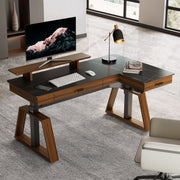
If you want built-in storage and a cleaner transition between modes, the Ark Pro L-Shaped Standing Desk is worth checking as a fit example. Eureka lists it as a 63" x 23" model with two soft-close drawers, a cable-management bracket, a desktop riser, and a mouse pad, so it leans toward buyers who want organization features built into the workstation. It also adjusts from 28 to 49.2 inches and is listed with a 265 lb capacity, so it may suit a hybrid setup if those current product details match your gear load and room footprint.
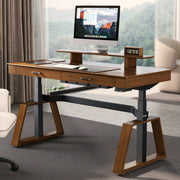
If you want a broader executive-style surface, the Ark Executive standing desk is a reasonable comparison point. The listed 63" x 29" size gives you more front-to-back depth than the narrower model, which can matter if you use a deeper monitor placement or prefer more room for keyboard and peripherals. Eureka lists two soft-close drawers, a movable desktop riser, anti-collision technology, and a 265 lb capacity, so it may be the better fit when your hybrid workflow needs a larger-feeling surface and a more traditional executive look.
For browsing other desk paths, the best seller desk tables collection is a useful place to compare related layouts without committing too early. The important question is whether the desk supports your actual switching pattern, not whether it looks good in a vacuum.
Hybrid Setup Checks Before You Buy
Before you buy an L-shaped standing desk for work and gaming, check the corner footprint first, then match the orientation to your room layout. After that, confirm that your monitor count, keyboard reach, mouse path, and any storage needs fit without crowding the work side. If the return or second leg cannot hold the gear you actually use, the hybrid layout will feel cramped from day one.
Next, look at cable access and power placement. You want enough hidden routing space that the desk still looks tidy after you plug in a dock, charger, headset, and game accessories. Finally, verify current shipping, returns, assembly, and warranty details before checkout, since those policies are product-specific and can change.
If those checks pass, a standing desk in an L shape can be a strong hybrid choice. If they do not, a simpler layout will usually be easier to live with.
FAQs
How Do You Split an L-Shaped Desk Between Work and Gaming?
Use one side for focused work, the other for gaming, and the corner as the transition zone for shared items. The most useful rule is consistency: if a device keeps moving, it probably belongs in the middle. If it stays there all day, it belongs to one zone or the other.
What Monitor Placement Works Best on a Hybrid Standing Desk?
Keep the main monitor centered in front of you and angle any secondary screen to the side. In most setups, a monitor arm or riser makes that easier, especially when one desk has to support both seated work and gaming after hours.
Can One L-Shaped Desk Hold Both Work Devices and Gaming Gear?
Yes, if the surface area and storage match the load. The failure point is usually not the desk shape itself, but underestimating how much room the keyboard, monitor(s), headset, dock, and controllers really need. Measure the gear before you decide.
Why Does Cable Routing Matter in a Dual-Purpose Desk Setup?
Because cables are often what make a hybrid desk feel messy or easy to use. When power and signal lines stay grouped by zone, it is much easier to switch from work mode to gaming mode without dragging clutter across the whole surface.
Can a Standing Desk Help a Hybrid Work and Gaming Routine?
It can add flexibility, especially if you like alternating between sitting and standing during the day. The desk still needs a sensible screen height, practical viewing distance, and a layout that matches your room. Without that, the sit-stand feature helps less than people expect.
Final Takeaway
A hybrid workstation works best when the desk, the screens, and the cables all follow the same zoning logic. Keep work simple, keep gaming contained, and use the transition area for the items that need to move. If you are close to buying, compare footprint, orientation, monitor count, and cable access before you compare finishes or extras. That order saves more regret than any single accessory choice.

Leave a comment