

Beyond the Screen: Laptop Stand Heights for Hybrid Video Calls
In the transition to hybrid work models, the laptop has evolved from a portable secondary device into a primary workstation. However, this shift has introduced a subtle but persistent health challenge: the "Video Call Paradox." Professionals now spend a significant portion of their day in virtual meetings, often unknowingly sacrificing their musculoskeletal health for a better camera angle.
Why does your neck feel stiff by 3:00 PM, even if you’ve been "sitting straight" all day? The answer often lies in the height of your laptop screen. Most users either place their laptop too low, leading to a hunched posture known as "Tech Neck," or they raise it too high to improve their on-camera appearance, creating an unnatural chin-tuck that strains the upper trapezius and cervical spine. Achieving a balance between professional presence and physiological safety requires a technical understanding of visual ergonomics and workstation geometry.
As outlined in The 2026 Workstation White Paper: Converging Ergonomic Science and Sustainable Engineering, the integration of ergonomic science into daily work habits is the foundation of long-term productivity and employee well-being.
The Physiology of Static Load and "Tech Neck"
To understand why laptop height matters, we must examine the mechanics of the human spine. The cervical spine is designed to support the weight of the head—typically 10 to 12 pounds—in a neutral position. According to the U.S. Occupational Safety and Health Administration (OSHA), a neutral working posture keeps joints aligned, minimizing stress on muscles, tendons, and the skeletal system.
When you tilt your head forward to look at a low laptop screen, the effective weight on your neck increases dramatically. At a 60-degree tilt, the head can exert up to 60 pounds of force on the cervical spine. This is a primary risk factor for Work-related Musculoskeletal Disorders (MSDs).
The Role of Static Posture
The danger isn't just the angle; it’s the duration. ISO 11226:2000 (Evaluation of static working postures) specifies that maintaining static postures for extended periods leads to reduced blood circulation and muscle fatigue. In a video call, users tend to remain exceptionally still to appear engaged, which exacerbates the "static load" on the neck and shoulder muscles.
Logic Summary: Our analysis suggests that the "stiff neck" experienced during back-to-back calls is less about the intensity of the work and more about the sustained static load caused by a screen positioned outside the neutral visual zone.
The Conflict: Ergonomics vs. Professional Presence
A common misconception is that a single laptop stand height can optimize both ergonomics and video presence. In reality, these two goals often conflict.
- The Ergonomic Target: Industry guidelines, such as ISO 9241-5:2024, recommend that the top of the screen be at or slightly below eye level. The goal is for the user's gaze to fall on the upper third of the screen, creating a gentle 15-20 degree downward angle. This keeps the cervical spine in a "packed" or neutral position.
- The Video Presence Target: To avoid the "up-the-nose" camera angle, many professionals raise their laptop until the camera is at eye level. While this creates a flattering image for colleagues, it often forces the user to look up at the center of the screen or tuck their chin excessively to see the bottom of the display, leading to neck strain.
The Practitioner’s "Gotcha"
A frequent mistake we observe in workplace assessments is placing the laptop stand so the top of the screen is at eye level while using the built-in camera. For most laptops, this positions the camera significantly higher than the user's eyes, or forces a screen tilt that reflects ceiling lights, causing glare and eye fatigue.
A professional workspace featuring a standing desk and ergonomic accessories.
Engineering Controls: The Role of Adjustable Furniture
To resolve this conflict, organizations and individuals must move beyond "administrative controls" (like reminding yourself to sit up straight) and implement "engineering controls." As defined by OSHA's hierarchy of controls, engineering controls involve physical changes to the workstation to eliminate hazards.
A high-performance Standing Desk with Drawers, Wood Finish (47'' /55'') serves as the primary engineering control. It allows for micro-adjustments in height that fixed desks cannot provide. When paired with a laptop stand, it enables the user to decouple the height of the keyboard from the height of the screen.
The Case for the Sit-Stand Rhythm
The Cochrane systematic review (2018) found that sit-stand desks can significantly reduce sitting time by over 80 minutes per day. For hybrid workers, alternating between sitting and standing during calls can prevent the accumulation of static load. However, it is vital to remember the WHO 2020 Guidelines: standing is not a substitute for exercise, but a method to interrupt sedentary behavior.
Modeling the "Tall Professional" Challenge
Standard office furniture is often designed for the "average" user, leaving those in the higher height percentiles at a disadvantage. We modeled the requirements for a 190cm (6'3") male professional to demonstrate how standard setups fail and how a laptop stand bridges the gap.
Modeling Transparency (Inputs & Logic)
| Parameter | Value | Unit | Rationale |
|---|---|---|---|
| User Stature | 190 | cm | 95th Percentile Male (CDC/NCHS) |
| Seated Eye Height | ~80 | cm | Anthropometric estimate from seat pan |
| Standard Desk Height | 74 | cm | ANSI/HFES 100-2007 (29 inches) |
| Laptop Screen Height | 30 | cm | Standard 16-inch laptop |
| Ergonomic Gap | ~5 | cm | Deficit in screen height on a standard desk |
Methodology Note: This scenario model uses anthropometric ratios derived from population averages. Individual proportions (torso vs. leg length) may vary the required lift by ±2cm.
For this "Tall Professional," a standard 29-inch desk is inherently too low. Without a laptop stand or a height-adjustable desk, this user is forced into a permanent slouch. Our modeling shows that a laptop stand providing approximately 5cm (2 inches) of lift is the minimum required to reach a neutral gaze angle, even before accounting for camera placement.
Practical Recommendations for Hybrid Setup
To optimize your setup for both health and video performance, follow these expert-vetted heuristics.
1. The Eye-Closing Heuristic
To find your neutral gaze point without complex measurements:
- Sit in your typical work posture.
- Close your eyes and take a deep breath.
- Nod your head slightly until it feels perfectly balanced on your neck.
- Open your eyes. Where your gaze naturally lands is the ideal center point for your primary content or your webcam.
2. Decouple Input from Output
Never type directly on a laptop that is raised on a stand. Doing so forces the wrists into extension, increasing the risk of Repetitive Strain Injury (RSI). Always pair a laptop stand with an Adjustable Keyboard Tray. This allows you to keep your elbows at a 90-degree angle (aligned with BIFMA G1-2013 standards) while the screen remains at eye level.

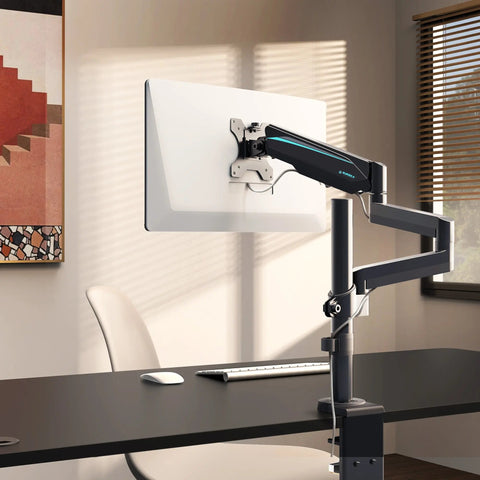
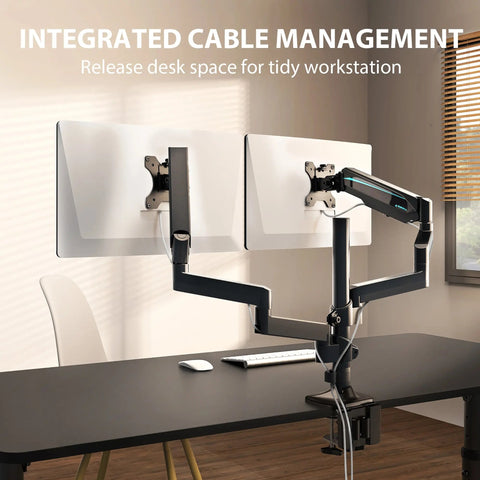
3. The Dual-Screen Strategy
For those using a laptop alongside an external monitor, the "head-swivel" is a major contributor to trapezius fatigue.
- The Setup: Place your primary monitor directly in front of you.
- The Laptop: Place the laptop on a stand to the side of your non-dominant hand, angled inward.
- The Logic: Use the laptop screen exclusively for video call feeds and chat, while keeping your deep-focus work on the main screen. This minimizes the degree of neck rotation required throughout the day.
4. Support the Lower Extremities
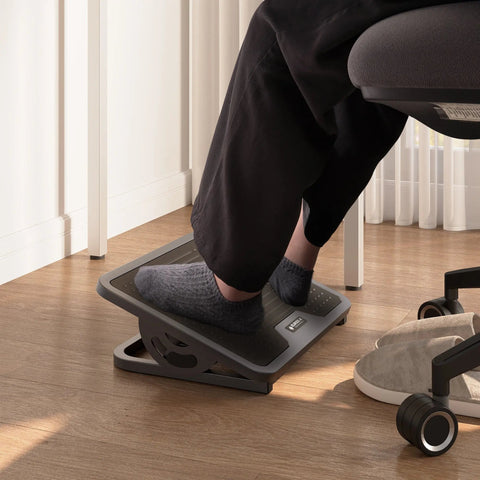
Ergonomics is a systemic issue; tension in the neck can often be traced back to a lack of stability in the feet. If raising your chair to reach a high desk leaves your feet dangling, blood circulation is compromised. An Adjustable Ergonomic Footrest ensures that your thighs remain parallel to the floor, reducing pressure on the underside of the legs and stabilizing the pelvis.
An adjustable footrest under a desk helping a user maintain proper leg alignment.
The ROI of Workplace Wellness
For B2B managers, investing in ergonomic hardware is not just a perk—it is a financial strategy. The EU-OSHA (2019 Report) highlights that musculoskeletal disorders are the most common work-related health problem in Europe, costing billions in lost productivity and sick leave.
By providing employees with tools like the Standing Desk with Drawers, Wood Finish (47'' /55''), companies can mitigate these risks. These desks often feature programmable memory presets, allowing users to switch between their scientifically modeled sitting and standing heights with a single touch, removing the "friction" of manual adjustment.
Summary of Ideal Sit-Stand Ratios
While individual needs vary, the Cornell University Ergonomics Web suggests the "20-8-2" rhythm as a baseline for the workday:
- 20 Minutes Sitting: In a neutral posture with proper lumbar support.
- 8 Minutes Standing: Using a height-adjustable workstation to change the load on the spine.
- 2 Minutes Moving: Stretching or walking to promote blood circulation.
Implementing this rhythm during a day of hybrid video calls requires a workstation that can transition quickly. A desk that meets UL 962 safety standards ensures that these frequent transitions are handled by a motor designed for durability and mechanical safety.
Final Considerations for the Hybrid Professional
The laptop stand is a deceptively simple tool, but its impact on long-term health is profound. By aligning your screen height with the physiological requirements of the cervical spine—rather than just the aesthetic requirements of a Zoom call—you can eliminate the source of afternoon fatigue and chronic strain.
Remember that ergonomics is a dynamic process. As you change tasks—from typing a report to presenting in a meeting—your posture and equipment height should adjust accordingly. Utilizing a combination of a height-adjustable desk, a keyboard tray, and a footrest creates a modular environment that adapts to you, rather than forcing your body to adapt to the furniture.
Disclaimer: This article is for informational purposes only and does not constitute professional medical advice. Individuals with pre-existing musculoskeletal conditions or chronic pain should consult a qualified physiotherapist or occupational therapist before making significant changes to their workstation setup.
References
- Agarwal et al. (2018). Sit-Stand Desks & Low Back Discomfort.
- BIFMA G1-2013 Ergonomics Guideline for Furniture.
- CCOHS: Office Ergonomics - Sit/Stand Desk.
- Cornell University Ergonomics Web — Workstation Guides.
- ISO 9241-5:2024 Workstation layout & postural requirements.
- OSHA eTools: Computer Workstations - Neutral Working Postures.
- WHO 2020 Guidelines on Physical Activity & Sedentary Behaviour.




Leave a comment