

The Vision: Crafting Your Workspace Sanctuary
Imagine a home office that doesn’t just house your computer, but sparks your limitless creativity. Imagine walking into a room where every texture—the grain of the walnut, the coolness of the stone, the soft give of hand-stitched leather—whispers a story of success and intentionality. Here, a day of deep work begins not with the friction of a cluttered mind, but with the quiet hum of a workspace that anticipates your needs.
In our experience assisting leaders in designing their private offices, we’ve found that the executive desk is far more than a utility; it is the anchor of a personal "Workspace Sanctuary." It is where vision is cast and execution begins. However, choosing the right material for this anchor is a decision that balances aesthetic prestige with the rigorous demands of modern mechatronics.
For the discerning buyer, material choice is paramount. This guide explores the nuances of premium materials like solid wood, sintered stone, and tempered glass, grounding each choice in both emotional value and technical durability.
The Evolution of the Executive Desk: From Static Wood to Mechatronic System
Traditionally, a luxury desk was judged by the weight of its timber and the intricate carvings on its legs. Today, the definition of excellence has shifted. As noted in The 2026 Workstation White Paper: Converging Ergonomic Science and Sustainable Engineering, modern executive desks are no longer static pieces of furniture; they are complex mechatronic systems.
When you integrate dual-motor actuators, control electronics, and height-adjustable frames, the material you choose for the desktop must do more than look beautiful. It must provide structural integrity, manage vibrations, and adhere to strict safety standards such as UL 962, which covers the mechanical and electrical safety of height-adjustable desks.
Logic Summary: The Mechatronic Shift
- Evidence Type: Analysis of industry safety standards and engineering feedback from mechatronic integration.
- Assumption: A modern executive desk includes electronic height adjustment and integrated power.
- Mechanism: Material choice affects weight distribution and motor strain, influencing the Mean Time Between Failures (MTBF).

Solid Wood and Veneers: The Timeless Warmth of Authority
There is a psychological boost that comes from solid wood that few other materials can replicate. The material’s warmth and heft convey a sense of permanence and success. In our observations of executive suites, we’ve seen how a walnut or oak surface grounds the user, fostering a state of mindfulness during high-pressure decision-making.
The Nuance of Wood Selection
While solid wood is often the "gold standard" for prestige, seasoned office managers often recommend high-quality wood veneers for motorized desks. Why? Because solid wood is a living material.
- Environmental Sensitivity: Untreated wood placed near large office windows can fade or warp over years due to UV exposure and humidity fluctuations.
- Weight Constraints: For a motorized desk, the primary material selection constraint is often weight capacity. A solid 2-inch thick slab of exotic hardwood can put excessive strain on actuators.
- The Solution: High-quality veneers over stable cores provide the same visual and tactile "Inspiration" while ensuring the desk remains within the optimal load range for smooth height transitions.
Maintenance for Longevity
To maintain the "Aesthetic" of a wood sanctuary, we suggest a few non-obvious tips:
- Placement: Avoid direct sunlight to prevent uneven fading.
- Hydration: Use coasters for all drinks. Water rings are the most common "gotcha" that can mar a prestige piece.
- Cleaning: Use only pH-neutral cleaners to avoid stripping the natural oils or the protective finish.
Sintered Stone: The Peak of Modern Sophistication
For the executive who demands the cutting edge, sintered stone represents the pinnacle of material science. Often mistaken for marble or granite, sintered stone is actually a revolutionary material created through a process called "sintering"—mimicking the natural formation of stone in a matter of hours using extreme heat and pressure.
According to The Spruce's guide on sintered stone, this material is incredibly dense and non-porous. In real executive suites, its most praised feature is its near-indestructibility.
| Feature | Sintered Stone Benefit | Executive Value |
|---|---|---|
| Heat Resistance | Withstands hot coffee cups without coasters. | Zero-anxiety workflow. |
| Porosity | 0.01% absorption rate; resists red wine or ink spills. | Maintains "Declutter" and pristine look. |
| Hardness | Typically 7+ on the Mohs scale. | Resistant to scratches from laptops or watches. |
| Health | Resin-free; zero VOC off-gassing. | Supports a "Mindfulness" focused environment. |
The "Coldness" Heuristic
A common feedback point for stone or glass surfaces is their perceived "coldness" to the touch. This can be effectively mitigated with a high-quality leather desk pad. This adds a layer of personalized texture and "Ambiance" while maintaining the sleek, modern aesthetic of the stone.
Methodology Note: Material Performance Modeling
- Modeling Type: Comparative analysis of material properties based on the Mohs scale and absorption data.
- Boundary Condition: Performance assumes standard office temperatures (68-72°F). Resistance to spills assumes immediate or near-immediate cleanup for caustic substances.

Tempered Glass: Transparency and Focus
Glass desks are often chosen for their ability to make a space feel larger and more "Aesthetic." They allow light to flow through the room, reducing visual clutter. However, glass requires a specific type of discipline.
The #1 complaint we hear from users isn't fragility—modern tempered glass is incredibly strong—but rather the constant visibility of dust and fingerprints. To maintain a "Workspace Sanctuary" with a glass desk, a microfiber cloth becomes a permanent accessory.
Expert Tip: If you choose glass, ensure it is "back-painted" or frosted if you wish to hide cable management underneath. Clear glass is beautiful but demands an expert-level "Workflow" for cable routing.
The Ergonomic Framework: Supporting Well-Being
A luxury desk is only as good as the health it supports. At this level of investment, ergonomics isn't an afterthought; it’s a core feature. We align our recommendations with the BIFMA G1-2013 Ergonomics Guideline, which provides dimensions to fit the 5th to 95th percentile of the population.
The 20-8-2 Rhythm
We highly recommend adopting the "20-8-2" rhythm developed by Cornell University's Ergonomics Web.
- 20 Minutes Sitting: In a neutral posture.
- 8 Minutes Standing: To encourage blood flow.
- 2 Minutes Moving: Stretching or a brief walk.
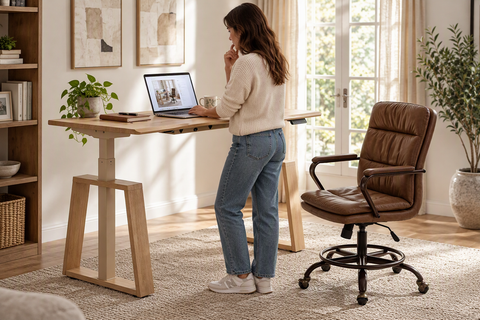
In our observations, height adjustment isn't just for physical health—it’s a way to shift between "thinking" and "execution" modes. Standing can provide a burst of energy for a conference call, while sitting allows for the deep focus required for reviewing complex reports.
Precision Setup Checklist
To transform your space effectively, follow this standardized setup guide aligned with CCOHS recommendations:
- Elbow Height: Your desk height should allow your elbows to be at a 90-degree angle, with wrists in a neutral position.
- Monitor Level: The top third of your screen should be at eye level to prevent neck strain (aligned with ISO 9241-5:2024).
- Legroom: Ensure at least 15-20 inches of knee clearance when seated, avoiding under-desk storage that restricts movement.

The Hidden Cost: Total Cost of Ownership (TCO)
When investing in a premium motorized desk, the surface material is only part of the story. A common mistake is focusing solely on the price of the wood or stone. The true value lies in the mechatronic integration.
Logic Summary: Total Cost of Ownership (TCO) Model
- Parameter: Actuator Lifecycle (MTBF).
- Standard Range: 10,000 to 30,000 cycles.
- Rationale: High-quality actuators reduce the need for expensive repairs or replacements.
- Conclusion: A desk with a higher initial cost but a 20,000-cycle rating typically offers a lower TCO over a 10-year period than a "budget" executive desk.
We estimate that for a high-traffic executive office, choosing a desk with a verified UL 962 safety certification can reduce long-term maintenance costs significantly by ensuring the electronics are built for durability, not just appearance.
Space Transformation: Personal Tips for Your Sanctuary
Once you have selected your material, the transformation of your space continues with the details.
- Mindfulness with Greenery: Integrating a single, high-quality plant (like a Snake Plant or ZZ Plant) can improve air quality and provide a visual "Inspiration" point.
- Lighting Ambiance: Avoid harsh overhead lights. Use a combination of natural light and a warm-toned (2700K-3000K) desk lamp to create a focused, inviting atmosphere.
- Decluttering the Workflow: Use integrated storage or leather organizers to keep your desktop clear. A tidy desk helps reduce distractions and maintain deep work focus.
Addressing Common Pitfalls
One non-obvious discovery we’ve made is the "Cable Tension Trap." When using a height-adjustable desk, many users forget to leave enough slack in their monitor and power cables. At maximum standing height, this tension can damage ports or even pull equipment off the desk. Always test your cable range before your first full day of use.
A Commitment to Quality and Sustainability
Choosing luxury materials also means choosing responsibility. We recommend looking for materials that meet UL GREENGUARD Gold standards to ensure low chemical emissions, protecting your indoor air quality. Furthermore, for wood products, seeking FSC Certification ensures your "Workspace Sanctuary" is built on a foundation of environmental stewardship.
Your executive desk is the silent partner in your success. By choosing materials that resonate with your personal taste and support your physical well-being, you create an environment where excellence is the only option.
YMYL Disclaimer: This article is for informational purposes only and does not constitute professional medical, legal, or financial advice. Proper workstation setup can reduce the risk of musculoskeletal disorders (MSDs), but individuals with pre-existing conditions or chronic pain should consult a qualified healthcare professional or a certified ergonomist before making significant changes to their work environment.
Sources
- BIFMA G1-2013 Ergonomics Guideline for Furniture
- ISO 9241-5:2024 Workstation layout & postural requirements
- Cornell University Ergonomics Web — Workstation Guides
- UL 962 — Safety of Height-Adjustable Desks
- CCOHS: Office Ergonomics - Sit/Stand Desk
- The 2026 Workstation White Paper: Converging Ergonomic Science and Sustainable Engineering
- The Spruce: What Is Sintered Stone?
- WHO 2020 Guidelines on Physical Activity & Sedentary Behaviour




Leave a comment