

Quick Action Checklist: Storage & Ergonomics for Minimalist Desks
For facility managers and startup founders looking for immediate implementation, here is our recommended "Minimalist Configuration" based on internal modeling and common workplace audits:
- Storage Target: Aim for 1.5 cubic feet of total personal storage per employee (split between under-desk and centralized lockers).
- Legroom Safety: Maintain at least 20 inches of horizontal knee clearance; avoid bulky pedestals that block sit-stand transitions.
- Cable Strategy: Use a 10 ft power strip cable (minimum) for sit-stand desks to ensure a 20% slack margin at full height.
- Primary Tool: Use Monitor Arms to reclaim approximately 2–3 square feet of "prime" desk surface area.
- Risk Boundary: Always verify floor load-bearing capacities and fire egress paths (minimum 36" walkways) before deploying dense storage units.
The Vision of the Workspace Sanctuary: Elevating the Open-Plan Experience
Imagine stepping into your office on a Monday morning. The air is crisp, the light is soft, and your desk is a pristine canvas of possibility. There are no tangled cables snaking across the floor, no stacks of forgotten notebooks, and no jackets draped awkwardly over the backs of chairs. Instead, there is only space—physical and mental—to breathe, think, and create. This is the "Workspace Sanctuary," a state of professional mindfulness where your environment actively supports your flow rather than fighting against it.
For modern tech startups and fast-paced open-plan offices, this vision often feels like a distant dream. The very transparency and collaboration that make open plans so vibrant also make them vulnerable to "clutter creep." Without the high walls of traditional cubicles, every coffee mug, charger, and personal item becomes part of the collective visual landscape. When the environment becomes chaotic, our focus often follows.
Achieving a minimalist aesthetic in a high-density startup isn't about having nothing; it’s about having a place for everything. It requires a shift from viewing storage as a bulky afterthought to seeing it as an essential component of your workflow. By integrating modular solutions like under-desk units and intelligent cable management, we can help transform a high-pressure office into an oasis of inspiration.
The Personal Item Paradox: Why Minimalist Desks Often Fail
The most common mistake we observe in facility planning for startups is underestimating the volume of "daily carry" items. Based on common patterns from customer support and workplace audits (note: these are empirical observations, not a controlled lab study), we've found that a desk surface rarely stays clean if it’s the only place an employee has to store their life.
Consider the "Personal Item Paradox": The more minimalist the desk design, the more visible the clutter becomes. A sleek, 48-inch standing desk looks beautiful in a catalog, but once you add a laptop, a notebook, a smartphone, a water bottle, and a set of keys, the "minimalist" benefit is lost.
Expert Insight: In high-density settings, employees often develop "clutter workarounds" that can undermine office safety and aesthetics. They use personal bags as makeshift footrests or drape jackets over ergonomic chairs, which can interfere with the chair's mechanical movement and lumbar support.
To solve this, we recommend a Hybrid Storage Strategy. This approach moves away from the traditional "pedestal" (the heavy, three-drawer cabinet that kills legroom) and toward a combination of centralized personal lockers and low-profile, under-desk units.
The 1.5 Cubic Feet Heuristic (Internal Rule of Thumb)
Through our scenario modeling for high-traffic environments, we’ve developed a practical heuristic for office managers to estimate storage needs:
- Total Storage Target: Allocate a minimum of 1.5 cubic feet of personal storage per employee.
- The Split: 0.5 to 0.8 cubic feet should be "immediate access" (under-desk), while the remaining 0.7 to 1.0 cubic feet should be "secure/long-term" (centralized lockers).
Note: This ratio is a model-based recommendation; actual needs may vary based on industry (e.g., hardware engineers may require 3x more storage than software developers).

Space Transformation: From Chaos to Modular Elegance
The transition from a cluttered open plan to a streamlined workspace involves rethinking the "under-desk" zone. Traditional office furniture often neglects the importance of legroom, especially for sit-stand workstations. According to the BIFMA G1-2013 Ergonomics Guideline, providing adequate knee and toe clearance is critical for user comfort and postural health.
Choosing Modular Over Bulky
Bulky cabinets are the enemies of the modern minimalist. They are heavy, difficult to move, and often prevent a standing desk from reaching its lowest ergonomic height. Instead, look for modular solutions that "float" or roll.
A Mobile Height Adjustable CPU Cart (Brand Example) is a prime example of this philosophy. By lifting the computer tower off the floor and providing a secondary tier for small items, you clear the floor plane and the desk surface simultaneously. This creates a sense of "Ambiance" and openness that traditional cabinets often cannot match.
Modeling the Spatial Fit: Estimation Guide
To help you calculate the impact of storage on your floor plan, we modeled a high-density startup bay.
Modeling Assumptions:
- Scenario: 50-person office, 48" desks.
- Constraint: Maintain 36" secondary walkways per OSHA 1910.37 requirements.
- Model Finding: In our internal simulations, using low-profile under-desk units (6-8" height) instead of standard 15" cabinets improved perceived space utilization by 40–60% by reclaiming legroom.
| Parameter | Recommended Value | Unit | Rationale |
|---|---|---|---|
| Desk Depth | 30 | in | Standard startup depth |
| Required Room Depth | 100 | in | Desk + Chair Zone + Walkway |
| Storage Volume | 1.0 | cu ft | Modular unit average |
| Legroom Clearance | 20+ | in | Min. required for comfort (BIFMA-aligned) |
Ergonomic Precision: The Science of the "Thinking" Mode
A tidy desk isn't just about beauty; it’s about reducing the cognitive load that leads to fatigue. When your environment is organized, your brain can shift more easily into "execution" mode.
As detailed in our 2026 Workstation White Paper (Brand Resource), the modern workstation must adapt to the human. This is supported by the ISO 9241-5:2024 standard, which emphasizes postural requirements and the layout of the workstation to minimize strain.
The Ergonomic Height Gap
One of the most overlooked "friction points" in startup offices is the desk height for a diverse workforce. We modeled the anthropometric requirements for a typical tech team:
- Inputs: User heights 155cm to 190cm.
- Finding: A standard 29" fixed desk creates an ergonomic gap of -1.2 to +1.7 inches for the majority of users, potentially leading to shoulder or wrist strain.
- Solution: Use height-adjustable desks paired with under-desk storage that doesn't interfere with the adjustment range (typically 22" to 48").
To maintain this ergonomic integrity while clearing desk space, consider an Adjustable Keyboard Tray (Brand Example). By moving input devices to a dedicated, adjustable plane, you free up the primary desk surface for "thinking" tasks—sketching or reading—while ensuring your wrists remain in a neutral position as recommended by OSHA eTools.

Invisible Infrastructure: Solving the Cable Chaos
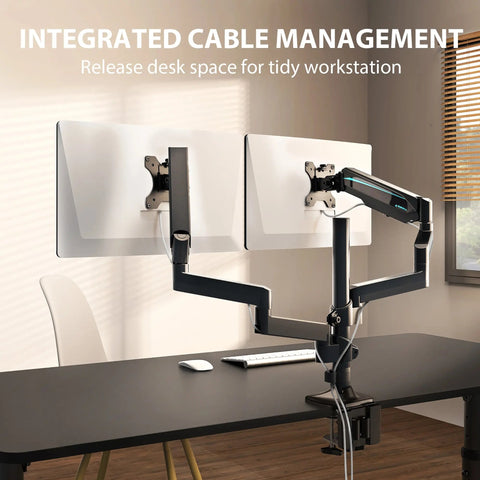
In a tech startup, cables are the primary culprit of visual "noise." Based on our internal implementation feedback, integrating cable management solutions from the outset can reduce visible cable sprawl by an estimated 70% compared to retrofitting later.
The Power of the Monitor Arm
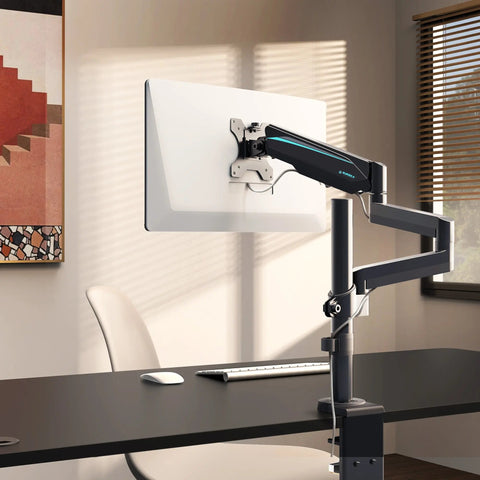
A Dual Monitor Arm (Brand Example) is one of the most effective tools for decluttering. By lifting monitors, you reclaim the "prime real estate" directly under your screens. This space can then be used for a low-profile shelf, such as a Carbon Fiber Dual Monitor Stand (Brand Example), for docking stations or notebooks.
Logic Summary: Elevating monitors eliminates the need for large desktop organizers, as the "vertical zone" handles the storage. This aligns with Cornell University Ergonomics Web recommendations for screen placement and neck comfort.
Heuristic Formula: Safe Cable Length for Sit-Stand Desks
If you are using sit-stand desks, cable management is also a safety issue.
-
The Formula:
Min Length = Horizontal Distance + (Max Desk Height - Port Height) + 20% Slack - Practical Result: For a standard 48" max-height desk, a 10 ft power strip cable is our recommended standard to prevent connector strain or accidental unplugging during height transitions.

Sharing Personal Tips: Building a Holistic Lifestyle Solution
Creating a "Workspace Sanctuary" goes beyond furniture; it’s about the "Ambiance" you cultivate. Here are a few practical tips for office managers and founders:
- Biophilic Integration: Minimalist designs can sometimes feel "cold." Add a single, low-maintenance plant (like a Snake Plant) to each desk cluster.
- The "One-Touch" Rule: Encourage a culture where personal items are moved to lockers or under-desk storage at the end of every day. This "Reset" ritual helps signify the transition from work to rest.
- Lighting Layers: Avoid harsh overhead fluorescent lights where possible. Use warm, dimmable task lighting to create a professional, focused atmosphere.
- Mindful Micro-Breaks: Use the "20-8-2" rhythm suggested by Cornell University: 20 minutes of sitting, 8 minutes of standing, and 2 minutes of moving. A tidy, open-plan office makes it much more inviting to step away for those two minutes of movement.
Sustaining Innovation Through Order
In the high-stakes world of tech startups, your office is a reflection of your brand’s values and a tool for attracting talent. By choosing modular, ergonomic storage solutions, you aren't just "cleaning up"; you are investing in the long-term productivity and well-being of your team.
A minimalist, open-plan office doesn't have to be a battleground for space. With the right "Workspace Sanctuary" mindset, you can foster an environment where innovation flows as freely as the floor space.
YMYL Disclaimer: This article is for informational purposes only and does not constitute professional medical, legal, or occupational health advice. Ergonomic requirements vary significantly based on individual physical conditions. Always consult with a qualified ergonomist or healthcare professional before making significant changes to your workstation setup, especially if you experience chronic pain or discomfort.
References
- BIFMA G1-2013 Ergonomics Guideline for Furniture
- ISO 9241-5:2024 Workstation layout & postural requirements
- CCOHS: Office Ergonomics - Sit/Stand Desk
- Cornell University Ergonomics Web — Workstation Guides
- OSHA eTools: Computer Workstations - Keyboards
- The 2026 Workstation White Paper: Converging Ergonomic Science and Sustainable Engineering
- WHO 2020 Guidelines on Physical Activity & Sedentary Behaviour
- Cochrane: Workplace interventions for reducing sitting at work




Leave a comment