

The multi monitor standing desk stability question is mostly about geometry, not marketing. If your desk feels steady while sitting but starts to move at full height, the weak point is usually the frame, the load layout, or the monitor arms, not the idea of standing itself.
Why Stability Matters in Multi-Monitor Setups
For most buyers, stability only becomes a real issue once two things happen at the same time: the desk rises, and the screens sit farther from the center of the frame. That is why a setup can feel fine at sitting height and still show wobble when you start typing, mousing, or nudging an arm-mounted monitor.
Why Frame Weight is the Best Metric for Gaming Desk Stability is a useful follow-up if you are also thinking about high-movement use cases, because the same layout questions show up there. A second practical anchor is load planning: when a desk is carrying monitors, a PC, and accessories, the working load matters more than the brochure image.
A good decision sentence here is simple: if the desk only feels solid when the load is centered and low, it is probably a poor fit for a multi-monitor rig; if it stays composed as the desk rises, it is more likely to keep working once the screens and arms are added.

What a Real Stability Benchmark Measures
A useful benchmark should compare stability at different heights, not just at one comfortable sitting position. That matters because standing desks do not behave the same way at 29 inches and at full extension, and many buyers judge them only where motion is hardest to notice.
This BIFMA standards overview is the clearest public definition anchor for the benchmark side of the discussion. BIFMA X5.5 covers safety, durability, and structural performance testing for height-adjustable desks, which is why it is the right reference point for a stability-oriented evaluation.
A practical desk test should look at four things:
- Front-to-back movement when you type or tap the desktop.
- Left-to-right sway when the desk is near its tallest position.
- Whether monitor arms change the motion pattern more than the frame itself.
- Whether the desktop carries small vibrations from mouse movement or typing.
The important boundary is this: if the monitor arm is doing most of the moving, the frame may be fine; if the whole desk shifts together, the desk geometry is the problem.

How BIFMA Standards Ensure Your Standing Desk is Stable is a sensible internal reference when you want a broader load-first framework. The practical takeaway is that symmetry matters. Even a desk with a high total capacity can still feel less stable if one side is heavily loaded or if the monitors sit far from the frame centerline.
Design Choices That Reduce Wobble
This is where the recommendation starts to separate strong frames from merely attractive ones. For multi-monitor setups, dual motors, wider bases, crossbars, and three-stage legs usually help more than a clean-looking desktop alone. They do not guarantee stability, but they often slow the onset of visible sway as the desk rises.
The table below summarizes the most useful design checks for a heavy monitor setup.
| Design Choice | What It Changes | Why It Helps | Trade-Off | What To Check Before Buying |
|---|---|---|---|---|
| Dual-motor lift | More even motion between legs | Can reduce uneven lift behavior under load | Usually costs more | Published weight capacity and lift symmetry |
| Crossbar or bracing | Side-to-side rigidity | Helps resist sway at taller heights | Can reduce legroom or limit under-desk space | Whether the crossbar is fixed, removable, or absent |
| Three-stage legs | Column overlap and extension behavior | Often improves tall-position control | More moving parts | Height range and stability at the height you use most |
| Wider base footprint | Resistance to tipping or rocking | Better for arm-mounted screens | Needs more room | Desk depth, wall clearance, and floor leveling |
| Monitor arms | Screen placement flexibility | Frees desktop space and improves ergonomics | Adds leverage to the frame | Arm reach, clamp fit, and monitor weight |
For a more detailed product-family browse, the Ark Standing Desk collection and Office Desks are better treated as starting points than final answers. The right choice depends less on the label and more on whether the frame can keep the load centered when the screens are extended.
When you compare specific models, the safest wording is: choose the frame that gives you the best balance of lift symmetry, width, and load support; skip the one that only looks substantial at sitting height.
Setup Details That Change the Result
A desk can pass the eye test and still fail the lived-use test if the setup is poorly balanced. That is why the same frame may feel firm in one room and shaky in another.
- Keep the center of mass inside the footprint.
Heavier monitors, a PC, and any drawer or riser should sit as close to the center of the frame as practical. If the heaviest gear hangs off one side, the desk will reveal motion sooner.
- Treat the monitor arm as part of the system.
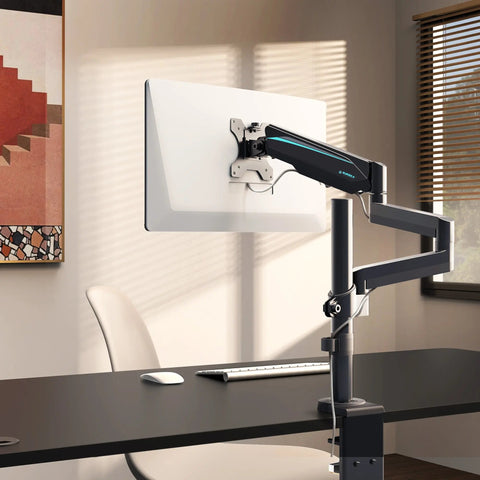
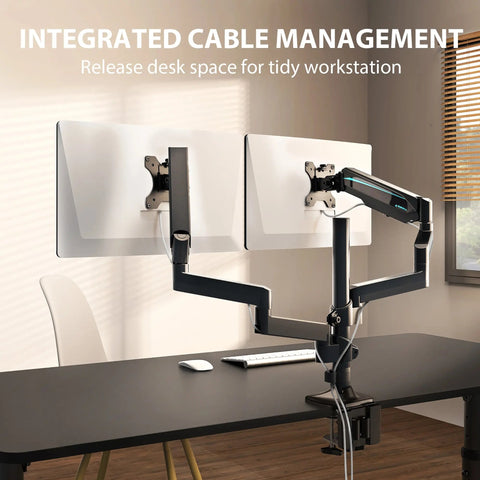
The Dual Monitor Arm supports most 17 to 32 inch monitors up to 17.6 lb each, with C-clamp or grommet mounting and 360-degree adjustability. That is useful, but the leverage from extended arms can also make small frame motion more visible at the screen edge.
- Reduce cable pull.
If cables are tight, they can tug against the desk during height changes and make the frame seem worse than it is. Loose, guided cabling is not glamorous, but it prevents false wobble signals.
- Level the feet before judging the frame.
Floor unevenness can create motion that looks like frame weakness. If the desk sits on carpet or a slightly sloped floor, test after leveling first.
- Retest after every major load change.
Adding a second arm, a heavier monitor, or a PC tower can change the result more than buyers expect. A setup that felt fine last month may behave differently after one accessory swap.
For readers who want a mobility-versus-stability comparison, Caster Wheels vs. Fixed Feet: Balancing Mobility and Stability is relevant because floor contact is one of the easiest variables to overlook. The practical rule is simple: if you need maximum steadiness, fixed feet are usually the safer default; if you need frequent movement, expect to give up some rigidity.
Which Desk Types Fit Heavy Monitor Rigs
The best fit flips based on monitor count and how far the screens extend from the desk edge. Dual-monitor users usually need balanced lift behavior and usable mid-height performance more than a giant top. Triple-monitor users usually need more width, better geometry, and a cleaner load layout, especially if the monitors sit on articulated arms.
This is where a larger surface is not automatically better. An L-shaped desk can separate zones and spread gear out, but it can also encourage uneven loading if the heaviest items drift to one side. A compact rectangular desk can still work if the frame is symmetrical and the monitor footprint stays controlled.
For a broader premium-desk path, the Executive Home Office collection is a reasonable browsing lane, while the Ark Standing Desk collection is the more focused destination if you already want that family of frames. The decision filter is straightforward: if your screens sit close to the centerline, a simpler desk can work; if the arms reach far out, prioritize width and frame rigidity first.
The strongest product-level examples here are the Ark SWS Pro Executive Standing Desk (63"x29"), the Unique Shape Office Standing Desk (70"x29"), and the Ark Pro L-Shaped Standing Desk (Sintered Stone, 63"x23"). Their published feature sets point in the same direction: dual motors, crossbar or rigid frame elements where stated, and three-stage legs on the strongest stability-oriented options. That does not make one universally best, but it does tell you which type of frame is more likely to hold up under a heavy multi-monitor load.
If you want the simplest decision sentence in the whole article, use this one: choose a dual-motor, wide-footprint frame when your monitors are arm-mounted or asymmetrically loaded; choose a less elaborate frame only when the load is centered, modest, and you do not raise the desk often.
Final Checks Before You Buy
Before you buy a standing desk for a heavy multi-monitor setup, verify the load number against the full system, not just the desktop. Monitors, arms, a PC, and accessories add up quickly.
- Check the published weight capacity against your real rig.
- Compare the maximum height with the height you will actually use most often.
- Confirm whether the frame uses dual motors, three-stage legs, or a crossbar where stated.
- Make sure the monitor arm fits the desktop thickness and monitor weight.
- Review return and shipping terms before loading the desk heavily on day one.
The MSU Extension guidance on standing desk use is a good buyer-side check because it emphasizes a simple point: the desk should not wobble noticeably under the intended load. That is the right test to keep in mind after the desk is assembled and before you assume the frame is the issue.
A final caution is useful here. If your setup only feels stable when the screens are centered and the desk is mid-height, that is not a full pass for a multi-monitor workflow. The better desk is the one that still behaves predictably at the height, load, and arm reach you plan to use every day.
FAQs
Q1. How Do I Test Standing Desk Wobble With Two or Three Monitors?
Start at your normal standing height, then type, tap the desktop lightly, and move the mouse the way you do in real work. Repeat with the monitors mounted the way they will actually be used. If motion only appears at full height or with the arms extended, that is a useful boundary, not a random flaw.
Q2. What Desk Features Matter Most for Heavy Monitor Setups?
The most useful cues are dual-motor lifting, a stable base footprint, three-stage legs where available, and a crossbar or similar bracing when the product states one. Load rating matters, but only after you check how far the screens sit from the desk centerline.
Q3. Can a Monitor Arm Make a Standing Desk Feel Less Stable?
Yes, because an extended arm adds leverage and can make small frame motion easier to notice. That does not mean the desk is bad. It means the desk and arm need to be judged together, especially if the monitor is large, off-center, or raised high above the desktop.
Q4. Why Does a Desk Feel Wobblier at Full Height?
As the columns extend, the frame has less overlap and usually less resistance to motion. That makes small pushes, typing, and arm movement more visible. If the desk is only acceptable at mid-height, you should treat that as a fit issue for your actual use case.
Q5. Can a 220 Lb Desk Handle Three Monitors?
Sometimes, but total capacity alone is not enough to answer that. Three monitors on arms can create more leverage than the number suggests, especially if one screen is ultrawide or mounted far from the center. Check the arm load, the total system weight, and the desk’s behavior at full height.
The Safest Buy Is the One That Stays Quiet Under Load
The best multi monitor standing desk stability outcome is not “no movement at all.” It is predictable behavior under your actual load, at your actual height, with your actual arms and accessories. If a frame only looks stable in a centered showroom setup, keep looking. If it remains composed when the load is off-center and the desk is fully raised, that is the better buy. Test the full rig at standing height with monitors mounted before finalizing any purchase.




Leave a comment