

Silent Productivity: Noise-Reducing Layouts for Open Law Hubs
The shift toward open-plan environments in legal and professional services was intended to foster collaboration, yet for many executive-level decision-makers, it has introduced a critical vulnerability: the erosion of acoustic privacy. In a field where attorney-client privilege is the cornerstone of the practice, the "distraction" of a noisy office is not merely a productivity hurdle; it is a potential liability.
Quick Take: Strategic Acoustic Privacy
- The Goal: Achieve "zero intelligibility" where confidential speech is heard only as a murmur.
- The Method: Use high-density furniture (bookcases/cabinets) as "shadow zone" barriers rather than relying solely on walls.
- The Rule: Position barriers at least 71" high and perpendicular to noise sources to maximize sound diffraction.
- The Result: A potential reduction in speech intelligibility by 15–20% and sound pressure levels by 12–18 dB in targeted zones (based on standard acoustic modeling).
How to Audit Your Office Privacy (Self-Test)
Before investing in new layouts, perform this 3-step acoustic check:
- The "Phone App" Baseline: Use a free SPL (Sound Pressure Level) meter app. Measure the decibel level at your desk during peak hours. A professional office usually averages 45–55 dB.
- The Intelligibility Test: Have a colleague stand at a common "distraction point" (like a printer) and read a document at normal volume. If you can understand more than 50% of the words, your Speech Intelligibility Index (SII) is too high for confidential work.
- The Line-of-Sight Check: Sit at your desk. If you can see the mouth of a person talking 15 feet away, sound waves have a direct path to you. You need a physical barrier of at least 71 inches to interrupt this path.
The Science of Acoustic Privacy in Legal Environments
Acoustic privacy is governed by the relationship between background noise, sound barriers, and the distance between the speaker and the listener. In a legal setting, the goal is often "zero intelligibility"—a state where a conversation may be heard as a murmur but cannot be understood by an unintended listener. According to the Speech Intelligibility Index (SII) Rating 101, a rating between 0.50 and 0.70 is considered "fair" for general productivity but remains a risk for confidentiality.
The Role of Mass and Absorption
Sound waves, particularly the mid-to-high frequencies associated with human speech (typically 500 Hz to 4 kHz), are easily reflected by hard surfaces. To mitigate this, one must introduce materials with high sound absorption coefficients.
While many focus on specialized foam, the "mass" of legal documentation is an effective acoustic asset. Dense materials are superior at absorbing low-frequency sounds, while textured surfaces break up high-frequency reflections. Based on general acoustic principles, a standard 71" bookcase, when filled with legal binders, acts as a high-density acoustic baffle.
Heuristic Guide: The following table estimates sound absorption effectiveness based on common material properties and industry heuristics for office environments.
| Material Type | Typical Absorption Coefficient (at 1 kHz) | Unit | Rationale |
|---|---|---|---|
| Empty Wooden Shelf | 0.05 – 0.10 | α | Highly reflective, minimal mass |
| Metal File Cabinet (Full) | 0.20 – 0.35 | α | Dense core reduces low-frequency resonance |
| Bookcase with Binders | 0.40 – 0.55 | α | Irregular surfaces diffuse high-frequency sound |
| Acoustic Fabric Panel | 0.70 – 0.95 | α | Specifically engineered for absorption |
Strategic Furniture Placement: Creating the "Shadow Zone"
The most effective acoustic barriers in an open law hub do not always require permanent walls. Instead, they leverage strategic placement to create "shadow zones"—areas where sound pressure levels drop due to an intervening mass.
The Perpendicular Heuristic
A common mistake is placing storage units against existing walls. This does little to interrupt the path of sound between workstations. Based on typical office diffraction models, positioning bookcases and storage units perpendicular to noise sources (such as printer stations) can be significantly more effective. This placement interrupts the "line-of-sight" for sound waves, which can reduce speech intelligibility by an estimated 15–20% in the immediate vicinity.
The 71-Inch Rule
Height is a critical parameter. A barrier must be tall enough to interrupt the sound path of a standing or seated speaker. Aligned with the principles in the ISO 9241-5:2024 standard for workstation layout, we recommend barriers of at least 71 inches. A single 71" unit positioned 3–4 feet from a conversation area creates a diffraction effect that can help make confidential discussions less intelligible to those beyond the barrier.

Integrating Professional-Grade Solutions
Disclosure: The following sections feature Eureka Ergonomic products as examples of how professional furniture can be integrated into an acoustic strategy. While these are engineered for high-performance offices, results may vary based on room dimensions and materials.
Storage as a Sound Buffer
The 19" File Storage Cabinet, Dark Walnut is an example of a high-density unit that serves a dual purpose. When placed at the end of a workstation cluster, these cabinets provide mass to help dampen mid-frequency speech. The internal document load acts as a vibration-dampening core, effectively turning a storage necessity into an acoustic tool.
Minimizing Reflective Surfaces
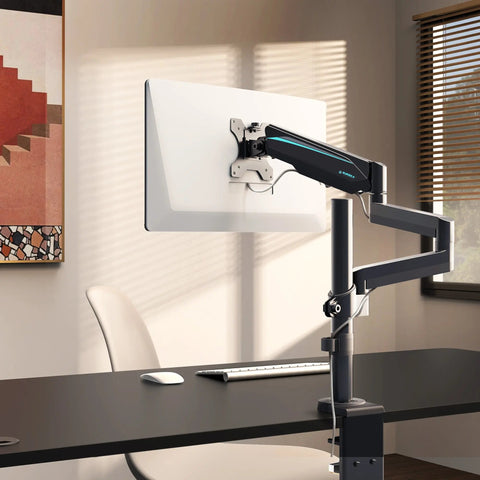
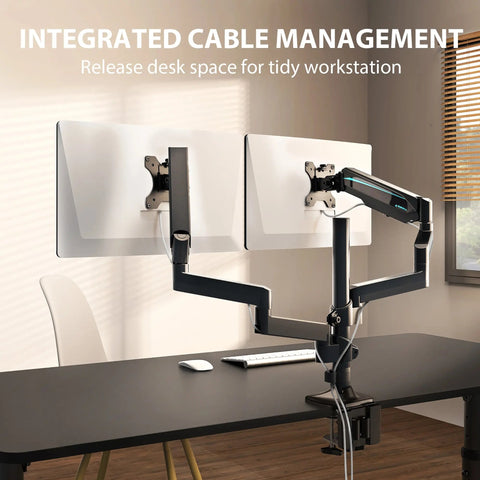
Beyond large barriers, small adjustments to the workstation can reduce high-frequency "flutter echo." Reflective surfaces, such as large monitor backs, bounce sound around the room. By using a Single Monitor Arm or a Dual Monitor Arm, attorneys can tilt their screens to optimal ergonomic angles that also serve to deflect sound waves toward floor-level absorbers (like carpeting).
Furthermore, consolidating cables into trays—a standard feature in our professional-grade furniture—can reduce the "clutter-induced" scattering of high-frequency noise. This is consistent with HSE guidelines on working safely with display screen equipment, which advocate for organized environments to reduce both physical and cognitive stress.
Practical Recommendations for Law Firm Executives
1. The Ideal Sit-Stand Rhythm
Acoustics change based on the height of the speaker. When using height-adjustable desks, the sound profile of the office shifts as users move. To maintain ergonomic health while managing noise, follow the "20-8-2" rule recommended by Cornell University Ergonomics Web: 20 minutes of sitting, 8 minutes of standing, and 2 minutes of moving.
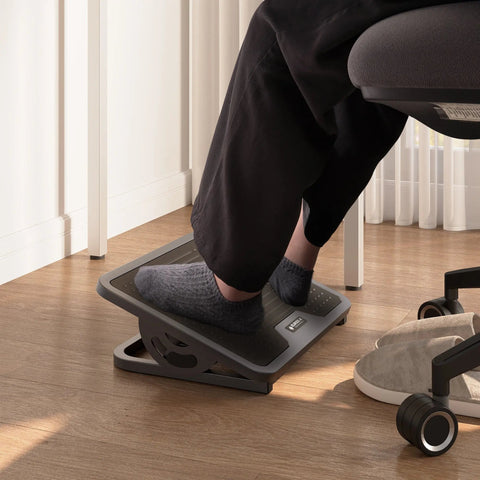
To support this, ensure workstations include a Footstool with Wheels. This allows for micro-adjustments that reduce musculoskeletal strain. According to the CCOHS guide on sit/stand desks, proper foot support is essential for maintaining a neutral spinal position.
2. Visual Overstimulation
It is a common observation that noise is not the only distractor. Research cited by WCOnline indicates that for some professionals, visual overstimulation is as disruptive as auditory noise. Strategic furniture placement solves both issues by providing "visual privacy" through the same tall bookcases used for acoustic dampening.
Modeling the Acoustic Shadow Zone
To assist office managers in visualizing these changes, we have modeled a "Shadow Zone" scenario based on common legal office parameters.
Method & Assumptions: This is a scenario model based on standard sound diffraction physics (Fresnel zones), not a controlled laboratory study. It assumes a point source of sound and a rigid, non-porous barrier.
| Parameter | Value / Range | Unit | Rationale |
|---|---|---|---|
| Barrier Height | 71 | Inches | Standard tall bookcase height |
| Distance from Source | 3 – 4 | Feet | Optimal diffraction distance |
| Ambient Noise Floor | 45 – 50 | dB | Typical professional office level |
| Source Volume (Speech) | 60 – 65 | dB | Normal conversational volume |
| Estimated Reduction | 12 – 18 | dB | Potential reduction in the "shadow" of the barrier |
Note: This model is an illustrative estimate. Effectiveness can vary significantly based on room reverberation times, ceiling tile absorption (NRC), and background noise levels.
The Path to a More Productive Practice
Creating a quiet, professional environment in an open law hub is an ongoing process. By moving away from "one-size-fits-all" layouts and adopting the principles of Acoustic-First Desks, firms can better protect their time and their clients' trust.
As detailed in The 2026 Workstation White Paper, the future of office design lies in the integration of health, privacy, and performance. Whether you are a solo practitioner or managing a large firm, the strategic use of high-quality furniture remains a highly practical way to achieve silent productivity.
Disclaimer: This article is for informational purposes only and does not constitute professional legal, medical, or architectural advice. Acoustic performance can vary significantly based on specific building materials and site conditions. For critical confidentiality requirements, consult with a certified acoustic engineer. Individuals with pre-existing musculoskeletal conditions should consult a healthcare professional before making significant changes to their workstation setup.
Sources
- BIFMA G1-2013 Ergonomics Guideline for Furniture
- ISO 9241-5:2024 Workstation layout & postural requirements
- OSHA eTools: Computer Workstations - Workstation Environment
- Cornell University Ergonomics Web — Workstation Guides
- HSE: Working safely with display screen equipment (DSE)
- Speech Intelligibility Index (SII) Rating 101
- CCOHS: Office Ergonomics - Sit/Stand Desk




Leave a comment