

The Discrepancy Between Manufacturer Estimates and Professional Reality
A common point of frustration for remote professionals is the premature degradation of their primary workstation tool: the office chair. While conventional wisdom and manufacturer marketing often cite a 7-to-10-year lifespan, many users find that their chairs lose ergonomic integrity within 3 to 5 years. This gap exists because standard durability ratings are often based on "average" office usage—typically 40 hours per week—which does not account for the high-intensity, multi-functional usage patterns of the modern hybrid worker.
Understanding the lifespan of an office chair requires moving beyond physical appearance. According to the Occupational Safety and Health Administration (OSHA), a chair's primary function is to maintain a "neutral" spinal posture. When components like the gas lift or seat foam begin to fail, the chair may still look intact while failing its fundamental health objective. This article explores the physiological, mechanical, and economic factors that dictate when a chair has reached its true end-of-life.
The Three Timelines of Chair Longevity
To accurately assess a chair, professionals should evaluate it across three distinct timelines. As noted in The 2026 Workstation White Paper: Converging Ergonomic Science and Sustainable Engineering, the convergence of material science and usage intensity means that a chair's aesthetic life is almost always longer than its ergonomic life.
- Ergonomic Lifespan (2–4 Years): This is the period during which the seat foam and lumbar support maintain their original resilience. Research indicates that polyurethane foam can lose 20–40% of its support within 2 to 3 years of heavy use (8+ hours daily) before any visible wear appears.
- Functional Lifespan (5–8 Years): This covers the mechanical components—the hydraulic cylinder, the tilt mechanism, and the casters. ANSI/BIFMA X5.1 standards require gas lifts to withstand 120,000 cycles, but frequent adjustments by heavy users can accelerate this timeline.
- Aesthetic Lifespan (7–10+ Years): This is simply how long the frame and fabric remain visually acceptable. Relying on this metric alone is a common mistake that can lead to cumulative musculoskeletal strain.

Scientific Principles of Material Fatigue
The degradation of an office chair is a matter of physics and material science. Two primary factors contribute to the decline of ergonomic support: static load and compression set.
Foam Compression and Pelvic Support
Most office chairs utilize high-density polyurethane foam. Over time, the cellular structure of the foam undergoes "compression set," a permanent deformation where the material no longer rebounds to its original height. According to ASTM D3574 foam testing standards, budget foams reach their deformation limit much faster than the high-density molded foams used in professional-grade seating. Once the foam "bottoms out," the user’s sit-bones (ischial tuberosities) press against the hard seat pan, causing localized pressure and restricting blood circulation in the lower limbs.
Mesh Tension and Frame Stress
In mesh-backed chairs, such as the Lira, Ergonomic Office Chair, the mesh is under constant tension. While high-quality elastomeric mesh is designed for longevity, the most frequent failure point is actually the plastic frame or the attachment points. Constant leaning and shifting create lateral stress that can lead to micro-cracks in the polymer.
Logic Summary: Our analysis of material fatigue assumes that "heavy use" involves more than 8 hours of seated time daily. This intensity accelerates the compression set of foam and the tension loss in mesh components compared to the 40-hour work week used in standard BIFMA testing.
Scenario Modeling: The Heavy-Use Hybrid Worker
To demonstrate how usage intensity dictates lifespan, we modeled a specific "Heavy-Use Hybrid Worker" persona. This individual represents the upper bounds of workstation stress.
Method & Assumptions (Scenario Model)
This model is a deterministic simulation based on engineering heuristics and anthropometric data. It is intended for illustrative purposes and does not represent a controlled laboratory study.
| Parameter | Value | Unit | Rationale / Source Category |
|---|---|---|---|
| User Weight | 110 (242) | kg (lbs) | 90th percentile male weight (CDC Data) |
| Daily Usage | 10–12 | Hours | Combined work and gaming sessions |
| Height Adjustments | 6+ | Per Day | Frequent transitions between sitting and standing |
| User Stature | 185 (6'1") | cm | High-leverage stress on tilt mechanisms |
| Desk Mismatch | -1.12 | Inches | Improper knee angle increasing seat edge pressure |
Quantitative Findings
In this specific scenario, the modeling suggests that a standard chair rated for 250 lbs will experience accelerated wear:
- Hydraulic Failure: Likely within 2–3 years due to the 110kg load combined with frequent height adjustments.
- Foam Support Loss: High-density foam is estimated to lose its ergonomic effectiveness within 18–24 months under 10+ hours of daily use.
- Caster Degradation: Extended movement during gaming sessions (common for this persona) accelerates wheel wear, especially on hard surfaces.
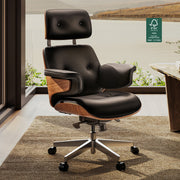
For this user, a chair like the Royal II, Silicone & Leather Executive Ergonomic Office Chair is a more rational investment because its high-back design and reinforced structure are better suited to manage the higher center of gravity and weight load.

Critical Signs It’s Time to Replace Your Chair
Identifying the need for a replacement requires a proactive "check-up." Based on common patterns observed in warranty handling and professional ergonomic assessments, users should look for the following "red flags."
1. The "Slow Sink" (Hydraulic Failure)
If your chair slowly loses height over the course of an hour, the nitrogen seal in the gas lift has failed. This is a safety concern and a major ergonomic disruption. While cylinders can be replaced, the labor and part cost often approach 40% of a mid-range chair's value.
2. Loss of "Rebound" in the Seat
Perform the "Press Test": Press your fist firmly into the center of the seat cushion and release. If the foam takes more than a second to return to its original shape, or if you can feel the hard seat pan underneath, the pelvic support is gone. This is a leading cause of lower back discomfort in the afternoon.
3. Structural Instability or "Wobble"
Aligned with ISO 9241-5:2024 standards, a workstation must provide a stable base. If the chair has developed a persistent tilt to one side or the central stem feels loose, the internal welding or the mounting plate may be compromised.
4. Caster Friction and Floor Damage
High-quality casters should glide silently. If you feel resistance or hear a grinding sound, the bearings have likely failed. Using a chair with failed casters significantly increases the force required to move, putting unnecessary strain on the hip flexors and damaging flooring.
Maintenance: How to Extend Your Investment
While all mechanical objects eventually fail, proactive care can push a chair toward the upper end of its functional life. The Office Chair Care & Maintenance Guide provides detailed steps for long-term preservation.
- Fastener Inspection: Every 6 months, check and tighten the bolts connecting the armrests and the seat mechanism. Vibrations from movement naturally loosen these over time.
- Caster Cleaning: Hair and dust accumulate in caster axles, creating friction. Periodically removing debris can double the life of the wheels.
- Upholstery Care: For leather or silicone-based materials like those on the Royal II, regular cleaning prevents body oils from breaking down the protective coatings.

The Economic "40-50% Rule" for Replacement
When a major component fails, users often struggle with the "repair vs. replace" decision. A professional heuristic used in facility management is the 40-50% Rule:
If the cost of a single major repair (including parts and shipping) exceeds 40-50% of the chair's current market value, replacement is typically more economical.
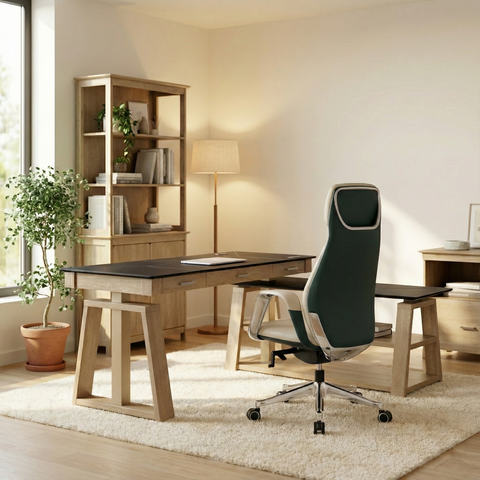
This is because mechanical failures often occur in clusters. If the gas lift has failed due to age, the seat foam and tilt mechanism are likely nearing their limits as well. Investing in a new, certified model like the Onyx, Ergonomic Office Chair often provides better long-term value and a fresh warranty.
Choosing Your Next Chair: Longevity Features
When upgrading, look for features that specifically address the failure points mentioned above.
- BIFMA Certification: Ensure the chair meets ANSI/BIFMA X5.1 for safety and durability.
- Weight Capacity: If you are a "heavy-use" worker, select a chair with a capacity at least 20% higher than your actual weight to provide a safety margin for the mechanisms.
- Material Choice: For high-traffic home offices, silicone-leather or high-density mesh (like the Lira) offers superior resistance to abrasion and tension loss compared to standard fabric.
- Adjustability: As specified in the BIFMA G1-2013 Ergonomics Guideline, a chair must accommodate a wide range of body types. Look for seat depth adjustment, which prevents the "edge pressure" that destroys seat foam.
The Matt, Faux Leather Office Chair is an example of a design that balances aesthetic longevity with functional simplicity, making it ideal for home environments where the chair might be used intermittently but needs to maintain its structural integrity for years.

Summary of Ergonomic Health
The lifespan of an office chair is not a fixed number of years, but a variable equation of material quality and usage intensity. For the professional working 8+ hours a day, the chair is the most critical piece of health equipment in the room. By identifying the early signs of foam fatigue and mechanical failure, you can prevent the cumulative musculoskeletal disorders that arise from "powering through" on a worn-out seat.
Whether you choose a high-performance mesh model or a reinforced executive chair, the goal remains the same: maintaining a neutral posture that allows for productivity without physical cost. Regular assessments and timely upgrades are not just about comfort—they are essential components of a long-term professional wellness strategy.
Disclaimer: This article is for informational purposes only and does not constitute professional medical advice. If you are experiencing chronic back pain or other musculoskeletal issues, please consult a qualified healthcare professional or an occupational therapist for a personalized ergonomic assessment.
References
- BIFMA G1-2013 Ergonomics Guideline for Furniture
- OSHA eTools: Computer Workstations - Chairs
- ANSI/BIFMA X5.1 General-Purpose Office Chairs
- ISO 9241-5:2024 Workstation layout & postural requirements
- ASTM D3574 Standard Test Methods for Flexible Cellular Materials
- The 2026 Workstation White Paper: Converging Ergonomic Science and Sustainable Engineering
Leave a comment