

Visual Harmony: Coordinating Styles Across Multi-Use Zones
In a studio apartment or compact urban home, your living space often doubles as a high-stakes office. Achieving visual harmony isn't just about aesthetics; it is about creating a "mental boundary" that helps you transition from relaxation to deep work.
To help you get started immediately, here is our Workspace Sanctuary Checklist:
- [ ] Measure Your Base: Ensure your desk height allows elbows to rest at roughly 90 degrees (usually 28"–30" for sitting).
- [ ] Apply the 60-30-10 Rule: Choose one primary material (60%), one secondary (30%), and one accent (10%).
- [ ] Standardize Eye Level: Position your monitor so the top third of the screen is at eye level to reduce neck strain.
- [ ] Route Your Cables: Use ties to clear "visual noise" from the floor and desk surface.
- [ ] Sync Your Lighting: Use consistent color temperatures (e.g., 3000K) across both work and living zones.
The Psychology of Visual Sanctuary
Living in a multi-functional space often introduces "visual noise"—clutter that the brain must constantly process. While not a medical diagnosis, research on Brain Health and Visual Clutter suggests that cluttered environments can tax the visual cortex, potentially making it harder to focus on complex tasks.
In our experience supporting remote workers, a common pattern is the use of mismatched "statement" pieces that compete for attention. True harmony occurs when the eye can move across a room without being snagged by clashing materials.
Heuristic Note: The Aesthetic-Stress Framework Based on industry heuristics regarding environmental psychology, we assume that reducing visual entropy (clutter) can help lower perceived stress and support cognitive endurance. This is a practical framework for design, rather than a clinical medical model.
Space Transformation: From Chaos to Cohesion
To move from a makeshift setup to a professional sanctuary, we recommend a "series-based" approach. Selecting furniture from the same design lineage creates an immediate sense of intention.
1. Defining the Anchor Zone
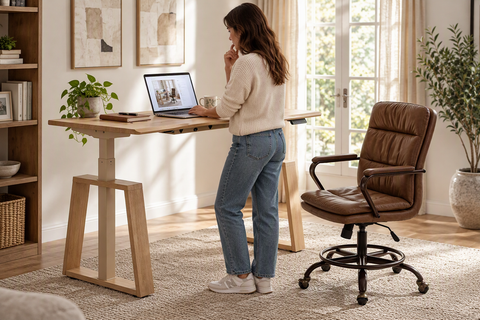
In an open floor plan, furniture acts as the architecture. Using a substantial piece like the Ark SWS Pro Executive Standing Desk (63"x29") (Brand Example) provides a visual anchor. Its X-shaped legs and wood finish help define a dedicated professional zone without the need for physical walls.

2. Coordinated Storage
The "Before" state of many home offices often involves mismatched shelving. To improve cohesion, consider pairing your desk with a coordinated solution. The Ark ES, 29" File Storage Cabinet (Brand Example) complements the executive desk with a matching dual-tone finish, signaling that the area has a specific, respected function.

3. The 60-30-10 Rule (Design Heuristic)
A practical rule of thumb used by designers to maintain harmony is the 60-30-10 rule. In a multi-use zone, this can be applied as:
- 60% Primary Material: Usually wood tones or a neutral base (e.g., a dark brown desk surface).
- 30% Secondary Material: Often a metal finish (e.g., matte black legs or hardware).
- 10% Accent Texture: Fabric, glass, or greenery to add visual interest.
Linking Functionality with Ergonomics
Ergonomics is often discussed in physical terms—angles and clearances. However, the emotional benefit of a well-adjusted workspace is also significant. When a desk like the Ark SWS Pro Executive Standing Desk (Brand Example) allows for height adjustment, it facilitates a shift in mental mode.
Raising a desk to a standing position can act as a physical trigger for "execution mode," while lowering it might signal "deep thinking."
Ergonomic Benchmarks
While individual needs vary, these benchmarks provide a baseline for a typical adult user. These ranges are derived from general ergonomic principles and BIFMA G1-2013 guidelines.
| Feature | Practical Rule of Thumb | Potential Impact |
|---|---|---|
| Desk Height (Seated) | Elbows at ~90 degrees, feet flat | Can reduce shoulder tension. |
| Monitor Level | Top third of screen at eye level | Helps prevent "tech neck" posture. |
| Leg Clearance | Minimum 20–30 inches of width | Reduces the feeling of being cramped. |
| Surface Depth | 24–30 inches for focal distance | May reduce eye strain from screen proximity. |
Methodology Note: These ranges are a synthesis of postural requirements from ISO 9241-5:2024 and OSHA eTools. They serve as a baseline for general comfort.
Lighting and Ambiance: The Final Layer
In a studio apartment, lighting is a powerful tool for zoning. Relying on a single, harsh overhead light can create a sterile "office" feel. Instead, layer your lighting to build a holistic lifestyle solution.
Using Soho Art Lighting (Brand Example) allows for warm, indirect light to define the perimeter of your workspace. A key tip from lighting professionals is to maintain a consistent color temperature (typically 2700K to 3000K) across all ambient and task lighting to prevent a disjointed visual environment.

Cable Mindfulness
Visible "cable waterfalls" can quickly disrupt the visual harmony of a room. For maintaining the clean lines of a coordinated style, cable management is a practical necessity.
We recommend using Magnetic Cable Ties (Brand Example) to route lines along the metal legs of your furniture. This practice aligns with OSHA Workstation Environment guidelines, which note that a tidy workspace can reduce both physical hazards and cognitive distractions.
Scenario Analysis: Professional vs. Creator
- The Studio Professional: Often focuses on "Executive" coordination. They might pair an executive standing desk with matching filing cabinets to create a mini-office suite that integrates seamlessly into a living area when not in use.
- The Content Creator: Often needs "Dynamic" coordination. They might prioritize versatile lighting, such as the Soho Art Collection (Brand Example), to serve as both functional task lighting and an aesthetic background for filming.
Building Your Blueprint
As discussed in our industry white paper, The 2026 Workstation White Paper (Manufacturer Research), the future of the home office lies in the convergence of performance and domestic elegance.
By choosing series-based furniture, adhering to the 60-30-10 material rule, and mastering small details like cable management, you can transform your studio from a place where you have to work into a sanctuary where you want to create.
YMYL Disclaimer: This article is for informational purposes only and does not constitute professional medical, ergonomic, or interior design advice. While ergonomic furniture can support better posture, individuals with pre-existing musculoskeletal conditions should consult a qualified healthcare professional or a certified ergonomist before making significant changes to their workstation setup.
Sources
Independent Standards & Research
- BIFMA G1-2013 Ergonomics Guideline for Furniture
- OSHA eTools: Computer Workstations - Neutral Working Postures
- ISO 9241-5:2024 Workstation layout & postural requirements
- Brain Health University: Why You Can't Focus in Cluttered Spaces
Manufacturer Resources 5. The 2026 Workstation White Paper: Converging Ergonomic Science and Sustainable Engineering (Eureka Ergonomic Research)




Leave a comment