

The Hidden Cost of the "Budget" Seat: Why Initial Comfort Often Fails
Many professionals and gamers begin their ergonomic journey with a common observation: after four or five hours of focused work, a dull ache begins to radiate from the lower lumbar region, often accompanied by a noticeable "sinking" sensation in the seat. This is not merely a matter of personal fatigue; it is a physiological response to inadequate support structures. While the market is saturated with mesh chairs ranging from $100 to $1,500, the disparity in price reflects a fundamental difference in material science and mechanical integrity.
The primary misconception is that all mesh is created equal because it all "breathes." In reality, the breathability of low-tier polypropylene mesh often degrades as the fibers experience "creep"—a permanent deformation under constant load. According to the 2026 Workstation White Paper: Converging Ergonomic Science and Sustainable Engineering, high-performance seating must balance tension, durability, and thermal regulation to maintain a healthy Musculoskeletal (MSD) profile over a multi-year lifespan.
For high-budget users, the investment in a premium mesh chair is rarely about the first hour of use; it is about the eighth hour of the day and the fifth year of ownership. This article analyzes the technical mechanisms that justify a premium investment, grounded in international ergonomic standards and quantitative ROI modeling.

The Physiology of Seated Work: Static Load and Neutral Posture
To understand the value of premium engineering, one must first understand the physiological risks of prolonged sitting. The human body is not designed for static positions. When we sit, the natural "S-curve" of the spine tends to flatten into a "C-shape," increasing intra-discal pressure.
Musculoskeletal Disorders (MSDs) and Static Load
Prolonged static sitting is a primary risk factor for work-related MSDs. According to the European Agency for Safety and Health at Work (EU-OSHA), static load occurs when muscles remain in a state of contraction without movement, leading to reduced blood circulation and the accumulation of metabolic waste products. This is the "burning" sensation often felt in the trapezius or lower back.
A premium chair addresses this through Dynamic Support. Unlike rigid budget models, advanced ergonomic chairs utilize synchronized tilt mechanisms that allow the backrest and seat to move in a fixed ratio (often 2:1). This encourages "micro-movements," which are essential for disc hydration and muscle oxygenation.
The Role of Blood Circulation
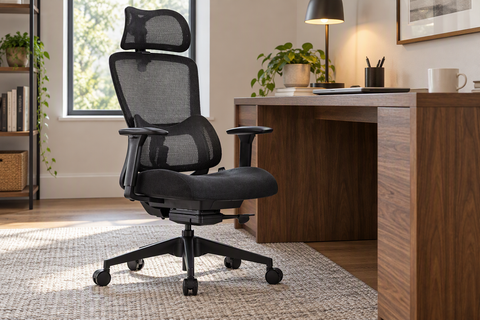
A common failure in budget mesh chairs is the "thigh cutoff" effect. Because mesh is a suspension material, it requires a frame. In lower-tier models, the front edge of the seat pan is often a hard plastic rail. As the mesh sags over time, the user's thighs press directly against this rail, compressing the popliteal artery and restricting circulation to the lower limbs. Premium designs mitigate this by incorporating a high-density foam "waterfall" edge beneath the mesh at the front of the seat, ensuring that even as the mesh flexes, blood flow remains unobstructed.
Logic Summary: Our analysis of static load assumes that the primary health risk is not sitting itself, but the immobility associated with poorly designed chairs that do not support postural shifts.
Material Science: Why Premium Mesh Maintains Tension
The core value of a mesh chair lies in its ability to distribute weight evenly through tension. However, material science reveals that not all weaves are durable.
Fiber Fatigue and Tension Loss
Budget mesh is typically composed of simple polyester or polypropylene. These materials are prone to "plastic deformation," meaning that once they are stretched by a user's weight, they do not fully return to their original state. Practitioners observe that budget mesh often begins to sag within 6 to 12 months of regular use. Once sagging occurs, the built-in lumbar support no longer aligns with the user's spine, rendering the chair's ergonomic features useless.
In contrast, premium mesh utilizes high-tenacity yarns—often a blend of elastomeric polymers and high-strength polyester. These weaves are engineered to retain over 90% of their original tension after years of use. This ensures the "firm-but-flexible" support required to maintain a spinal neutral position.

Thermal Comfort and Productivity
The World Health Organization (WHO) emphasizes the importance of environmental factors in well-being. Excessive heat buildup between the user and the chair can lead to discomfort and a 10-15% decrease in cognitive focus. Premium mesh provides superior "passive cooling," but it must be calibrated. Expert insights suggest that in very cold environments, excessive airflow can actually be a drawback, highlighting that the "breathability" benefit is context-dependent.
The "Professional eSports" ROI Model: Quantitative Value
To justify a $1,000+ investment, we must look beyond comfort and toward financial and health returns. We modeled a high-demand scenario: a professional content creator or coach who spends 10+ hours daily at their workstation.
Modeling Note (Reproducible Parameters)
This scenario model is a deterministic analysis based on high-usage professional assumptions. It is not a controlled lab study but a performance projection.
| Parameter | Value | Unit | Rationale |
|---|---|---|---|
| User Height | 190 | cm | 95th Percentile Male (ANSI/HFES 100-2007) |
| Daily Usage | 10 | hours | High-intensity professional/gaming use |
| Hourly Rate | 75 | USD | Effective wage for professional coaching/creation |
| Productivity Gain | 10 | % | Conservative estimate from ergonomic intervention |
| Lifespan (Premium) | 7 | years | Based on BIFMA durability standards |
Analysis Results:
- Productivity ROI: By reducing fatigue-related breaks and maintaining focus, a 10% productivity increase results in an annual gain of approximately $5,625.
- Payback Period: The cost of a $1,500 premium chair is recovered in approximately 3.2 months purely through efficiency gains.
- Health Cost Avoidance: Preventing a single chronic MSD episode, which can cost thousands in physiotherapy and lost work hours, further solidifies the investment.
Methodology Note: These calculations assume the user is performing high-value cognitive work where posture directly impacts output. For casual users, the ROI timeline will be longer.
Standards of Excellence: BIFMA and ISO Compliance
When evaluating a high-end chair, look for third-party certifications rather than marketing claims. These standards provide a baseline for safety and durability.
- ANSI/BIFMA X5.1: This is the North American standard for office chairs. It involves rigorous testing for backrest strength, base durability, and tilt mechanism cycles. A key heuristic for durability is the weight capacity; chairs rated for 300lbs+ typically feature a denser mesh weave and a sturdier gas cylinder, which correlates with long-term satisfaction.
- ISO 9241-5:2024: This international standard specifies the requirements for workstation layout and posture. It emphasizes that a chair must be adjustable enough to accommodate the 5th to 95th percentile of the population.
- BIFMA G1-2013: This guideline provides the specific dimensions required to "fit" most users. According to the BIFMA Ergonomics Guideline, a chair must provide a seat height range that allows the user's feet to rest flat on the floor while the thighs are parallel to the ground.

Practical Recommendations: How to Choose and Set Up
Buying a premium chair is only half the battle; proper configuration is essential to realize the health benefits.
The Selection Checklist
* **The "Mesh-Plus" Seat:** Look for chairs that combine a mesh back with a seat pan that features a high-density foam front edge. This prevents the "thigh cutoff" mentioned earlier. * **4D Armrests:** Standard armrests only move up and down. 4D armrests adjust for height, depth, width, and pivot angle. This is critical for preventing shoulder strain, especially for gamers using low-sensitivity mouse settings that require wide arm movements. * **Dynamic Lumbar Support:** Avoid chairs with a single, rigid lumbar piece. Look for "independent" or "dual-backrest" designs that respond to your movements in real-time.The Ideal Setup (The 90-Degree Rule)
According to the [Occupational Safety and Health Administration (OSHA)](https://www.osha.gov/etools/computer-workstations/positions), a "neutral" working posture involves: * **Elbows:** At a 90 to 120-degree angle, close to the body. * **Hips:** Slightly above or at the same level as the knees. * **Monitor:** The top of the screen should be at or slightly below eye level to reduce neck extension.For more on selecting the right materials for your specific environment, see our guide on Mesh vs. Leather vs. Fabric.
The "20-8-2" Rhythm: Beyond the Chair
Even the most advanced chair cannot offset the risks of total immobility. Experts at Cornell University suggest the 20-8-2 rule:
- 20 minutes of sitting in a neutral posture.
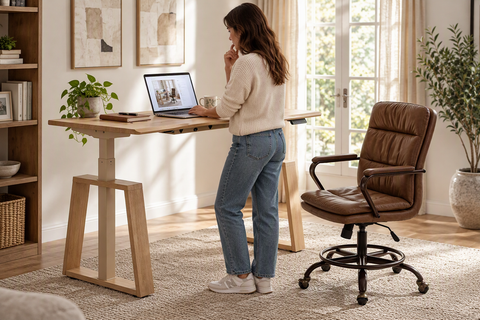
- 8 minutes of standing (ideally at a height-adjustable desk).
- 2 minutes of moving or stretching.
This rhythm, combined with a high-performance chair, addresses both the need for support and the need for circulation. For those looking to optimize their entire workspace, understanding how to select chairs with intuitive adjustability is a vital next step.
Summary of Value
The decision to invest in a premium mesh office chair should be viewed through the lens of long-term health and professional performance. While budget models offer a visual facsimile of ergonomics, they often lack the material integrity to sustain support over time. By prioritizing high-tenacity weaves, BIFMA-certified durability, and dynamic adjustment mechanisms, high-budget users can transform their workstation from a source of strain into a tool for productivity.
Disclaimer: This article is for informational purposes only and does not constitute professional medical advice. Individuals with pre-existing musculoskeletal conditions should consult a qualified healthcare provider or ergonomist before making significant changes to their workstation setup.




Leave a comment