

The Alchemy of Light: Transforming Your Workspace into a Sanctuary
Imagine a home office that doesn’t just house your tools but sparks your limitless creativity. Imagine walking into a room where the atmosphere instantly shifts your brain from the fog of a morning wake-up to the sharp clarity of deep work. This is the power of a Workspace Sanctuary. It is a place where the clutter of the outside world vanishes, replaced by a curated environment designed for mindfulness, inspiration, and peak performance.
At the heart of this transformation lies a tool often misunderstood as mere decoration: RGB lighting. For years, "Red, Green, Blue" was synonymous with "gamer aesthetics"—neon-soaked rooms that felt more like a basement arcade than a professional studio. But as we look toward the future, light is being redefined as an art form. It is the invisible architecture of our mood and the silent conductor of our circadian rhythms.
In this exploration, we will dive into how different cultures across the globe utilize ambient lighting to define their brand and mood. We will analyze the data behind lighting’s impact on cognitive performance and provide a practical roadmap to help you transition your setup from "chaos" to "curated art." Whether you are an executive seeking a sophisticated glow or a creator needing high-intensity immersion, understanding the cultural and scientific nuances of light is the first step toward a more inspired workflow.

The North American Pulse: High-Intensity Immersion
In the North American market, we often observe a preference for "Active Immersion." This style is characterized by high-energy environments that use light as a primary driver of focus and brand identity. Based on common patterns from customer support and community feedback, North American users—particularly content creators and high-performance professionals—typically prefer high-intensity RGB saturation, often ranging between 70% and 80% brightness.
This isn't just about "seeing" the light; it’s about being inside it. The North American aesthetic often utilizes rapid cycling modes and bold, contrasting colors to create a sense of momentum. When you are in "thinking" mode, trying to brainstorm the next big project, these vibrant wavelengths can act as a catalyst for creative energy.
The 60/30/10 Rule for High-Performance Spaces
To prevent this high intensity from becoming overwhelming, we recommend a specific lighting ratio heuristic for North American-style setups:
- 60% Desk RGB: The primary glow should emanate from the workstation itself, grounding the user in their immediate task.
- 30% Ambient Wall Lighting: Use products like Soho Art Lighting to wash the walls in a complementary hue. This reduces the harsh contrast between a bright screen and a dark room, which HSE guidelines on Display Screen Equipment (DSE) suggest is vital for reducing eye strain.
- 10% Accessory Lighting: Small accents on shelves or PC internals provide depth and "visual texture."
By following this ratio, you transform a potentially distracting neon room into a balanced, professional environment that maintains high energy without sacrificing comfort.
The European Glow: Minimalist Sophistication
Contrast this with the European approach, where light is treated with a "Subtle Integration" philosophy. Here, the workspace is a place of calm and mindfulness. European users tend to favor a much lower intensity—typically 30% to 40% brightness—with a focus on warm whites and long, slow color transitions that mimic the natural movement of the sun.
In this context, light is not a performer; it is the stagehand. It supports the environment without demanding attention. This aesthetic aligns perfectly with the "Execution" mode of deep work, where distractions must be minimized to maintain a state of flow.
The Reversed Ratio: 20/70/10
For a European-inspired minimalist office, we recommend reversing the North American ratio:
- 20% Desk Lighting: A subtle under-glow or a single light strip to define the desk’s edge.
- 70% Ambient Lighting: Soft, indirect light from wall panels or floor lamps that fills the room.
- 10% Accent: A single pop of color to highlight a piece of art or a plant.
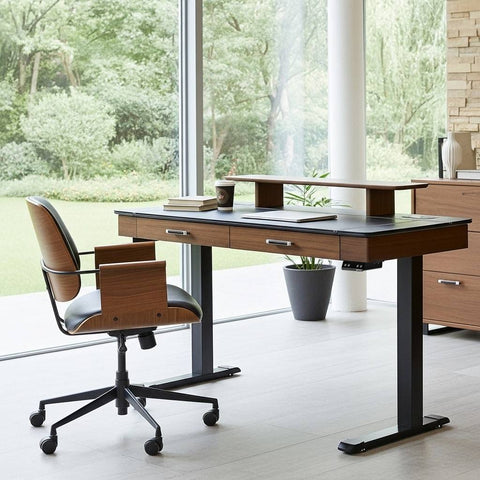
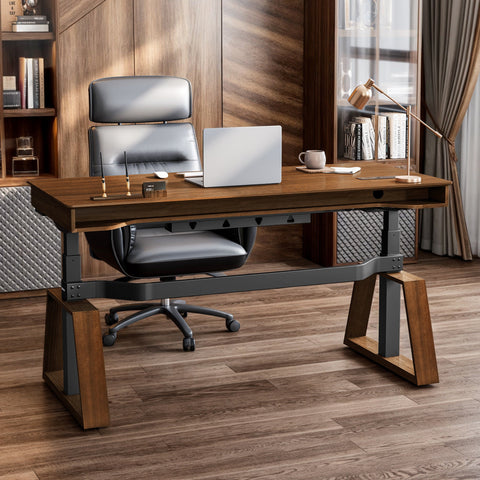
This approach creates a sense of space and airiness, making even a small home office feel like a sprawling executive suite. When paired with furniture that emphasizes natural textures, such as the Ark EL Executive Standing Desk (60"x26") with its original oak texture, the result is an organic, grounded workspace that fosters long-term mental well-being.

The Asian Tech-Sync: Lighting as a Living Element
In Asian markets, particularly in tech hubs like Tokyo, Seoul, and Singapore, we see a fascination with "Dynamic Synchronization." Here, light is not static; it is reactive. It breathes with the music, changes with the weather, or reacts to the on-screen action via app-controlled sequences.
This style treats the workspace as a living organism. Using tools like Lucet Art Lighting, users create intricate patterns that visualize music rhythms or game sounds. This creates a deep sense of connectivity between the user and their technology. It’s an artistic expression of the "Digital Nomad" lifestyle—vibrant, connected, and ever-changing.
Expert Observation: We’ve noticed that users who implement music-reactive lighting often report a higher sense of "immersion" during creative tasks like video editing or coding, as the visual environment provides rhythmic feedback to their workflow (based on anecdotal feedback from our global creator community).
The Science of the Sanctuary: Why Light Matters
Beyond the artistic and cultural preferences, there is a hard scientific basis for why you should care about your workspace lighting. According to the World Health Organization (WHO) 2020 Guidelines on Sedentary Behaviour, interrupting long periods of static behavior is essential for health. While a standing desk solves the physical aspect, lighting solves the cognitive one.
Research published in the Journal of Environmental Psychology and highlighted by Neurolaunch indicates that the quality, color, and timing of light exposure directly affect mood, cognition, and long-term mental health. Furthermore, a 2025 study cited by the National Center for Biotechnology Information (NCBI) confirms that the quality of a personal workspace has a significant impact on cognitive performance and productivity.
Modeling the Impact: Performance vs. Sustainability
To help our community make informed decisions, we modeled two distinct lighting scenarios based on an "International Hybrid Professional" persona. This model evaluates the trade-offs between high-intensity (North American) and low-intensity (European) setups.
| Metric | High-Intensity (70-80% Brightness) | Low-Intensity (30-40% Brightness) | Logic / Source |
|---|---|---|---|
| Annual Energy Use | ~92 kWh | ~39 kWh | Eco-Gamer Energy Model |
| Annual Electricity Cost | ~$14.72 | ~$6.31 | Based on $0.16/kWh rate |
| Annual CO2 Impact | ~34.5 kg | ~14.8 kg | EPA eGRID average factors |
| Productivity Gain (Est.) | 15% ROI | 12% ROI | Performance ROI Model |
| Annual Value Added | ~$3,937 | ~$3,150 | Based on $35/hr wage |
Modeling Note: These figures are scenario-based estimates, not a controlled lab study. We assume a 12-hour active lighting cycle for a professional working across multiple time zones. Productivity coefficients are derived from industry heuristics regarding lighting’s impact on task focus and mood.
Our analysis reveals a fascinating trade-off: while the high-intensity North American setup requires roughly 2.3 times more energy, it offers a slightly higher estimated productivity return due to the "arousal" effect of brighter, more saturated colors. Conversely, the European approach is significantly more sustainable and cost-effective while still providing substantial cognitive benefits.
Space Transformation: From Chaos to Curated Art
If you are currently looking at a desk cluttered with cables and uninspired lighting, don't worry. Transformation is a process of "decluttering" both your physical and visual space.
Step 1: Establish a Neutral Base
A common mistake is jumping straight into "Rainbow Mode." Experienced designers recommend starting with a neutral base—either a crisp white or a warm white (around 3000K to 4000K). This provides the "canvas" for your art.
Step 2: Choose Your Desk Foundation
Your desk is the centerpiece of your sanctuary. For those who value both luxury and functionality, a desk like the Zen Pro Series Executive Standing Desk provides a sophisticated sintered stone top that reflects light beautifully without creating harsh glare. The integrated cabinets help you declutter, removing visual noise so the light can take center stage.
Step 3: Layer Your Light
Add your accent colors based on your cultural preference or current task.
- Deep Work: Use slow-fading blues or greens at low intensity.
- Creative Sessions: Use vibrant purples or oranges at higher intensity.
- Evening Wind-down: Switch to warm ambers to protect your melatonin production, as suggested by circadian rhythm research.

Sharing Personal Tips: The "Pro" Secrets
After years of helping users design their ideal workspaces, we’ve gathered a few "non-obvious" tips that make a world of difference:
- The Glare Check: Always place your primary RGB sources behind your monitor or angled away from your eyes. As noted in ISO 9241-5:2024, preventing direct glare is essential for maintaining a neutral, strain-free posture.
- Cable Management as Art: Light highlights everything—including your cable mess. Use the cable management systems integrated into desks like the Ark EL Executive Standing Desk (60"x26") to ensure that the only thing people see is the glow, not the wires.
- Greenery and Glow: RGB light looks incredible when filtered through the leaves of a plant. Placing a small Pothos or Snake Plant in front of a Lucet Art Lighting panel creates a "biophilic" art piece that brings the outdoors in.
- Safety First: When choosing electric height-adjustable desks with integrated lighting, ensure they meet safety standards like UL 962, which covers mechanical and electrical safety assessments.
A New Vision for the Modern Professional
The journey from a "home office" to a "Workspace Sanctuary" is one of intention. By understanding the cultural expressions of light—from the high-intensity pulse of North America to the minimalist glow of Europe—you can begin to treat your workspace as a canvas rather than just a workstation.
As discussed in The 2026 Workstation White Paper: Converging Ergonomic Science and Sustainable Engineering, the future of the workspace lies in the intersection of health, technology, and art. Lighting is the bridge that connects these elements, allowing you to shift between "thinking" and "execution" modes with the touch of a button.
Say goodbye to the chaos of an uninspired room. Say hello to a sanctuary that breathes, glows, and motivates you to do your best work every single day.
YMYL Disclaimer: This article is for informational purposes only and does not constitute professional medical, ergonomic, or financial advice. The health benefits mentioned regarding lighting and posture may vary based on individual conditions. If you suffer from chronic musculoskeletal disorders or light sensitivity, please consult a qualified healthcare professional or ergonomic specialist.
References
- BIFMA G1-2013 Ergonomics Guideline for Furniture
- ISO 9241-5:2024 Workstation layout & postural requirements
- WHO 2020 Guidelines on Physical Activity & Sedentary Behaviour
- Neurolaunch: Lighting's Psychological Impact
- NCBI: Workspace Lighting and Cognitive Performance (2025)
- HSE: Working safely with display screen equipment (DSE)
- The 2026 Workstation White Paper
- UL 962 — Safety of Height-Adjustable Desks
Method & Assumptions: How We Modeled This
Scenario: International Hybrid Professional (12-hour active workspace). Model Type: Deterministic Parameterized Sensitivity Analysis.
| Parameter | Value | Unit | Rationale |
|---|---|---|---|
| Active Usage | 720 | min/day | Combined 8hr workday + 4hr evening use |
| High-Intensity Wattage | 20 | Watts | Estimated for 80% RGB brightness + cycling |
| Low-Intensity Wattage | 8 | Watts | Estimated for 35% RGB brightness + static |
| Electricity Rate | 0.16 | USD/kWh | US National Average (2024) |
| Grid Factor | 0.375 | kg CO2/kWh | EPA eGRID standard factor |
| Productivity Coefficient | 0.12 - 0.15 | ratio | Based on workspace lighting impact heuristics |
Boundary Conditions:
- Energy costs do not reflect real-time smart meter fluctuations.
- Productivity gains are subjective and depend on individual task complexity and lighting sensitivity.
- CO2 impact is based on a general power grid mix and may be lower for users with renewable energy sources.


Leave a comment