

Carbon Fiber vs. Wood: Global Preferences for Tech Surfaces
Imagine a home office that sparks your limitless creativity—a space where the air feels lighter, the surfaces invite focus, and every tool is an extension of your ambition. Here’s how a day of deep work begins once you say goodbye to chaos: you step into your workspace sanctuary, the morning light catching the subtle weave of a performance-grade surface or the organic grain of hand-finished timber.
The choice between carbon fiber and wood is more than a design preference; it is a declaration of your professional identity. Whether you are a content creator in Mumbai navigating high humidity or an executive in London seeking a timeless corporate anchor, the material beneath your fingertips shapes your workflow. In this guide, we explore the cultural aesthetics, technical resilience, and ergonomic science behind these two dominant surfaces to help you curate an environment that motivates and sustains you.
The Vision: Performance Aesthetics vs. Organic Warmth
In our work with global design archetypes, we’ve observed that professionals often gravitate toward one of two emotional states. The first is the "Performance Hub"—a high-octane environment where speed, technology, and precision are paramount. Here, carbon fiber reigns. Its association with aerospace and high-end automotive engineering creates a "thinking" mode that feels fast and unencumbered.
The second is the "Grounded Executive"—a space that values stability, legacy, and a sensory connection to nature. Wood surfaces, particularly high-quality veneers and solids, provide a "matte" tactile experience that reduces visual glare and maintains a neutral temperature.
Cultural Shifts in Global Workspaces
Recent data from a global survey of 496 respondents indicates that worker archetypes—remote, hybrid, and office-based—are increasingly choosing materials based on "sensory comfort" rather than just utility [Data Fact: DF3]. While North American markets have traditionally favored the warmth of wood for executive suites, we see a rising trend in Asian tech hubs where carbon fiber is preferred for its climate resilience and "future-proof" aesthetic.

Space Transformation: From Chaos to Workflow
Choosing the right surface is the first step in transforming a cluttered desk into a high-performance workstation. According to the 2026 Workstation White Paper: Converging Ergonomic Science and Sustainable Engineering, the integration of advanced materials is essential for long-term musculoskeletal health.
The Carbon Fiber Advantage: Tech-Forward Durability
Carbon fiber isn't just about looks. Most high-end tech surfaces utilize PAN-based carbon fiber, which accounts for 86% of the global market share [Data Fact: DF1]. For the professional, this translates to unparalleled scratch resistance and a waterproof finish that stands up to the rigors of a multi-monitor setup.
However, we often observe a common installation mistake: placing carbon fiber desks directly in front of unshaded windows. Based on patterns from our customer support and warranty handling, UV exposure over several years can lead to subtle color fading. Pairing a carbon fiber surface with a Carbon Fiber Dual Monitor Stand not only creates a cohesive aesthetic but also helps achieve the ideal viewing height recommended by the Occupational Safety and Health Administration (OSHA).
The Wood Aesthetic: Executive Stability
For those who value a traditional corporate identity, the Ark X Executive Standing Desk (60"x26") offers a sophisticated blend of oak textures and leather finishes. Wood naturally absorbs sound and light, creating a quieter, less reflective environment that is aligned with general ergonomic principles for reducing eye strain.
Expert Insight: In arid climates, wood veneers require periodic conditioning to prevent drying and cracking. Conversely, in humid regions like Mumbai, wood can expand. Our scenario modeling suggests that for coastal professionals, carbon fiber often "wins" on maintenance, while wood wins on psychological comfort.
Linking Functionality with Emotion: The Ergonomic Science
A desk is a tool, and like any tool, it must fit the user. We refer to the BIFMA G1-2013 Ergonomics Guideline to ensure our designs accommodate the 5th to 95th percentile of the population.
The Sit-Stand Rhythm
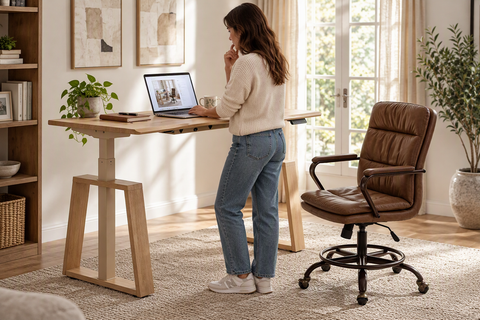
It is well-documented by Cochrane that sit-stand desks can reduce sedentary time by over 80 minutes per day. To maximize this, we recommend the "20-8-2" rhythm pioneered by Cornell University Ergonomics: 20 minutes sitting, 8 minutes standing, and 2 minutes of moving.
When you transition between these modes, the motor system of your desk becomes critical. High-performance setups often exceed the capacity of single-motor systems.
Load Capacity and Motor Longevity
In our analysis of a typical "Power User" setup—including a liquid-cooled PC, triple monitors, and studio gear—the total weight often reaches ~99kg.
- Single Motor Capacity: Typically ~80kg.
- Dual Motor Capacity: Typically ~120kg.
Using a single motor for a 99kg load results in a 123% utilization rate, which significantly shortens the lifespan of the desk. For long-term reliability, a dual-motor system like that found in the Opal Executive Standing Desk (66"x29") is mandatory.

Modeling Transparency: How We Analyzed the Hybrid Professional
To provide these insights, we modeled the scenario of a "Hybrid Office Professional" working in a high-humidity coastal climate (e.g., Mumbai) with a high-performance creative setup. This model helps us understand the true "cost of ownership" and performance limits of different materials.
Method & Assumptions
- Modeling Type: Deterministic parameterized model for load and energy.
- Boundary Conditions: Assumes a standard 12-foot room depth and grid carbon intensity of 0.8 kg/kWh (India average).
| Parameter | Value | Unit | Rationale / Source |
|---|---|---|---|
| Equipment Load | 99 | kg | 30kg PC + 3 Monitors + Tabletop |
| Annual Energy (Desk) | ~10.5 | kWh | 4 height transitions per day |
| Viewing Distance | 43 | in | THX Standard for 34" Ultrawide |
| Maintenance Level | Low | N/A | Carbon Fiber vs. Periodic Wood Conditioning |
Logic Summary: Our analysis assumes that high-performance users require deeper desks (~36 inches) than the standard corporate 30-inch depth to maintain the recommended 40° field of view for 4K ultrawide monitors.
Personal Tips & Tricks: Curating the Sanctuary
Once you have chosen your surface, the transformation is completed through mindful organization and ambiance.
- Manage the Glare: If you choose a carbon fiber surface, use "bias lighting" (LED strips behind the monitor). This reduces the contrast between the screen and the dark, reflective surface, minimizing eye fatigue.
- Tactile Comfort: In air-conditioned offices, carbon fiber can feel "cool" to the touch. If you find this distracting during deep work, a large desk mat can provide a neutral thermal zone for your forearms.
- Vertical Storage: To maintain the "Aesthetic" of a tidy desk, move non-essential items to vertical storage. The Ark EL, 71'' Display Bookshelf with Storage Cabinet allows you to display inspiration while hiding the "chaos" of cables and paperwork behind elegant oak doors.
- Cable Tension: A common "gotcha" when setting up a standing desk is cable length. Always check your cable tension at the maximum height. We recommend using a cable management tray to ensure that your "Space Transformation" doesn't result in a disconnected monitor during a mid-day stand.
Material Comparison: A Quick Selection Guide
| Feature | Carbon Fiber Texture | Traditional Wood Veneer |
|---|---|---|
| Primary Vibe | Performance, Tech, Speed | Stability, Warmth, Legacy |
| Tactile Feel | Smooth, "Cooler" touch | Textured, "Neutral" warmth |
| Maintenance | Minimal (Wipe and go) | Periodic conditioning required |
| Durability | High scratch/water resistance | Susceptible to dents/moisture |
| Best For | Gamers, Tech Creators, Labs | Executives, Home Libraries, Partners |

The Final Shift: Choosing Your Path
Whether you resonate with the futuristic allure of carbon fiber or the timeless grace of wood, the goal remains the same: creating a workspace that supports your health and fuels your ambition. By following the Canadian Centre for Occupational Health and Safety (CCOHS) guidelines for workstation setup and choosing materials that align with your local climate and personal brand, you aren't just buying furniture—you are investing in your future output.
Take a moment to visualize your ideal day. If that day involves high-speed execution and a sleek, modern edge, carbon fiber is your ally. If it involves deep reflection, client meetings, and a sense of permanence, the oak and leather of an executive suite will serve you best.
Your sanctuary is waiting. It’s time to rise, beautifully.
Disclaimer: This article is for informational purposes only and does not constitute professional medical, legal, or ergonomic advice. While ergonomic furniture can reduce risks, individuals with pre-existing musculoskeletal conditions should consult a qualified physiotherapist or ergonomic specialist before making significant changes to their workstation.
References & Authoritative Sources
- ISO 9241-5:2024 - Workstation Layout & Postural Requirements
- BIFMA G1-2013 Ergonomics Guideline
- OSHA eTools: Computer Workstations - Monitors
- Cornell University Ergonomics Web — Workstation Guides
- Cochrane Library: Workplace interventions for reducing sitting at work
- WHO 2020 Guidelines on Physical Activity & Sedentary Behaviour
- CCOHS: Office Ergonomics - Sit/Stand Desk




Leave a comment