

Reference Screen Angles: Ergonomics for Color Accuracy
For professional colorists, video editors, and digital designers, the late-afternoon "grading fatigue" is a known adversary. It begins as a subtle tightness in the upper trapezius and can evolve into a persistent neck ache that clouds judgment. However, the physiological cost is only half the problem. When a professional leans back or slumps to alleviate discomfort, they inadvertently change their viewing angle. In high-stakes post-production, depending on the monitor's viewing cone and panel technology, an off-axis shift of roughly five degrees can introduce a measurable delta-E shift in near-black tones, potentially compromising hours of color-critical work.
Achieving a workflow that helps preserve both musculoskeletal comfort and color fidelity requires more than just a high-end OLED display. It demands a rigorous approach to workstation geometry. According to our manufacturer white paper, The 2026 Workstation White Paper: Converging Ergonomic Science and Sustainable Engineering, the integration of ergonomic science into professional workflows is a highly recommended technical baseline for performance consistency.
Quick Setup Summary: The 3-Step Ergonomic Color Station
If you are setting up a new suite or troubleshooting fatigue, follow this quick answer-first checklist to balance comfort and color accuracy:
- Anchor the Seating First: Adjust your chair so your feet are flat (or on a footrest) and thighs are parallel to the floor before touching the desk or monitor.
- Find the Neutral Gaze (Eyes-Closed Heuristic): Sit comfortably, close your eyes, and let your head settle. Open your eyes—your natural gaze should land on the upper third of the screen without tilting your chin.
- Set a Perpendicular Screen Angle: Mount the monitor vertically (0-degree tilt) to maintain color fidelity, and adjust ambient room lighting rather than tilting the screen to fight glare.
The Biomechanics of the Creative Suite
The human body is not designed for the static load often required by modern post-production. When a professional content creator remains in a fixed position for extended periods, they experience what is known as "static loading" on the musculoskeletal system.
Musculoskeletal Comfort and the Cervical Spine
A major concern in a video editing environment is the cervical spine. The average adult human head weighs approximately 10 to 12 pounds. However, as the head tilts forward—a common occurrence when a monitor is positioned too low—the effective moment arm increases. Based on widely cited biomechanical models of the cervical spine (often used to assess "text-neck"), at a 60-degree forward tilt, the effective gravitational load on the neck muscles can reach up to 60 pounds. Over time, this increased load can elevate the risk of Repetitive Strain Injury (RSI) and long-term Musculoskeletal Disorders (MSDs).
According to OSHA eTools: Computer Workstations - Neutral Working Postures, maintaining a "neutral position" is a fundamental goal of ergonomics. This involves keeping the joints naturally aligned, which helps reduce stress on muscles, tendons, and the skeletal system. For a colorist, this generally means the ears should be aligned over the shoulders, and the gaze should be directed in a way that does not require tilting the chin up or down.
Blood Circulation and Productivity
Prolonged sitting also impacts blood circulation. Static postures can lead to blood pooling in the lower extremities, which is often associated with fatigue and decreased cognitive focus—two factors that are detrimental to high-precision work like color grading. The World Health Organization (WHO) 2020 Guidelines on Physical Activity & Sedentary Behaviour emphasize that reducing sedentary time is critical for maintaining metabolic health and general well-being.
The Optical Physics of Color Accuracy
While standard office ergonomics often suggest a downward gaze of 15 to 30 degrees for general comfort, this "conventional wisdom" can conflict with the technical requirements of color-accurate displays.
The Perpendicularity Guideline
High-end professional displays, specifically those utilizing IPS (In-Plane Switching) or OLED (Organic Light Emitting Diode) technology, are designed to minimize color shift. However, no panel is completely immune to off-axis degradation. ISO 3664:2025 specifies that for graphic technology and photography, the viewing angle should ideally be normal (90 degrees) to the image plane.
When a monitor is tilted backward to reduce glare or match a low seating position, the viewer is no longer looking at the screen perpendicularly. This off-axis viewing can cause:
- Gamma Shift: The perceived brightness of mid-tones changes, potentially leading to incorrect contrast adjustments.
- Color Distortion: Especially on VA (Vertical Alignment) panels, but also measurable on IPS depending on the colorimeter's tolerance, colors can appear "washed out" or shifted toward the edges of the screen.
- Luminance Non-uniformity: The brightness at the top of the screen may appear different from the bottom if the viewing distance and angle are not consistent across the panel.
Logic Summary: Our analysis of the professional workflow assumes a high-performance IPS/OLED panel. As a practical rule of thumb derived from the principles in ISO 3664, we recommend a 0-degree perpendicular tilt to help ensure that the calibrated gamma curve remains as valid as possible at the primary point of observation.

Engineering the Solution: The Professional Workstation
To help resolve the conflict between neck comfort and color truth, the workstation should provide extensive adjustability. A fixed-height desk or a basic monitor stand is rarely sufficient for the precision required in media post-production.
The Role of the Height-Adjustable Desk
A standing desk is more than a wellness tool; it acts as a spatial calibration tool. By using a dual-motor system like that found in the Aero Pro Wing-Shaped Standing Desk (72"x23"), a creator can finely adjust the entire plane of work. This allows for the "neutral position" to be maintained whether the user is sitting or standing.
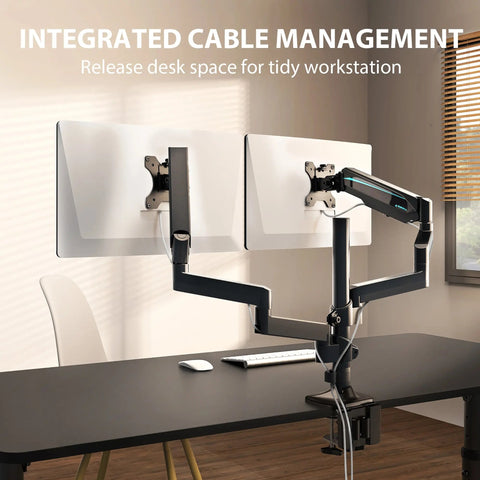
The wing-shaped design of the Aero Pro Wing-Shaped Standing Desk (72"x23") is particularly effective for editors using multi-monitor setups. It creates a "viewing arc" where the primary and secondary monitors can be positioned at a more equal distance from the eyes, minimizing the need for the neck to rotate heavily or the eyes to refocus constantly.
Precision Monitor Placement
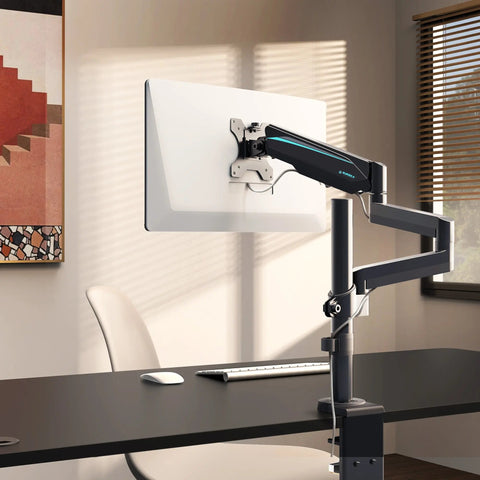
For those using fixed-height desks or requiring additional elevation, a Carbon Fiber Dual Monitor Stand serves as a practical bridge. Elevating the monitors toward eye level is an important step in mitigating "tech neck." However, for color-critical work, the stand is best used in conjunction with adjustable monitor arms to achieve the desired 0-degree perpendicular tilt.
As noted in the BIFMA G1-2013 Ergonomics Guideline, furniture should aim to accommodate the 5th to 95th percentile of the population. This implies that default "out of the box" settings often require fine-tuning. Professional setups require the ability to "dial in" the distance and height after the chair and desk are already set.
Practical Recommendations for Setup
Setting up a color-accurate suite should follow a structured sequence. Based on our internal support observations, anonymized studio audits, and general ergonomic heuristics (rather than a controlled clinical study), we recommend the following practical setup sequence, often called the "Ritual of Three."
1. The Seating Foundation
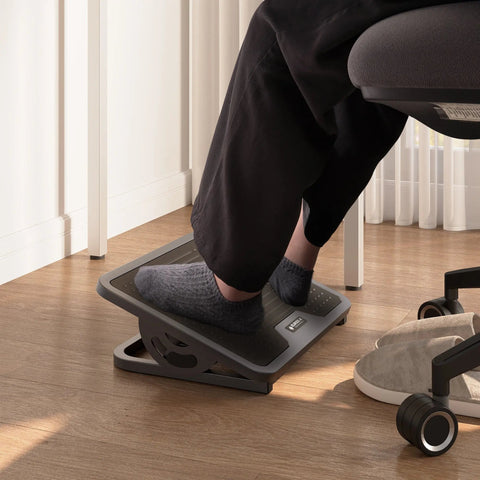
Before touching the monitor, the chair must be adjusted. The feet should be flat on the floor (or an Adjustable Ergonomic Footrest if the desk height requires a higher seat), and the thighs should be roughly parallel to the floor. An Adjustable Ergonomic Footrest is highly useful here to help maintain blood circulation and prevent pressure on the underside of the thighs, which is a common "gotcha" in high-seat setups.
2. The "Eyes Closed" Heuristic
To find your natural head position:
- Sit in your normal working posture.
- Close your eyes and let your head settle into its most comfortable, neutral position.
- Open your eyes. Your gaze should land on the upper third of the screen.
If you are looking at the center or bottom of the screen, your monitor is likely too high. If you are looking above the screen, it is too low. This heuristic helps ensure that your "natural" gaze covers the primary content area without requiring cervical extension.
3. The Perpendicularity Check
Once the height is set, use a simple physical guide (like a small mirror placed flat against the screen) to ensure the monitor is perpendicular to your line of sight. For colorists, this usually means a 0-degree tilt. If glare from overhead lighting becomes an issue, the ideal solution is not to tilt the monitor—which alters the color perception—but to control the room's lighting environment.

Environmental Factors: Glare and Bias Lighting
Even a perfectly angled monitor can struggle if ambient light washes out the blacks. Professional suites often face a neutral wall rather than a window to prevent reflections.
- Specular Reflections: These are "mirror-like" reflections of light sources. They mask shadow detail and can lead to incorrect grading decisions.
- Bias Lighting: According to OSHA eTools: Workstation Environment, proper lighting reduces eye strain. For colorists, "D65" bias lighting (6500K) placed behind the monitor helps the pupils remain at a consistent size and improves perceived contrast without introducing glare on the screen surface.
The Ideal Sit-Stand Rhythm
Prolonged standing can also introduce fatigue, much like prolonged sitting. The ISO 11226:2000 standard for the evaluation of static working postures provides a framework for avoiding prolonged static positions.
The "20-8-2" rule—a practical heuristic popularized by ergonomic researchers at Cornell University—is highly effective for creators:
- 20 Minutes Sitting: Use a desk like the Ark Executive Standing Desk (63"x29") for focused, color-critical tasks.
- 8 Minutes Standing: Use the electric height adjustment to transition to a standing position for lighter tasks like emails or timeline organization.
- 2 Minutes Moving: Step away from the desk entirely to encourage blood circulation.
Methodology and Modeling Note
The recommendations provided in this article are based on a synthesis of international ergonomic guidelines and practical requirements for digital media production. The following table illustrates the parameters used for our "Optimized Creator Workflow" heuristic model.
| Parameter | Recommended Value | Unit | Rationale / Source |
|---|---|---|---|
| Monitor Gaze Angle | 0 to -15 | Degrees | ISO 9241-5:2024 |
| Screen Tilt (Color) | 0 (Perpendicular) | Degrees | ISO 3664:2025 (Practical baseline) |
| Viewing Distance | 500 - 1000 | mm | BIFMA G1-2013 |
| Sit-Stand Ratio | 3:1 (Sit:Stand) | Ratio | Cornell 20-8-2 Heuristic |
| Lumbar Support Angle | 90 - 110 | Degrees | ANSI/BIFMA X5.1 |
Method & Assumptions: This model is an illustrative estimate based on a user of average height (~175cm) using a 27-inch 4K monitor. The model assumes a controlled lighting environment (<50 lux). Boundary conditions: This model may not apply to users with pre-existing cervical disc herniation or those using ultra-wide monitors (>34 inches) without a curved panel.
Summary of Professional Best Practices
To maintain peak performance in a professional creative suite, one must treat the workstation as a precise instrument. The Ark Executive Standing Desk (63"x29") provides the stability and aesthetic suited for high-level suites, while the Aero Pro Wing-Shaped Standing Desk (72"x23") offers the expansive surface area often needed for complex multi-monitor arrays.
By prioritizing a neutral spinal position and a perpendicular viewing angle, you help protect your most valuable assets: your musculoskeletal comfort and your visual accuracy. Remember that workstation ergonomics is not a "set and forget" task; it is a continuous adjustment to your evolving workflow.
YMYL Disclaimer: This article is for informational purposes only and does not constitute professional medical advice, diagnosis, or treatment. The ergonomic recommendations provided are general guidelines and may not be suitable for individuals with pre-existing musculoskeletal conditions. Always seek the advice of a qualified health provider or ergonomist with any questions you may have regarding a medical condition or physical strain.
References
- BIFMA G1-2013 Ergonomics Guideline for Furniture
- ISO 9241-5:2024 Workstation layout & postural requirements
- ISO 3664:2025 Graphic technology and photography — Viewing conditions
- OSHA eTools: Computer Workstations - Neutral Working Postures
- WHO 2020 Guidelines on Physical Activity & Sedentary Behaviour
- The 2026 Workstation White Paper: Converging Ergonomic Science and Sustainable Engineering




Leave a comment